
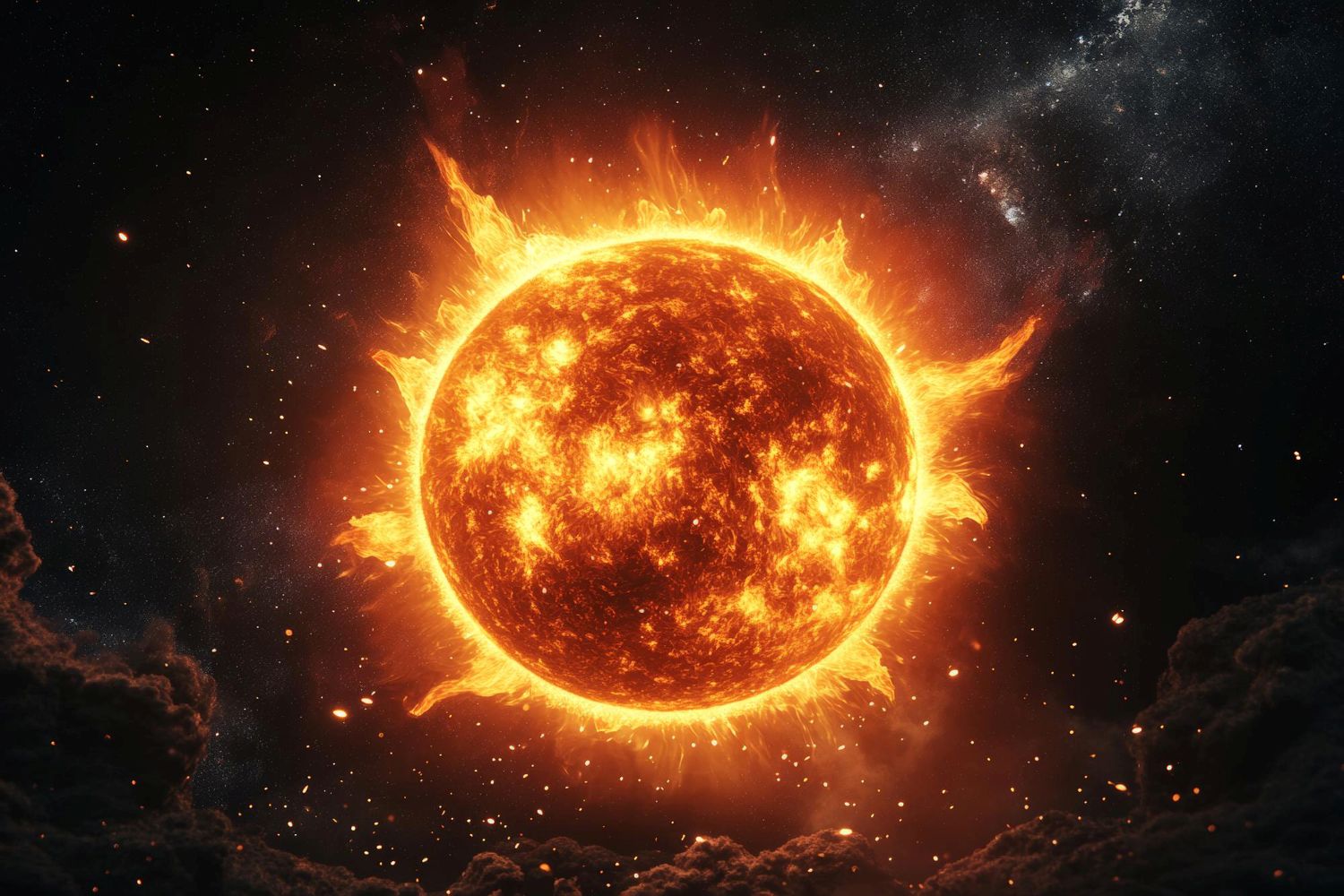
The Sun’s outer layer is extremely hot, but not uniform. Amid the million-degree corona, there are cooler, denser “clouds” of plasma called prominences, at about 10,000°C. They look like gentle, flickering flames, but are actually huge chunks of matter, far denser than their surroundings.
They can hang around for weeks or months, quietly suspended, until they don’t. Then, they can erupt dramatically, blasting charged particles into space and sometimes sparking solar storms near Earth.
To better protect Earth from solar storms, scientists need to understand prominences, the Sun’s unstable ‘hotspots.’
Researchers at the Max Planck Institute discovered that these structures survive so long because they run on a balance system: material is constantly lost and replenished.
The study offers clues on what makes the sun’s atmosphere so hot
Using advanced simulations, they tracked how magnetic fields and plasma interact, not only in the Sun’s outer atmosphere but also deep beneath its surface. Down there, turbulent flows constantly reshape magnetic fields, feeding energy and structure all the way up to the corona.
MPS scientist Lisa-Marie Zeßner-Ondratschek, study’s first author, said, “In the Sun’s atmosphere, the magnetic field is the driving force. It also plays a decisive role in all processes that contribute to the formation and maintenance of the prominences. Equally decisive is the temperature gradient within these layers. With a maximum temperature of 20,000 degrees, the lower solar atmosphere, the chromosphere, is significantly cooler than the corona; the underlying solar surface reaches just 6,000 degrees.”
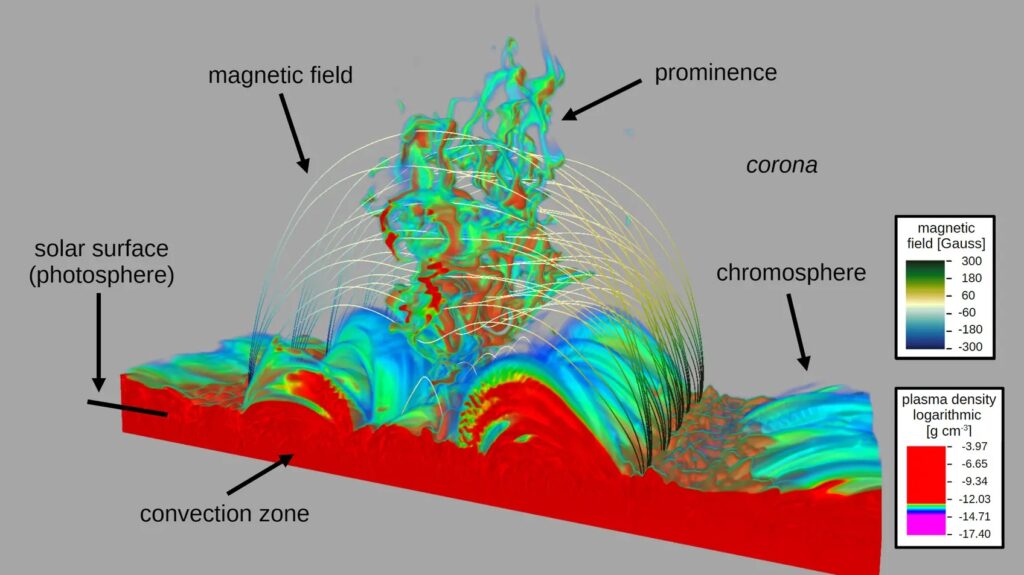 The new computer simulations are based on a magnetic field structure that is often associated with prominences: the magnetic field lines in the corona form a double arc with a small dip in the middle. As the calculations show, the flame-like prominence forms in this dip and remains trapped there. All relevant layers of the Sun were taken into account, from the corona, the Sun’s outer atmosphere, to parts of the convection zone below the Sun’s surface. © MPS
The researcher studied smaller solar prominences, loops rising to 20,000 km, where magnetic fields form twin arches like two hills. In the dip between them, cool plasma gathers.
Simulations show the process is like a cosmic refill system: bursts of cool material shoot up from below and get caught in the dip. Some of it falls back like rain, but it’s constantly replenished, both by fresh ejections from below and by hot plasma above that cools and settles in.
Detailed maps of the Sun’s coronal magnetic fields
Lisa-Marie Zeßner-Ondratschek said, “Our calculations show, more realistically than ever before, how both processes interact to supply the prominences with material and thus keep them alive. Earlier simulations, which accounted only for the Sun’s atmosphere, were mainly able to model condensation in the corona. The new publication thus closes a major gap in our knowledge. It impressively demonstrates that processes within the Sun’s interior are also crucial for understanding, and perhaps one day predicting, the eruptive nature of our star.”
Journal Reference:
Zessner, LM., Cameron, R.H., Solanki, S.K. et al. Self-consistent numerical simulations for the formation and dynamics of solar prominences. Nat Astron (2026). DOI: 10.1038/s41550-026-02840-7