
Jurors were not, however, told of Kerr’s extensive and violent criminal history stretching well beyond his relationship with the victim.
The Herald can now report the defendant was a patched Black Power member and drug dealer whose past prison sentences include a stint from 2018 to 2021 for swinging a tomahawk at a man’s head and stealing his dead son’s cremated ashes.
Tupaea Kerr appears in the High Court at Auckland in November 2024 accused of murdering ex-partner Charlie Josephine Watson in Glen Eden, West Auckland. Photo / Michael Craig
“What are the odds that if you threaten to stab someone’s throat, you then accidentally do that very same thing the next day?” Crown prosecutor Claire Paterson asked during her closing address yesterday.
“It’s difficult to think of a more obvious and compelling case… The evidence you have before you is quite simply overwhelming.”
Accidental stabbing?
Defence lawyer Arthur Fairley begged to differ. He urged jurors to “pocket” their emotions and reach a decision with their minds rather than their hearts.
“There is no question this man was a horrible partner,” Fairley said. “There’s no question that this man was a jealous partner. There’s no question that this man was verbally abusive and violent.
Charlie Josephine Watson was fatally stabbed in the neck after years of abuse at the hands of Tupaea Kerr. Photo / Supplied
“I accept all that stuff the Crown says. But look, this is not a family court case.”
The crux of the case, he argued, was whether prosecutors Paterson and Faisal Ganchi had adequately proved Kerr had ill intent when he pierced the knife through Watson’s voice box on the evening of November 3, 2024.
It was a “dynamic” situation in which the two were moving around as they tussled, Fairley said, suggesting the wound could have just as easily been accidental.
Kerr declined to give evidence, but Fairley said jurors could infer it was an accident because of Kerr’s 111 call minutes after the stabbing and the fact there was only one fatal wound.
Defence lawyer Arthur Fairley. Photo / NZME
While his client had a propensity for “brutal hidings”, he did not have a propensity for stabbing the victim, the lawyer said.
“He’s a bully boy who used a knife … not to kill but to intimidate,” he said.
‘You’re too late. For everything.’
But prosecutors argued Kerr had made his intentions clear. About 23 hours before her death, Watson had pushed a family harm alarm in her Glen Eden home.
The alarm triggered an automatic recording. In it, Watson could be heard talking to someone else about the abuse, explaining that one of her children had been traumatised upon hearing Kerr threaten to cut Watson’s throat.
Crown prosecutor Claire Paterson. Photo / Sam Hurley
But when police showed up, Watson lied to protect Kerr. The final day of her life was filled with calls and texts with her partner, as she tried to smooth things over and he issued veiled and not-so-veiled threats.
“You’re too late,” he wrote at one point. “For everything.”
The interaction that morning frightened Watson to the point where she decided to draft a goodbye message to her children on her phone.
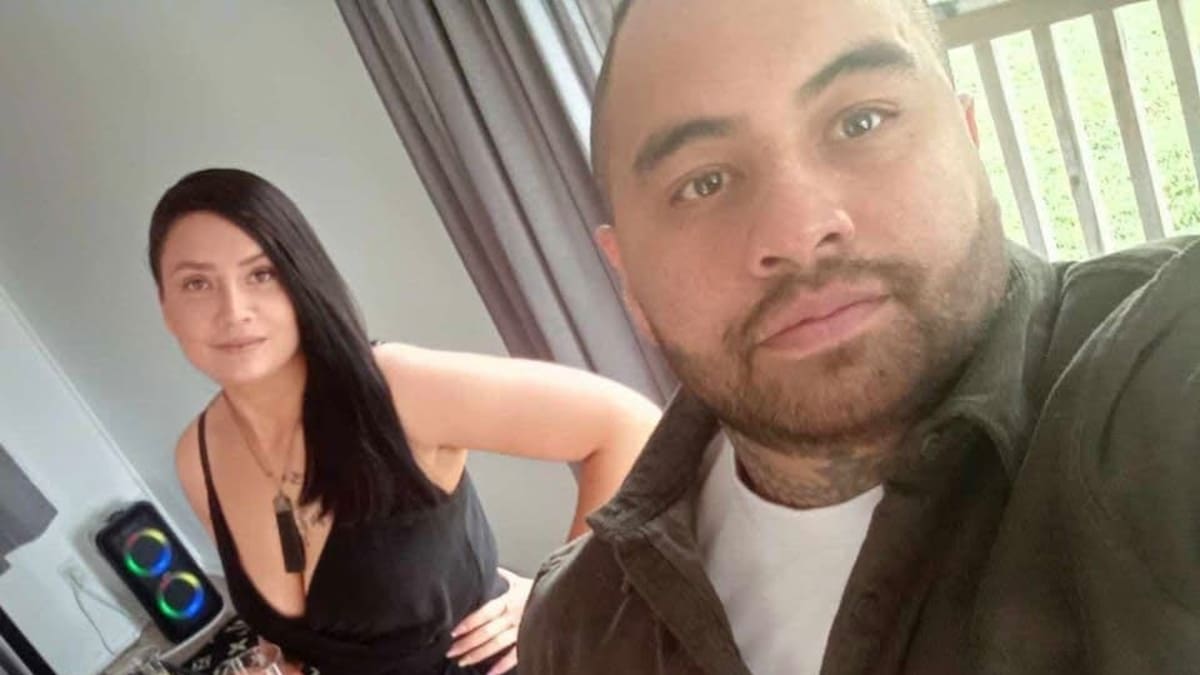
Charlie Josephine Watson with Tupaea Kerr, who admitted killing her but denied it was murder. Photo / Supplied
“If you find this, then the worst has happened. And for that, I’m sorry,” read the message. “I hope you recognise the steps I tried to take to make things safer for you. I’m sorry it wasn’t enough to keep me safe too. I really wish I was stronger.”
At 5pm, six hours before her death, Watson mentioned in a message how Kerr had previously stabbed her with keys, held a knife to her face and suffocated her with a pillow.
“You spent f***ing months abusing me,” she wrote at 6.09pm, five hours before her death.
At 9.41pm, there was a 41-minute video call in which Kerr made Watson walk around her home to prove to him that no other men were there.
‘Zero doubt’
“You can feel, you can hear, you can see the paranoia,” Paterson said of the video call, which was played for jurors after it was found recorded on Kerr’s phone. “The irrational anger, the attempts to control come through clearly.”
Less than an hour before Watson’s death, Kerr made it known she was not safe.
“You sneaky c***,” he said. “You not want to play ball. I’ll just show up.”
When he did show up a short time later, Watson ran from her house screaming.
“Help!” a neighbour’s CCTV recorded her pleading from the pitch-black backyard of a neighbour’s home. “He’s going to stab me!”
An autopsy revealed 11 blunt force injuries to her body, as well as a print on her face matching that of Kerr’s shoe. She also had cuts to her hands, which prosecutors described as defensive wounds.
Police attend the incident on Brandon Rd, Glen Eden, that led to Tupaea Kerr being charged with murder. Photo / Hayden Woodward
“Ms Watson suffered a sustained and violent assault,” Paterson told jurors, suggesting the shoe print showed that Kerr had stomped her head before inflicting the fatal wound.
“He did exactly what he’d previously and explicitly threatened to do. Meanwhile, not even a scratch on Mr Kerr. This was not a two-sided fight in any way.
“There is simply zero doubt that Mr Kerr deliberately slit his partner’s throat. He intended to inflict exactly the wound that he did inflict. It’s just common sense.”
‘Tough upbringing’
After the verdict, Justice Dani Gardiner ordered Kerr to remain in jail until his sentencing in June, at which point he will most likely face a mandatory life sentence.
Previous sentencing hearings for Kerr give clues as to what the court will hear this time.
In May 2024, six months before the murder, he was sentenced out of the High Court at Whangārei to one year and 10 months’ imprisonment for his low-level “gopher” role in what was described as an $8 million drug empire.
Tupaea Kerr (left) was a patched Black Power member and drug dealer whose past prison sentences include a stint from 2018 to 2021 for swinging a tomahawk at a man’s head. Photo / Michael Craig
“You had a tough upbringing,” Justice Christian Whata noted at that sentencing. “You were exposed to drug abuse as a child and developed a drug habit from the age of 15. You gravitated to gangs from a young age and started prospecting from about 20 years old.”
The judge also noted Kerr had been imprisoned 33 times before that sentencing “for a wide variety of offences” including violence.
But he had also recently completed an anger management programme and had shown “a strong work ethic and integrity” at the Grace Foundation drug rehab centre, emerging as a leader there, the judge said.
The judge ended his review of Kerr’s background with a reference to Watson.
“Finally, I note a letter provided to me by your partner, and she says that you have taken significant steps, including counselling, to improve yourself and to work towards a better relationship with her, that you are a loving and committed father, and that you genuinely desire to lead a better life,” he said.
In 2018, Kerr was sentenced at Tauranga District Court to three years and eight months’ imprisonment after a jury found him guilty of aggravated robbery, unlawfully taking a motor vehicle and assault of a person with a weapon.
He had taken a man’s $25,000 vehicle over a $400 drug debt, then returned to the home after learning days later that the man had contacted police. When he announced his intention to take another man’s vehicle from the address, the second victim tried to plead his case not to do so. As the man was doing so, Kerr picked up a tomahawk and swung it at his head, the sentencing judge outlined.
Like Watson, the victim ran from the home and called out for his neighbours to help. This time Kerr fled, taking the victim’s car and his son’s cremated ashes.
Other media coverage shows Kerr has previously been on the receiving end of a stab wound. In 2011, he was the complainant in a Tauranga District Court trial in which an 18-year-old claimed he lashed out in self-defence with a 20cm hunting knife after Kerr confronted him on a residential driveway.
Kerr, then also 18, suffered a pierced liver and underwent surgery to remove his gallbladder. The wound was centimetres from his heart, which would have resulted in instant death, authorities said at the time.
Craig Kapitan is an Auckland-based journalist covering courts and justice. He joined the Herald in 2021 and has reported on courts since 2002 in three newsrooms in the US and New Zealand.
Sign up to The Daily H, a free newsletter curated by our editors and delivered straight to your inbox every weekday.