
Photo: Steve Wilkie/Disney
Most girls get their periods between age 10 and 15, some as early as 8. Gilead doesn’t do science, but we know that the world in which it exists is plagued by infertility and falling birth rates. Given how anxious the Plums are about getting their periods, we can suppose that amenorrhea is a problem. Delayed menarche, too. Let’s be generous and say that these girls are closer to 15 or 16 or even 17 on the day of the long-anticipated cotillion ball.
The age difference between the Aunt Lydia School students and the actors who play them has never felt more merciful than in this week’s episode. Chase Infiniti, who plays Agnes, is 25; Lucy Halliday, who plays Daisy, is 22. It’s up to us to remember that the little girls dancing in the arms of the old fogey Commanders they’re destined to marry are much younger than they appear. Reimagine Agnes as a gawky 16-year-old girl with acne and Invisalign, and “Ball” becomes excruciating. As it stands, it’s just really, really hard to watch.
We’ve head-hopped back into Agnes’s point of view, and I admire the ambition of taking on her frame of mind at this exact moment — the morning after her emergency dentist appointment. How do you write from a place of such confusion? Agnes wakes up full of shame over an unconscious encounter she barely has the tools to imagine. Ignorance is not bliss. It’s the crevasse into which Agnes is hurtling and the context for all her future interactions with men.
The Testaments is at its strongest when it’s able to convey just how nearby Gilead is. Paula and Rosa gush over how grown-up their little Agnes looks in her prom dress, just like my mom and godmom did when I came out of my bedroom in a green taffeta Jessica McClintock number. And, like many a mother before her, Paula preps Agnes on what to do if she’s offered a cup of spiked punch. Her advice is telling. These girls were taught to be angels, but the men they need to attract come from our world. Agnes should lightly protest the drink and then relent. She should be demure rather than priggish. Gilead is a world of make-believe. These Commanders don’t actually want to marry the little princesses they’ve been raising.
No scene brushes up against the real world more intimately than watching the girls touch up their (clean, organic) makeup before the big dance, nerves bubbling over into jealousy and sniping. Agnes refuses to laugh at Becka’s jokes. Shu can’t stop wishing aloud that her friends’ good fortune was actually her own. Aunt Estée reminds the eager girls that their husbands are standing just one room away. She makes it sound like a fairy tale. A roomful of prom kings.
Agnes knows better. In voice-over, she tells her absent interlocutor — is it Daisy she’s confiding in? The real mom she mentioned in episode one? — that she didn’t expect to find love. That’s not even the order of things here. First, you get a husband; then, you love him because he is already your husband. “Gilead had reduced our adolescence to nearly nothing,” she laments. This is how you quash all that teenage curiosity and desire — by eroding even the daydream of real love.
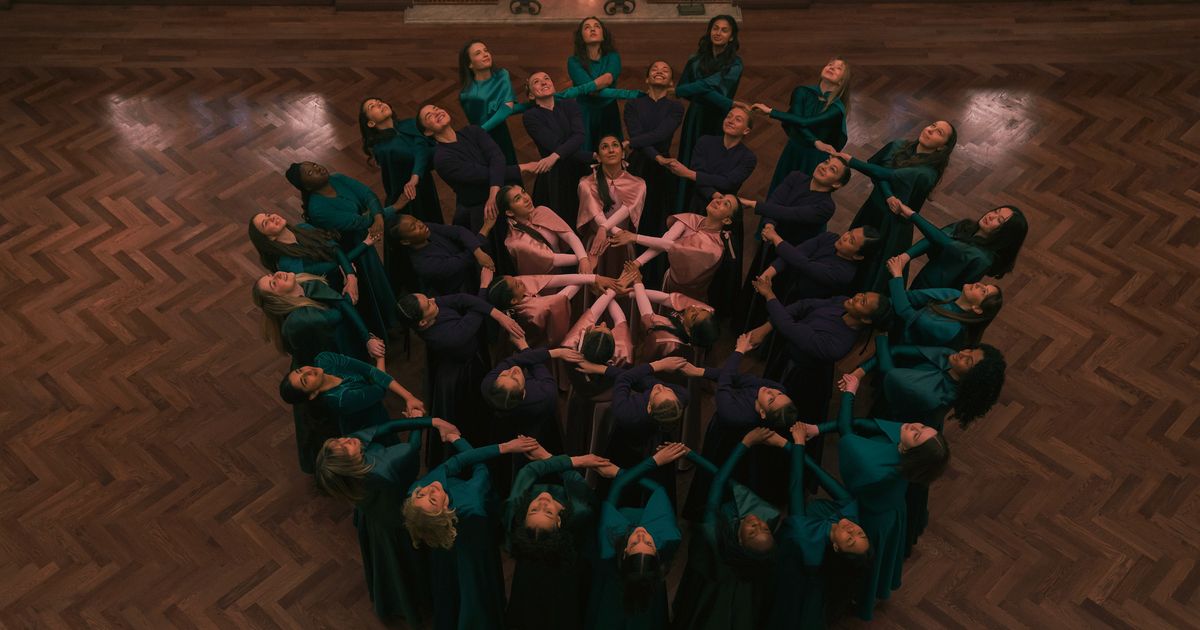
The ball kicks off with a Bridgerton-esque choreographed dance by the Greens, Plums, and Pinks, who shift around the ballroom to create a kaleidoscope effect for the Commanders watching from the mezzanine above. Next up is the father-daughter dance, though when Agnes sees Dr. Grove leading Becka around the floor, she shudders to touch even her own dad. I would have loved to head-hop into Commander MacKenzie’s mind for a few minutes to know how the fathers feel about this grotesque pageant.
There are two tiers to the Greens’ dance cards for the night. Initially, they’re paired to dance with youngish Commanders they have zero hope of actually marrying. These bucks need to wait in line. Later, the antique models — the Commanders with more seniority and more gold cords hanging from their epaulettes — will come to select their second or third wives. Still, Agnes’s first dance partner seems nice enough. If he weren’t a Commander in a totalitarian theocracy, he looks like he’d open up a café that’s also a bike shop, probably in Eugene. He quotes from the movie Jaws, but Agnes hasn’t seen it or any other movie. Becka isn’t faring much better. She tells her date that she loves playing old English folk songs on the hammered dulcimer, an instrument I’ll admit I had to Google. Aunt Lydia has not raised these girls for small talk.
When the horny old men join the dance floor, hearts fall. The girls from the best houses know they will be matched with the most powerful Commanders on the market, and yet each privately hopes to be the exception, like their friend Penny was. Penny had the miraculous fortune to be matched with Commander Judd, who is only two or three times her age. Agnes and her ancient partner have barely settled into each other’s uncomfortable arms when he’s pulled away to the War Room on urgent business. Always in the right place at the right time, Garth steps in. “This is what it’s supposed to feel like,” Agnes heartbreakingly opines.
Just because Garth is a more appropriate companion doesn’t make Agnes any more relatable. She asks her crush what it’s like to shoot somebody. He gamely flirts, teasing that all the other Guards must be jealous. For the rest of the night, their eyes will find each other across the room, but they must know the dream is up. Exception time is over. Adolescence is finished quicker than a slow dance.
One peculiar feature of this ball is that the girls are each pulled into a side room to be interviewed by potential suitors over Microsoft Teams. This, to me, seems like the part of the night Paula should have been coaching her daughter through. Agnes sits in a dark room where Commander Judd asks her questions as a bunch of men watch, their faces stacked on a big screen, like Hollywood Squares but hellish. Will they dim their boxes if they don’t like her answers?
The first question is a softball. Judd, who seems a decent man, wants to know how Agnes would exemplify her wifely duties. When Agnes falters, he humanely kills the camera so she can regain her composure. Not for the first time, I found myself praying he’s on the side of Mayday. Later, when Judd suggests to Aunt Vidala that she take over from Lydia, I hoped Vidala might be Mayday, too. We don’t see the remainder of her interview, but we can trust Agnes recovered. By the end of the evening, she’s even calm enough to apologize to Becka for her earlier bad manners. “Why are you paying attention to what I’m doing anyways?” she snapped at her friend, who dared to ask if Agnes liked the first boy she danced with.
Oh, poor Becka. It was hard enough to be only a dentist’s daughter. By the end of the night, she’s a cautionary tale of debs behaving badly. For the days leading up to the ball, she was too nervous to eat, and so she quickly gets sloppy drunk off a Commander’s strong hooch. She’s stumbling down the corridor when, praise be to Thee, Shu intercepts her and begs Daisy to help. Daisy, of course, knows what to do. Girls getting wrecked on prom night? This is a real-world special.
She whisks her into the bathroom, where Becka proves a loose-lipped drunk. She tells Daisy that she would prefer world annihilation to marriage. She even asks her what it feels like to run away from everything you’ve ever known. Of course, that’s not really Daisy’s story. It was Daisy’s life that was stolen from her. She tells Becka to focus on what’s good, like friendship. But this, too, is a source of pain for Becka, who confesses what previous episodes have only suggested with tight framing and lingering looks: She’s in love with Agnes. I doubt she’s ever said it aloud before, even to herself.
The only silver lining to Becka’s devastating predicament is that she chose the right Pearl Girl to confide in. “It’s okay to feel this way,” Daisy assures her. I wish she’d had time to tell her more. To explain that in most places on this planet, there are words for what she’s feeling and the existence of those words should help her to know that there is nothing wrong with her. Gilead has left huge vacuums in how these girls understand themselves and the people around them, and the older they get, the bigger the chasm grows, and it’s filling up with fear.
Fear and urban legends. Shu is perhaps a wee bit tipsy off the fermented nettle tea someone told her would bring on her period (and/or multiple births) when she slaps Jehosheba, who is gleefully spreading the news of Becka’s indiscretion. (Who had “catfight” on their prom-night bingo card?) The nettle moonshine might also be behind Huldah’s new backbone. When Shu suggests that God made Huldah ineligible this season because she needs to grow up, canny Huldah doesn’t object. With her perfectly practiced air of innocence, she goes for Shu’s jugular: “Do you think God made you ineligible for the same reason?” If they weren’t running around in a building full of pedophiles and extremely vulnerable, I might even say I prefer to watch the drunk version of these girls. It’s the closest they’ve seemed to real.
Aunt Lydia, however, is unimpressed. She can’t help but notice that at this event, no one’s glass is ever empty. She dresses down Vidala for not keeping everyone on a shorter leash. I’m sorry, but who cares, lady. You’re about to marry them off to the oldest men who share the same Zip Code. Let them have this one truly and deeply adolescent experience. Let them yak up their jungle juice in the high school lav.
Even Pearl Girls like Daisy aren’t safe. When she has the audacity to ask a frisky Commander not to touch her, Garth steps in to save her from his violent reprisal. I know Daisy wants out of this place, but I wish she’d focus slightly more on blending in and staying safe. She’s doing well, Garth tells her. Based on her gumshoeing, they’ve learned that Commander MacKenzie is brokering an artillery deal with the Japanese. It’s good work.
Like most prom nights, Gilead’s answer to le Bal is un désastre. There are winners and losers. There’s more drama than dancing. In fact, Vidala is in the middle of chastising these girls for taking advantage of the few hours of freedom they will ever know when the old school bell starts a-clanging. After the night they’ve had, it’s a somber sound. I hoped, for her sake, it would be Shu. But it’s Huldah. Sweet, delicate Huldah. I guess God thinks she’s seen enough of the world now.
Eventually, Agnes rejoins her dad, and Garth drives them both home. The men talk shop on the way. Efforts on the front have begun, MacKenzie announces, whatever that means. He lets slip that Garth is just a few weeks from making Commander. It’s rare that a young girl would be privy to military intelligence, but it’s the word Commander that catches Agnes’s ear. Commanders, like Greens, are eligible for marriage. She knows that a good girl from a good house is destined to be the wife of someone more powerful than Garth, but she can’t help herself. There’s always an exception.
“Gilead had reduced our adolescence to nearly nothing,” Agnes tells us earlier in the episode. But by the end of “Ball,” I’m not sure that’s possible. You can take girlhood off the schedule, but not the grappling — not the human desire, however girlish, to find yourself at the center of a real-world fairy tale.
Sign Up for the Vulture Newsletter
Entertainment news, for the pop-culture obsessed.
Vox Media, LLC Terms and Privacy Notice