
Track your investments for FREE with Simply Wall St, the portfolio command center trusted by over 7 million individual investors worldwide.
NVIDIA is reported to be in advanced talks to acquire a major PC manufacturer, with HP and Dell widely viewed as the main candidates.
The reports have triggered fresh attention on HP (NYSE:HPQ) as investors weigh how a potential transaction could reshape the PC and server market.
No company involved has issued an official statement, leaving the timing, structure, and likelihood of any deal uncertain.
HP shares recently closed at $20.44, with NYSE:HPQ showing a 6.3% gain over the past week and 10.3% over the past month. These shorter term moves contrast with returns of 7.6% year to date and 12.8% over 1 year, extending to 20.5% over 3 years and 28.7% over 5 years. Against that backdrop, fresh deal chatter is adding a new layer of attention to a stock that has seen pressure over longer periods.
For investors watching NYSE:HPQ, the key questions now center on whether HP is actually the target, what form any deal might take, and how it could affect HP’s role in PCs and servers. Until there is formal confirmation or denial, the story remains speculative. It may be useful to focus on HP’s current business profile and risk tolerance rather than treating an acquisition as a given outcome.
Stay updated on the most important news stories for HP by adding it to your watchlist or portfolio. Alternatively, explore our Community to discover new perspectives on HP.
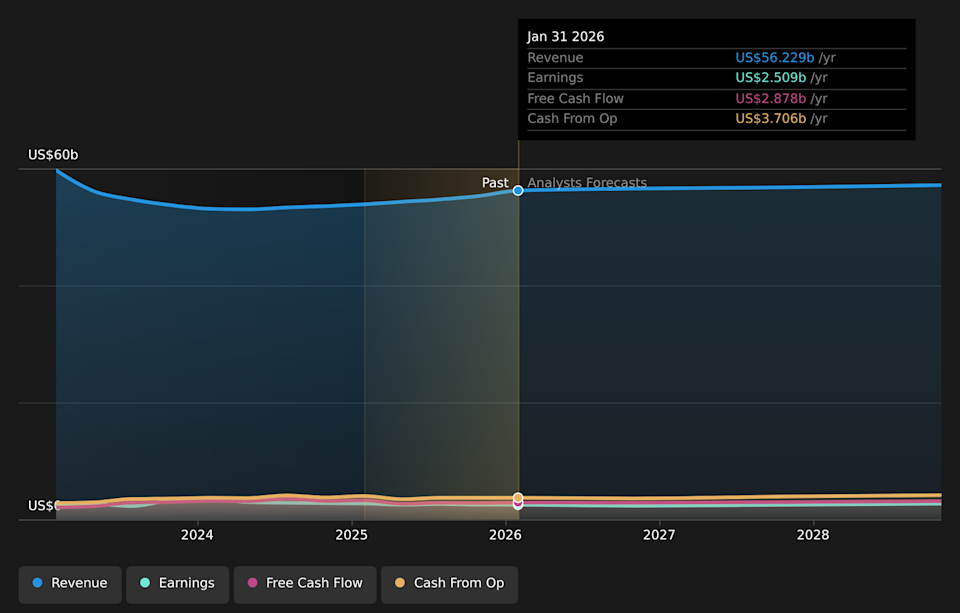 NYSE:HPQ Earnings & Revenue Growth as at Apr 2026
2 things going right for HP that this headline doesn’t cover.
For HP, the key question in the NVIDIA talks is whether being a potential target reflects long term industrial logic or just short term trading excitement. Owning a large PC and server vendor could give NVIDIA tighter control over AI PC design, data center platforms, and distribution, which naturally puts attention on HP and Dell as large, global manufacturers. For HP, that kind of buyer could bring closer alignment on AI chips, software, and PC architectures. However, it would also raise questions about brand, supplier relationships, and how an integrated model might affect margins over time. The share price reaction, with HP up around 5% on the initial report, signals that the market is already assigning some probability to a transaction, even though none of the companies have confirmed talks. Until there is more clarity, it can help to treat this as one possible scenario and weigh it alongside HP’s existing PC, print, and services plan rather than assuming a deal will set the direction for the business.
If HP were the chosen partner, tighter alignment with NVIDIA could support the narrative around AI-driven PCs and premium devices by giving HP earlier access to AI hardware and helping it differentiate offerings versus peers.
An acquisition or deep integration could challenge current expectations around cost reduction and supply chain diversification, as integration efforts and overlapping product decisions might introduce fresh execution risks.
The existing narrative focuses on AI PCs, services, and cost programs, but it does not explicitly factor in a large-scale corporate transaction with a chip supplier, which would be a separate layer of uncertainty and potential change.
Knowing what a company is worth starts with understanding its story. Check out one of the top narratives in the Simply Wall St Community for HP to help decide what it’s worth to you.
⚠️ Analysts have flagged 3 key risks for HP, including a high level of debt and negative shareholders’ equity, which could limit flexibility if a complex transaction or partnership requires additional investment.
⚠️ HP operates in a highly competitive PC and server market alongside Dell, Lenovo, and others, so any prolonged rumor period without clarity could influence pricing power, supplier terms, or customer decisions.
🎁 HP is flagged as trading at a large discount to one fair value estimate, which some investors may see as giving a cushion if deal speculation eventually fades and attention returns to underlying cash generation.
🎁 If NVIDIA ultimately chooses HP or a close partnership path, HP could gain closer alignment on AI roadmaps, which may support its push into AI PCs, premium systems, and recurring service models.
From here, focus on whether any of the companies formally address the acquisition reports, and if they do, what structure is suggested, such as a full buyout, joint venture, or deeper commercial partnership. Also keep an eye on how HP describes its AI PC roadmap, PC and print trends, and capital allocation plans in upcoming earnings or investor updates, especially in light of recent neutral analyst sentiment and expectations for flat earnings growth. Comparisons with peers like Dell and Lenovo on AI PC mix and server positioning can also help you judge whether HP is gaining or losing ground while the industry digests the NVIDIA rumor cycle.
To ensure you’re always in the loop on how the latest news impacts the investment narrative for HP, head to the community page for HP to never miss an update on the top community narratives.
This article by Simply Wall St is general in nature. We provide commentary based on historical data and analyst forecasts only using an unbiased methodology and our articles are not intended to be financial advice. It does not constitute a recommendation to buy or sell any stock, and does not take account of your objectives, or your financial situation. We aim to bring you long-term focused analysis driven by fundamental data. Note that our analysis may not factor in the latest price-sensitive company announcements or qualitative material. Simply Wall St has no position in any stocks mentioned.
Companies discussed in this article include HPQ.
Have feedback on this article? Concerned about the content? Get in touch with us directly. Alternatively, email editorial-team@simplywallst.com