
“We’ve talked to teams literally renting Airbnbs just so they can test their household robots overnight, or spending millions building fake warehouses and neighbourhoods to simulate the real world. It’s slow, expensive and wildly inefficient.”
Then there are robotics start-ups whose progress is slowed because they can’t test and deploy new models as fast as they’d like, due to cash constraints.
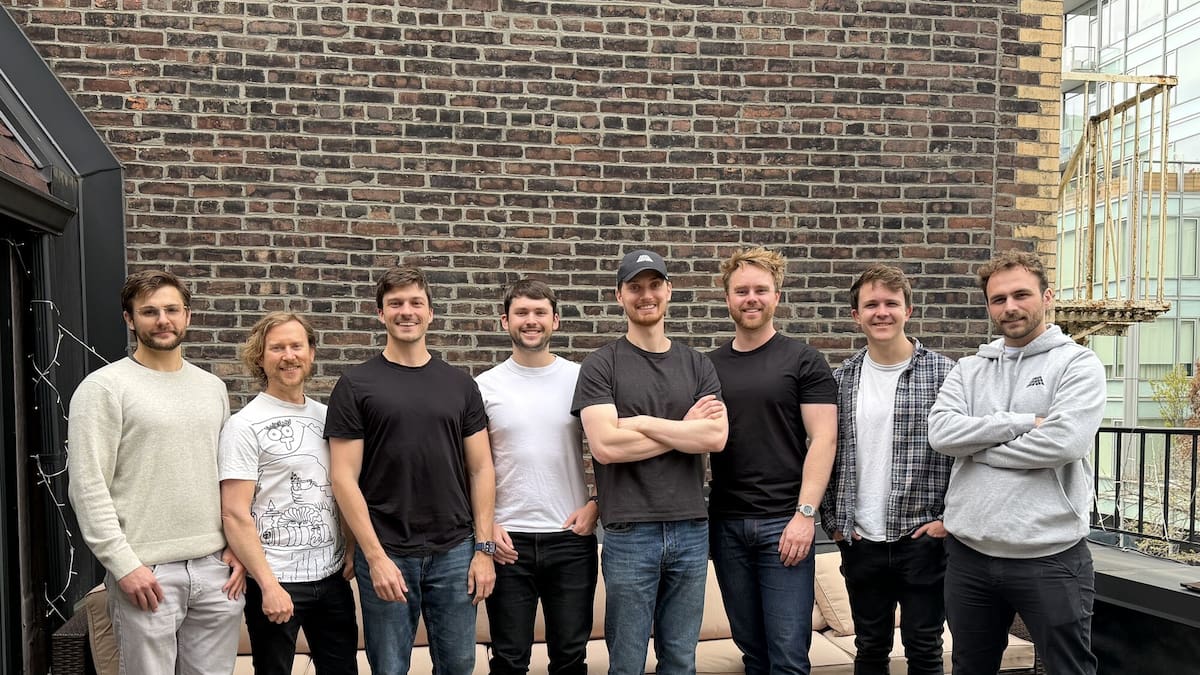
The Antioch team (from left): Jackson Vachal, Josiah Jordan, Michael Calvey, Colton Swingle, Alex Langshur, Harry Mellsop, Collin Schlager and Oliver Dyer.
“We can do it all virtually,” Mellsop says. Antioch has created AI-powered software models that simulate real-world training and testing, dramatically speeding the product development process.
Things have been moving at warp speed.
Antioch was founded in July last year in New York. Five months later, it raised US$4.3 million ($7.3m) in a “pre-seed” round.
This week, it’s followed up with a US$8.5m seed round at a US$60m valuation, led by venture firm A* and Category Ventures (both based in San Francisco), with additional participation from MaC Venture Capital, Abstract, Box Group and New Zealand’s Icehouse Ventures.
Kiwis bankrolling Kiwis: backers of Antioch’s $15m seed round included Auckland-based Icehouse Ventures and angel investor Adrian Macneil (left), pictured with Nvidia chief executive Jensen Huang. Former Treasury staffer Macniel relocated from Wellington to San Francisco, where he recently raised US$40m for his start-up, Foxglove, which numbers Nvidia among its customers.
Two angel investors also chipped in: Palantir chief technology officer Shyam Sankar and New Zealander Adrian Macneil – a former software engineer for Treasury in Wellington who is now in San Francisco and recently raised US$40m for his own AI software start-up, Foxglove, which operates in similar territory to Antioch.
$90m Series A in the works
The pace will only pick up, all going to plan.
“We’re planning to raise the [Series] A before the end of the year, likely over the summer US time. We’ll target US$30-85m ($50-$90m) raised,” Mellsop says.
“This opportunity is becoming increasingly obvious and we need to move fast and decisively.”
And even though it’s barely a year old, with just nine staff, Antioch has already bagged some household-name customers.
Antioch’s pitch is that it offers the same kind of virtual tools used by behemoths like Tesla and Waymo to test and deploy new products – but at a price affordable for start-ups.
“I can’t name names, our existing customer base includes Faang/Fortune 500 companies with established robotics, autonomy, and perception system divisions,” Mellsop says.
“We’re also in use within universities and research labs, including at MIT CSAIL.”
“Faang” is a term coined last decade for a group of hot tech stocks – Facebook (now Meta), Amazon, Apple, Netflix and Google, with Nvidia sometimes swapped in for the “N” these days.
CSAIL is the Massachusetts Institute of Technology’s Computer Science and Artificial Intelligence Laboratory.
Tesla powers on a fraction of the budget
Mellsop says companies like Tesla and Waymo have spent hundreds of millions of dollars on simulation infrastructure to minimise time-consuming and expensive real-world testing.
The idea is also that, with physical testing, it’s impossible to stage every scenario that an autonomous system might face, whereas virtual testing allows for the simulation of a near-infinite number of edge-case scenarios.
Mellsop says his firm can deliver the benefits of Tesla-style, huge-scale virtual testing, but at a price accessible to startups (even if, ironically, many initial buyers have been big corporates).
And it’s territory he’s familiar with.
After spending his high school years at Saint Kentigern College in Auckland, Mellsop did bachelor and master’s degrees in computer science at Stanford in California, specialising in AI – and with his studies part-funded by a US$35,000 Siebel Scholarship.
After graduating in 2022, Mellsop got a job as a vision engineer on Tesla’s autopilot team in Silicon Valley.
He then moved to New York, where he co-founded a blockchain company, Transpose, with fellow Stanford grad Alex Langshur.
In May 2023, the pair sold Transpose – still only months old – to the market leader in its field, national security contractor Chainalysis, in a deal the Herald understands ran to eight figures – and co-founded Antioch.
The founding team also included Colton Swingle, previously at Google’s DeepMind AI unit, and Collin Schlager, previously at Meta’s Reality Labs.
Bigger than ChatGPT
Mellsop says the disruption caused by AI robots, drones and other autonomous hardware will be much larger than what the LLMs (large language models or “chatbots” like OpenAI’s ChatGPT and Microsoft’s Copilot) will wreak on white-collar roles.
“The industries LLMs are disrupting – software, professional services, knowledge work – represent maybe US$8 trillion of the global economy,” he says, while “manufacturing, logistics, construction, energy and agriculture” represent US$50t.
Making manufacturing great again
“AI penetration in those physical industries is basically zero today. The industrial revolution that’s coming in physical AI isn’t going to be a sequel to the LLM revolution – it’s going to dwarf it.”
His co-founder also sees an onshoring angle, at a time when the blue-collar workforce is shrinking.
“Over the last 40 years, America’s manufacturing advantage has been systematically eroded by offshoring,” Langshur says.
“The only economically viable path to reindustrialisation runs through robotics and automation, and scalable testing is the rate-limiting step.”
Spark seizes Auckland Airport, One NZ says ‘yeah, nah’
Spark says it’s become the exclusive telco partner for Auckland International Airport’s duty-free area, making it “the first to be seen by more than 4.9 million overseas travellers annually.”
The telco wouldn’t say how much it had paid to secure its monopoly, citing commercial sensitivity.
But Tech Insider wonders if it’s worth as much as it once would have been, as more and more travellers opt for eSIMs which require no physical card swap-in. If you’ve got a recent smartphone, you can buy an eSIM from any of our telcos – or a third-party if you’re willing to rawdog it and go wi-fi only – before you fly.
A One NZ spokesman shrugged, “We continue to operate a retail presence in a prime location at Auckland International Airport in the arrivals terminal – landside – for anyone who wants in-person support.
“But, increasingly, we’re finding most people just want to get through the airport and on their way. Increasingly, travellers are opting for our Travel eSIM, which they can activate themselves as soon as they land, without a store visit.
“Being approached to buy a sim straight off a long-haul flight isn’t something we’re seeing as a growing trend.
“In a tight economic environment, we need to focus on the right opportunities for One NZ customers, and in this case decided to prioritise online sales due to where customer behaviour is heading – we’ve seen the eSIM mix for our Travel plan increase 43% year on year.”
2degrees will also sell you an eSIM if you’re visiting NZ, but declined to comment.
The Tait Technology Centre.
Tait’s digs for sale
The 5.42ha technology campus in Christchurch ,where global exporter Tait Communications manufactures radio telecommunications equipment, is up for sale.
Colliers estimates its value at “circa” $70m.
The campus was sold to its current owner, Auckland property syndicate GEK Property, for $57.75m in September 2017.
Tait is on a long-term lease.
“This property is one of the most significant investment opportunities in the South Island market in a number of years,” Colliers Christchurch general manager and investment broker Mark Macauley says.
In 2018, Japan’s JVC Kenwood won Overseas Investment Office approval to acquire 40% of Tait, with the option to acquire the remaining 60% at a later date. JVC remains at 40%.
Tait made a $44.1m profit last year, down from the $51.2m it earned in 2024 as its revenue increased to $516m from 2024’s $426.6m.
Squeezed? Check your phone and broadband bill
With the fuel crisis and rising cost of living putting pressure on nearly every New Zealand household, Telecommunications Dispute Resolution (TDR) is urging Kiwis to check their phone and internet plans now to head off financial strain down the track.
More than half the complaints TDR received in the first quarter of 2026 stemmed from disputed charges and credit management, which are being compounded by family budgets having less room to absorb unexpected bills, acting chief executive Judi Jones says.
Billing mistakes and plan confusion, rather than headline price rises, are frequently the biggest source of financial strain for consumers.
The TDR is funded by the telecommunications industry but operates on an independent remit and offers a free dispute resolution service.
Kiwi-made crimefighting software gets a shoutout from London’s mayor
In July last year, UK Home Secretary Yvette Cooper encouraged retailers to adopt the crime-reporting software created by Auckland-based Auror.
Now it’s earned a shoutout from Mayor of London Sadiq Khan, too:
“Amazing to see the Mayor of London talking about Auror’s impact on retail crime in the UK and the effectiveness and efficiencies seen by Police,” posted Auror cofounder and CEO Phil Thomson.
Auckland council goes AI
Auckland Deputy Mayor Desley Simpson recently launched the council’s new AI assistant for reporting graffiti, illegal dumping, roaming dogs, missed bin collections, and noisy parties.
An initial launch to 1000 people in February showed the AI assistant is almost twice as easy to use as existing channels, Simpson said.
Auckland Council’s new web-based AI assistant.
80% of users found the new tool easy to use compared to 42% using existing reporting methods.
“Depending on how Aucklanders like using this technology, it could eventually serve as an AI-powered ‘single front door’ to Auckland Council for services and information – the ‘one stop shop’ that people have been asking for,” Simpson said.
It’s a good move, but Tech Insider wonders why it’s web only (here) with no app (the council points out you can save a shortcut to its AI assistant’s web page to your smartphone homescreen.
In my neighbourhood, we’ve found the method of complaint – phone, online, whatever – is less important than the number of residents who complain about a problem. Don’t get one person to make a complaint on your block’s behalf. It’s multiple complaints that trigger a reaction. Six seems to be the magic number for something fixed – council resources allowing.
The council’s AI assistant was released on April 13. Simpson proved her tech chops again, to a fashion, by grooving with a robot at an AUT event yesterday.
No Antioch training is required for human or bot, by the looks of the above.
Xero target slashed
Morgan Stanley has slashed its valuations for a slew of ASX-listed technology stocks, largely on fears of AI eating software companies’ lunch.
Xero took the biggest knock, with its 12-month price target being lowered from A$225 (which hasn’t aged well) to A$130.
The cloud accounting firm was recently trading at A$82.74.
The good news: The investment bank said Xero had one of the most durable “moats” against the AI incursion. Founder Rod Drury has argued that Xero’s data is its crown jewel and not something an AI can replicate.
Morningstar recently reiterated its A$100 valuation for Xero – which was an effective sell when the rating was first issued last November, but with the stock down 26% this year has become effectively a “buy”.
Analyst Roy Van Keulen told the Herald the AI threat to Xero, and other SaaS firms, was overblown, but he still had concerns about its latest effort to crack the US through its $3 billion purchase of money-losing Melio.
He did not see Xero’s recent partnership with Anthropic as material, but still saw the stock as oversold.
Chris Keall is an Auckland-based member of the Herald’s business team. He joined the Herald in 2018 and is the technology editor and a senior business writer.
Tags:
- 102m
- 15m
- 70m
- AI
- airport
- antioch
- at
- auckland
- aucklands
- bill
- Business
- by
- Campus
- check
- cofounded
- confirms
- deputy
- gets
- groove
- harry
- insider
- kiwi
- kiwis
- mayor
- mellsop
- monster
- Morgan
- nah
- New Zealand
- NewZealand
- NZ
- Phone
- raises
- reveals
- robot
- round
- sale
- says
- seed
- seizes
- series
- slashes
- spark
- squeezed
- stanley
- startup
- taits
- takeover
- Tech
- their
- told
- Valuation
- works
- Xero
- yeah