
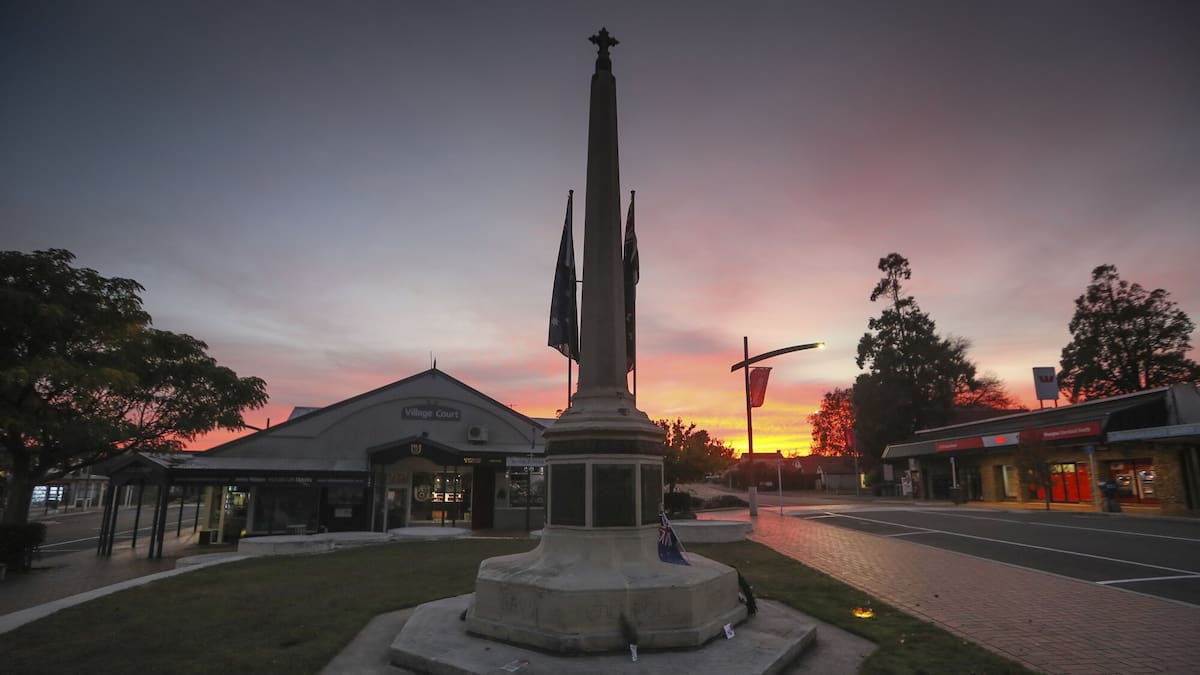
“That might look like joining the parade, wearing a loved one’s medals on the right side of the chest, and hearing the names of those who served, or the campaigns they were part of, reflected in the service,” she said.
Penk said the changes were “well overdue” and 2026 would be the first time New Zealand’s national commemoration formally recognises all those who served the country in times of war.
“We will remember them.”
John Hesketh joined the army in 1987 after leaving Hastings Boys’ High School.
His grandfather was part of the New Zealand Expeditionary Force in World War II, who fought through North Africa and Europe, and his father was also in the Army.
“It sort of just flowed to me,” he said.
John Hesketh and his wife Shiree at the Anzac Day breakfast at the New Zealand High Commission in Singapore in 2019.
Hesketh toured Bosnia Herzegovina, Bougainville and East Timor with the Army before leaving in 2007 and working for private contractors in Afghanistan and the Solomon Islands.
He’d regularly attended Anzac Day services, except for the last couple of years because he no longer felt comfortable.
But Hesketh said the new legislation is “really good” and a “good first step” into addressing some of the issues that challenge modern veterans.
“But it should be nowhere near the last step.”
He said he’d been frustrated at some Anzac services where politicians spoke of their relatives who fought in World War II, while living veterans sat right in front of them.
Hesketh said veterans should be remembered not only on April 25 but on the other 364 days of the year.
Hesketh said he was unsure if he would attend an Anzac service this year but said if he did, he would rather spend the time holding his grandchildren’s hands.
Born in the UK, Mike Cannon completed over 10 years in the Royal Air Force before emigrating to New Zealand, where he would go on to become the base commander of RNZAF Base Auckland Whenuapai.
Group Captain (Rtd) Mike Cannon NZBM, DSD. Helicopter Loadmaster Officer.
Cannon said despite the technicality of the legislation, he had always felt he could march on Anzac Day alongside his “brothers and sisters”.
An old boss of Cannon’s described military medals as the diary of a soldier.
“Another soldier will look at your chest and go, yes, you’ve been somewhere and you’ve done something that we all now have a shared experience in,” he said.
“You feel that bond when you’re standing out on Anzac Day.”
He said before this year’s legislative change, veterans may’ve felt the law “in some way” didn’t recognise their acts.
“It’s now a formal acknowledgment that we are all in it together and it is a shared experience, but now it’s recognised under the law,” he said.
“That’s important to me, that everybody feels now as though it is that shared experience and it’s inclusive.”
Cannon said Anzac Day is a difficult day for him now.
He was marching in Feilding on the morning of Anzac Day 2010 when his phone rang to tell him an Iroquois helicopter was lost.
Three people died in the crash north of Wellington and a fourth was seriously injured.
It was travelling from the RNZAF’s base at Ohakea to Anzac Day commemorations in Wellington.
“But it just brings home to me what Anzac Day is all about,” he said.
“It’s not about me, it’s about the remembrance of people that have served and people that have done their bit for New Zealand.”
Now based in Hawke’s Bay, leading emergency management for Napier City Council, 2026 will be the first Anzac Day for him out of uniform.
But Cannon still intends to march with his medals at an Anzac service this Saturday.
Jack Riddell is a multimedia journalist with Hawke’s Bay Today and has worked in radio and media in the UK, Germany, and New Zealand.