
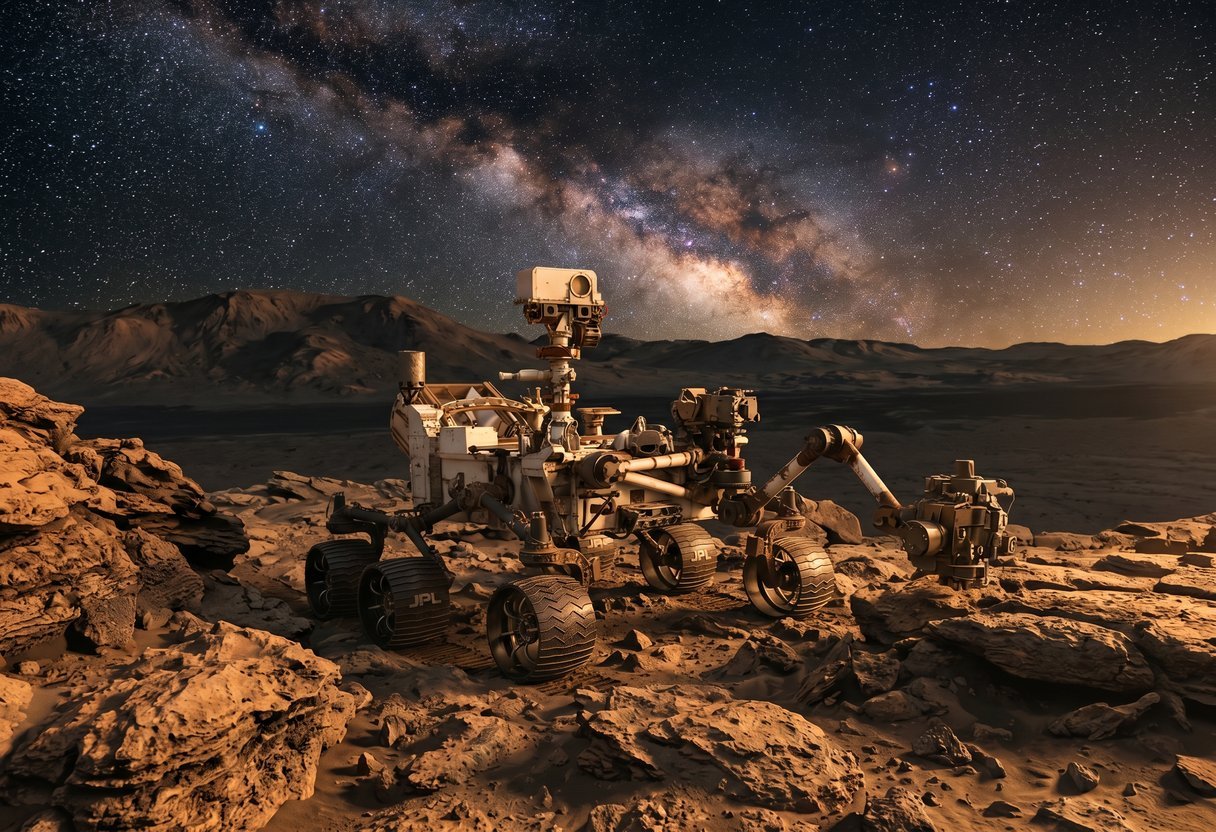
Twenty mysterious carbon signatures have surfaced from rocks older than most life on Earth. Are they Martian whispers of biology or the clever disguises of chemistry and time? NASA’s latest rover trick leaves a question hanging in the thin red air.
Curiosity’s drill bit struck more than stone in Gale crater, unearthing a chemical time capsule from 3.5 billion years ago. Inside, NASA scientists have teased out a suite of over 20 organic molecules using a heat-and-reagent maneuver never before pulled off on another world. The roster spans aromatics and sulfur- and nitrogen-bearing compounds, the kind that can persist across eons and spark fresh debate over where Martian organics come from. The findings don’t claim life, but they sharpen the questions scientists can finally ask with data to match their ambition.
A groundbreaking discovery on Mars
NASA has confirmed a rare kind of progress, the kind that reshapes quiet assumptions. Curiosity, still rolling across Gale Crater after more than a decade, detected over 20 organic molecules locked in ancient rocks. The result, achieved with a new on-board experiment, reframes Mars as chemically lively. It also invites careful questions about how far those chemistries might have gone.
How the molecules were found
The samples came from 3.5 billion-year-old rocks in Glen Torridon, at the base of Mount Sharp. In May 2021, Curiosity ran a first-of-its-kind test on another planet using thermochemolysis. The rover heated powdered rock, including the Mary Anning 3 sample, with a reagent called TMAH. Under heat, TMAH breaks tight chemical bonds, creating smaller, detectable fragments.
Those vapors flowed into Curiosity’s SAM instrument, which used gas chromatography and mass spectrometry to sort them. This method had been proven in labs on Earth, but never in situ on a distant world. Its success matters: it can reach organics that earlier approaches often missed, revealing a deeper layer of Mars’s chemical record.
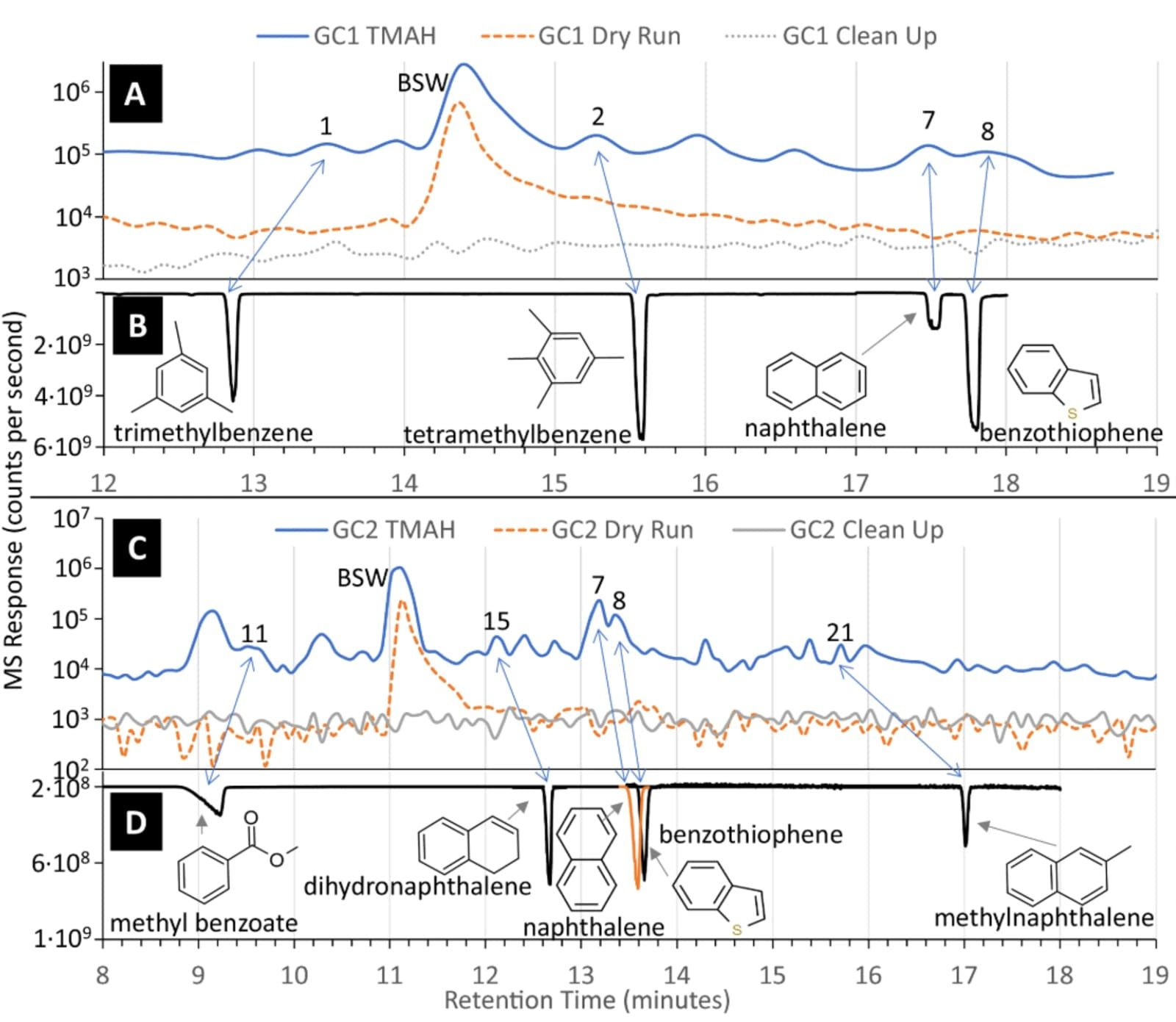 Identification of aromatic molecules using the SAM-Flight model compared to the results of laboratory retention time experiments. © Nature Communications
What the analysis revealed
Scientists cataloged aromatic and sulfur-bearing compounds, a sign of significant complexity. This is the case for trimethylbenzene, methylnaphthalene, and benzothiophene, a sulfur-containing molecule whose confirmation stands out. One signal resembled dimethyl-indole, hinting at N-heterocycles, which are relevant to nucleic acids. Findings like these show how organic matter can persist on Mars for billions of years, despite radiation and time.
Importantly, the chemistry aligns with what SAM would be expected to see if TMAH had accessed organics truly bound in the rock. That strengthens confidence that Curiosity sampled Martian material, not instrument contamination (a concern in earlier missions).
Why it matters
Where did these molecules come from? Several pathways remain on the table: geochemical reactions within ancient sediments, delivery by carbon-rich meteorites, or past biological activity. The evidence does not claim life. Instead, it builds a tighter case for habitability and for preservation of life’s building blocks in Martian clays and sandstones. According to this study, the planet’s subsurface may be friendlier to complex organics than many assumed.
What’s next for Mars exploration
Curiosity will run more TMAH experiments as it climbs Mount Sharp, targeting layers that track shifts from lake environments to drier eras. The results, published in Nature Communications, set a benchmark for future missions. In addition to continued Mars work, NASA’s Dragonfly mission to Titan will probe organic chemistry under very different conditions, offering a valuable comparison.
For US readers: follow NASA’s mission updates on nasa.gov and the agency’s official social channels for new SAM results and sample-by-sample breakdowns.