
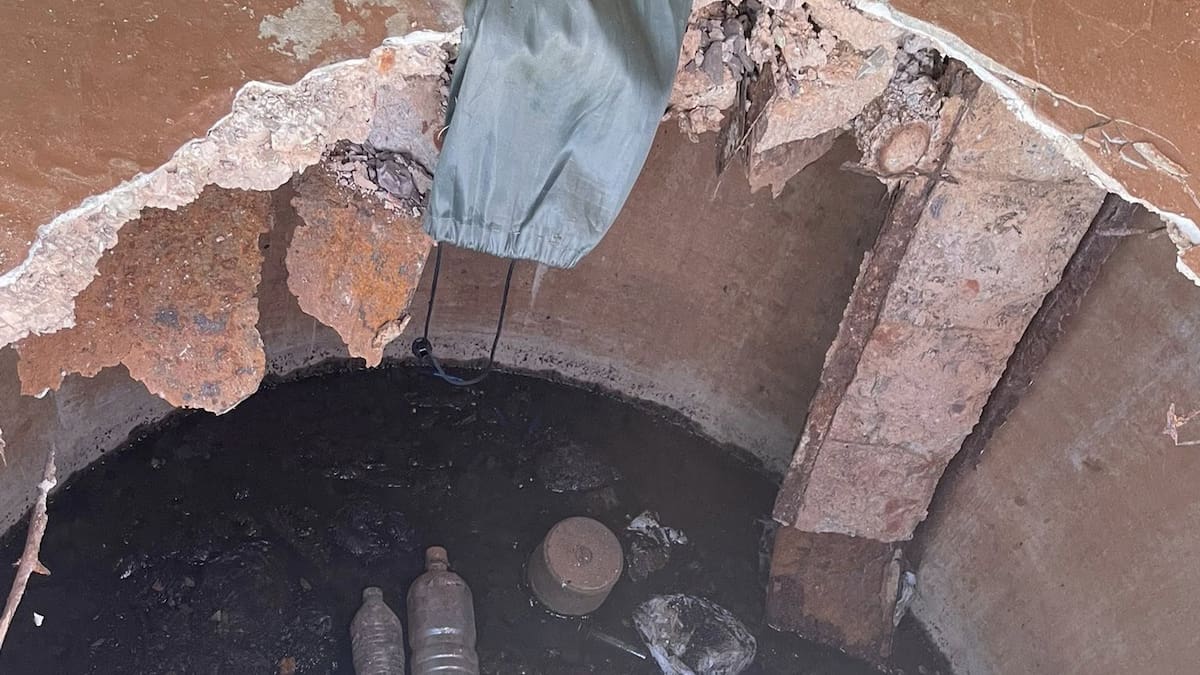
Because there was no phone signal in the area, 145km southwest of Alice Springs, her family was forced to leave her behind and drive an hour north to the nearest town to find help.
The woman was stuck in the hole for three hours, covered in “deep s**t,,” before a passing tradie rescued her, according to the NT News.
The 45-minute rescue was a difficult operation that required dismantling the toilet and lowering a tow rope into the hole to reach the woman.
She was then winched to safety using his 4WD.
“There’s s***, literal nappies, piss, all in that hole,” a witness told the local outlet.
“You couldn’t even see the toilet.”
The woman was said to be “incredibly shaken” and sustained minor cuts.
She was transported 144km to Alice Springs Hospital for further evaluation.
It is understood that she and her family were travelling from Canberra to visit relatives at the time.
The toilet has since been cordoned off while NT WorkSafe conducts an investigation.
Photos of the incident site show the toilet block taped off and the entry blocked.
“The notification was made by the agency with management of the conservation zone, as a collapse or partial collapse of a structure, which is a dangerous incident under the work health and safety laws,” a spokesperson said.
The Action for Alice community Facebook page posted photos of the aftermath of the dunny nightmare, saying, “This won’t feature in tourism brochures”.
“The decaying infrastructure of NT tourism,” they added.
Commenters were horrified by the story.
“Thanks for confirming my paranoid fear of drop loos is a legitimate one,” said one. “I will now opt for the bush toilet from now on”.
Another echoed: “This is my biggest fear”.
“This is nightmare fuel,” a third wrote.
Others were worried about the potential health risks.
The toilet is now out of order. Photo / Action for Alice
The main concerns for someone exposed to human waste are bacterial infections, parasites, hepatitis A and Tetanus. They may also contract skin infections.
The remote Henbury Meteorites Conservation Reserve is a popular tourist stop that offers a self-guided trail around a reserve that contains 12 craters.
The craters were formed 4700 years ago when the Henbury Meteor, weighing several tonnes and accelerating to over 40,000km/h, disintegrated before impact, leaving only fragments that hit the Earth’s surface.
Henbury is one of five meteorite impact sites in Australia with remaining meteorite fragments and one of the world’s best-preserved examples of a small crater field.
Sign up to Herald Premium Editor’s Picks, delivered straight to your inbox every Friday. Editor-in-Chief Murray Kirkness picks the week’s best features, interviews and investigations. Sign up for Herald Premium here.