
David Lowery specializes in genre movies that do not stay within the typical tropes or constraints. His fantasy film The Green Knight was more like The Last Temptation of Christ than Excalibur, while A Ghost Story unfolds like a spooky version of something you might see from Terrence Malick. The new film Mother Mary continues in that tradition. It includes surrealist gore, but it is not a body horror movie. It features Anne Hathaway singing original pop songs, but it is not a musical. The main characters discuss secrets and betrayal between them, but it is not a psychological thriller. Through Lowery’s blocking and use of metaphor, his latest is something else entirely. It is like the film version of an unrealized stage play.
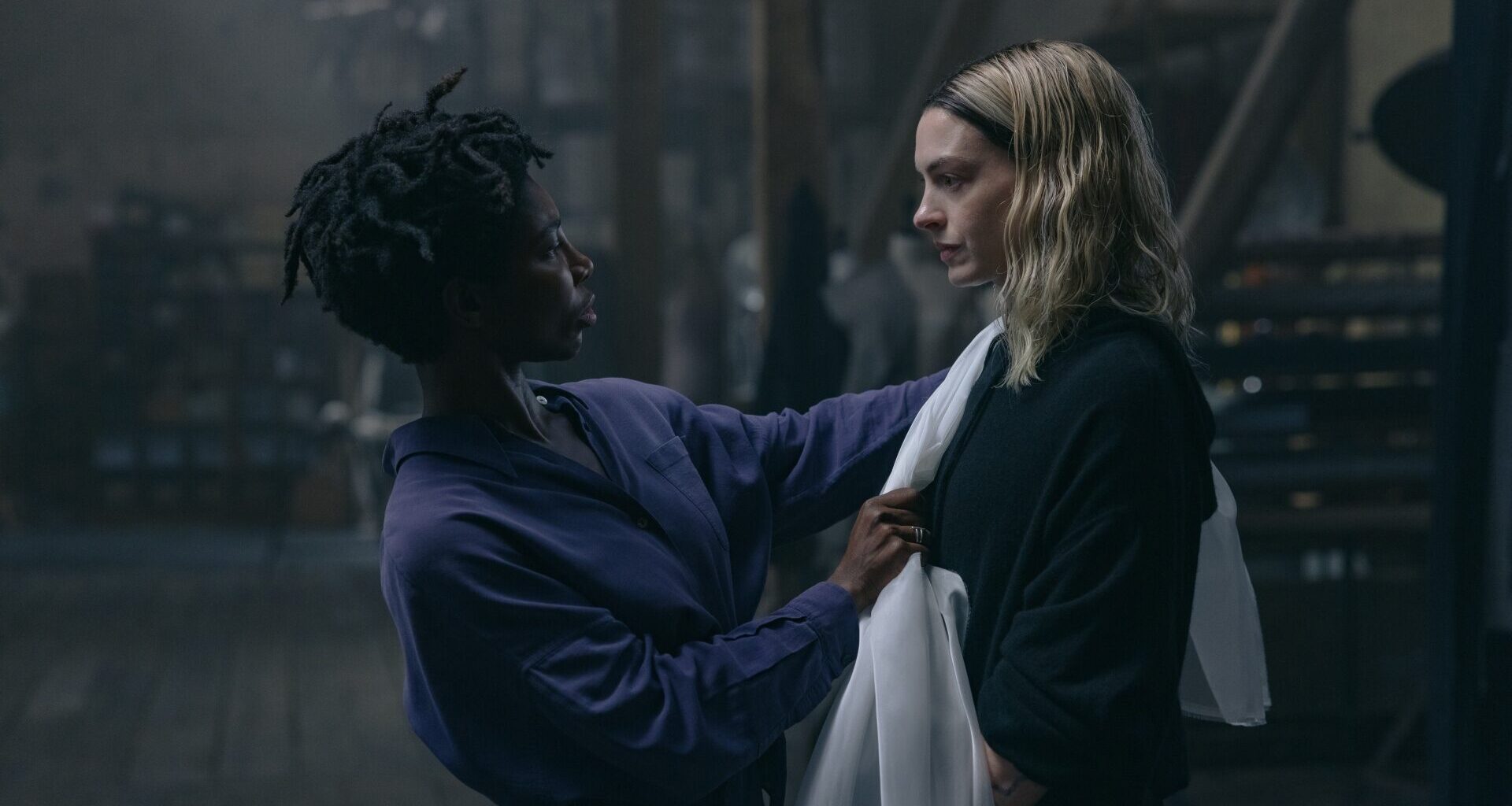
The first tell is the economy of the setting and characters. Hathaway plays Mother Mary, a worldwide pop star who shows up unannounced on the doorstep of her old friend Sam (Michaela Coel). Sam is a fashion designer, famous in her own right, and she helped design Mary’s signature look: a “halo” that looks like the crowns from the aforementioned Green Knight. The pair are nonetheless estranged, and Sam thinks Mary has some nerve to demand a dress for an upcoming performance. Sam obliges, anyway, for reasons that only become clear as they spend more together. Most of their time together unfolds in Sam’s airy, dimly lit studio, where they litigate the past and reveal painful secrets.
The setup is already stagey, and Lowery further invites that comparison by how he introduces flashbacks into what is essentially a protracted dialogue scene. Instead of merely cutting backward in time, Mother Mary metaphysically rearranges Sam’s workspace so it looks like everything from Mary’s old concerts to her private bathroom. By showing us how set pieces move in and out of the studio, Lowery avoids typical film grammar. The dialogue, Coel’s in particular, only underlines that feeling: she speaks precisely but with many rhetorical flourishes, the kind of language where syntax carries as much meaning as the words themselves. Clearly Sam has nursed her resentment, something made clearer by how Mary opts for one-word responses. Their major breakthrough only happens when Mary performs her latest choreography without a music accompaniment, another bit of business typically reserved for live theater.
Now a stagey two-hander does not necessarily mean that Mother Mary is a good film. It is just a signal that Lowery wants his audience to adjust their expectations, and accept his weird genre hybrid on its own level. There is a supernatural element introduced midway through the film, a ghost, and its presence does not necessarily signal we should be frightened. Instead, the imagery and dialogue are in service of metaphor, and of course audiences will disagree about what it all means. Maybe the movie is about the price of stardom, a woman’s body autonomy or the nature of artistic inspiration. No definitive answer means a lot is open to interpretation, a kind of ambiguity that is not typical of a medium where the camera often has a nasty habit of making everything literal.
Thankfully, Mother Mary is not all about vague unnerving imagery. Specificity can be found in its two lead performances, and through Mary’s music. Hathaway and Coel are good foils: they can be prickly in their own way, with a physicality that matches their mental state and profession. Hathaway is vulnerable or commanding, depending on what the scene requires, while Coel is more provocative and moves through the space like a skilled professional in peak form. As for the songs, they come from a variety of artists like Charli XCX, Jack Antonoff and FKA Twigs (the latter has a brief, memorable appearance during a séance flashback). The songs are convincing and good enough, which is all that Lowery really needs, although there is an accidental joke that comes from having so many artists contribute to the soundtrack: you can easily tell which song is Jack Antonoff’s because it stands out as the most annoying.
Mother Mary is sure to be divisive. No doubt it will alienate those who want a tidy resolution, or the kind of payoff you might find in something with a literal ghost and its creepy, haunted setting. Maybe those who are just fans of the aforementioned artists will wish Lowery had more musical numbers. That divisive quality, its refusal to be just one thing, is part of what makes it special. And unlike in the recent horror-adjacent The Bride!, Lowery is shrewd enough to abstract his influences so his penchant for imitation is never totally obvious. Only by the end does he make his inspiration clear: this is his postmodern riff on Powell and Pressburger’s The Red Shoes. Both films concern themselves with the madness and physical toll that comes with great performance, and how transcendence is its own reward. By channeling another movie that avoids any one genre, Lowery may lose old fans more than he gains new ones. But isn’t that risk what we want out of a filmmaker whose whole deal is never making it easy for himself?
Photo courtesy of A24
Summary
Stagey and hard to pin down, the David Lowery’s Mother Mary is a provocation that works better when you imagine it as a theater piece.