
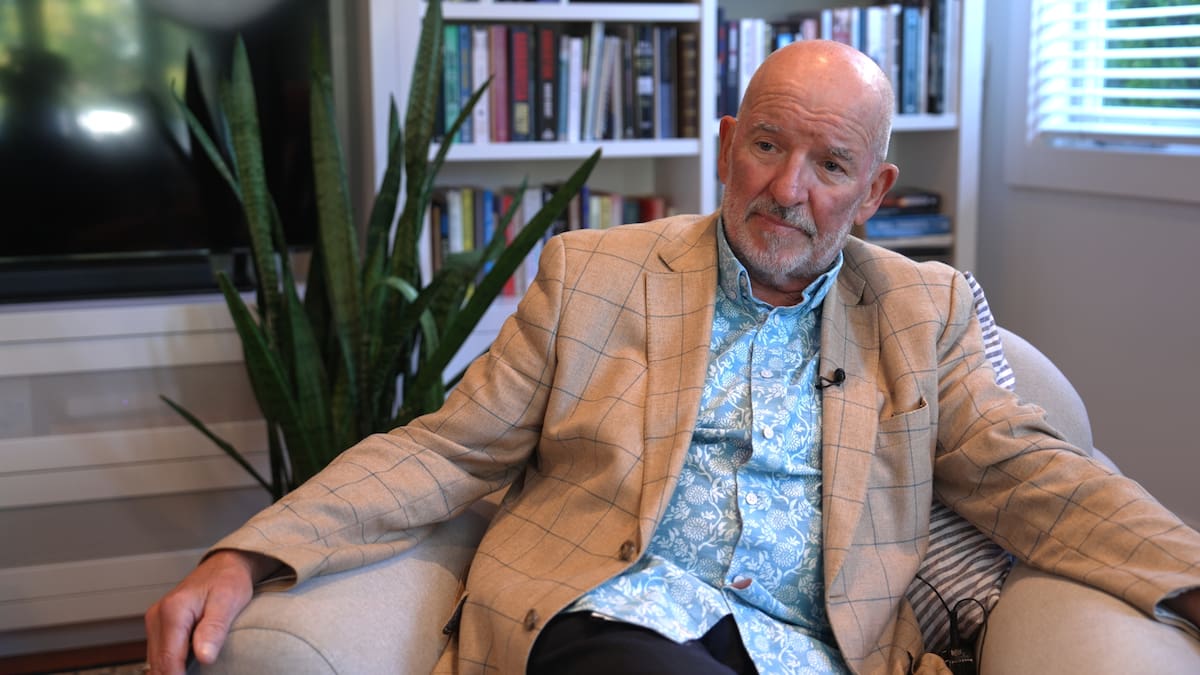
Newstalk ZB’s Heather du Plessis Allan, his girlfriend at the time and now his wife, was working in another office in the parliamentary Press Gallery and rushed out to see if the big bins at Parliament had been emptied. But the content had already been taken to the dump.
“I said to the person who destroyed them: ‘What on earth were you thinking about?’ And, the person said to me: ‘Well, I thought, oh, this is old stuff. Nobody would be interested in that’.”
That is about to be put to the test with Soper’s first book, One Last Question, Prime Minister.
It is not the book he originally had in mind but it is based on anecdotes, analysis and opinion from a career that has spanned 12 Prime Ministers, from Sir Robert Muldoon to Christopher Luxon.
It is a job that took him to the fall of the Berlin Wall with Mike Moore, to the Dakota Hotel in New York with David Lange to meet Yoko Ono, and to the Great Wall of China with Jim Bolger.
Along the way, Soper has been a witness to history and made his own contributions, coining such terms as “Rogernomics” and “Crusher Collins” and getting former US Secretary of State Colin Powell to describe New Zealand as “very, very, very good friends” of the US.
As the story of the office clean-out shows, Soper is a natural raconteur. He has the ability to turn a fact into a yarn. The book is a mix of known and previously unknown stories, peppered with a heavy dose of commentary on the qualities and failings of each of the Prime Ministers.
There is one verdict that stands out among others, however, his scathing assessment of Dame Jacinda Ardern.
He even weaponises her self-deprecating admission that she suffered from “imposter syndrome” against her.
“She talked a number of occasions about an imposter syndrome, and I think she genuinely felt that because I thought she was an imposter in the job,” he tells the Herald.
He says he really liked her in the beginning and welcomed the idea of a young liberal, woman Prime Minister, but his view changed quickly.
“She didn’t have the depth to be the Prime Minister of the country and was to me, more than any other Prime Minister, the biggest manipulator of the media.”
Soper took issue with the way Ardern ran press conferences, particularly the 1pm press conferences during the Covid-19 crisis.
It wasn’t so much that she would ignore his first question and almost always go first to “Jessica [Mutch-McKay] and Tova [O’Brien]” from TVNZ and Newshub. But she would make reporters put up their hands to ask questions and frequently cut to someone else before allowing him to ask follow-up questions.
He felt she had prevented him from doing his job properly.
Soper suggests in the book that there was trouble between them almost from the start.
During her first press conference after New Zealand First leader Winston Peters had announced he was installing Ardern as Prime Minister, Soper ruffled feathers by suggesting she could learn a lot from Peters.
It caused a great hubbub, Soper said. Some claimed the question amounted to a white, ageing journalist indicating that she could not do it on her own.
Soper is likely inviting fresh allegations of sexism when he concludes in the book that after regular trips back to Premier House to breast-feed her new daughter, “It is not unreasonable to ask if the job of a new mother is incompatible, to some extent, with the job of being Prime Minister”.
But Soper does have one fond memory of Ardern. He recalls a dinner one evening for senior gallery journalists hosted by Dame Annette King, not long after Ardern had become Prime Minister.
Barry Soper (left) with a pregnant Dame Jacinda Ardern at a dinner hosted by former Labour MP Dame Annette King at her home in Wellington in 2018.
As they were leaving, he had asked her respectfully if he could touch her stomach, to which she said: “Of course, Barry.”
“I’ve got this wonderful photo of me standing with Ardern and touching her stomach.”
In Soper’s judgment, Ardern escapes with one virtue: “I think she means very well,” he said.
Soper’s criticism of Ardern is not just limited to her time in politics but to her activities since then.
After resigning from Parliament in 2023, Ardern took up teaching and research fellowships at Harvard University’s Kennedy School.
She published her own memoir last year, A Different Kind of Power and both she and Soper are featured authors at next month’s Auckland Writers Festival.
Her TV presenter husband, Clarke Gayford, co-produced a documentary, Prime Minister, on her five years in office, which is a finalist in next month’s Emmy awards. It is currently screening on Netflix and Soper saw it last week.
“And I’m sorry, what I saw was acting, not very good acting, but all the way through,” he said.
“And, and they were doing it, her and Clarke Gayford, her man, they were doing it clearly with this in mind that they would go out, make money post the election, of course, she’s made a lot of money, through Harvard and through international appearances.”
Soper acknowledges that his view of Ardern was influenced by his experiences under Covid-19, when he endured the Auckland lockdown and when one of his adult children was stranded in Australia, unable to get into New Zealand without winning a ballot.
“Well, there must have been an element of that,” he concedes, “but there were other things that this woman continually preached, kindness. And when you keep people away from their loved ones on their deathbed, when you say to people, you can’t go along to the birth of your child, when you say to people, at a funeral, you can only have 20 people, there was nothing kind about that.”
Living in Auckland at the time was like living in a totalitarian state, he said.
“And I don’t think Jacinda Ardern ever really appreciated that.”
Barry Soper (from left) with Yoko Ono and former Prime Minister David Lange in April 1989 outside the Dakota Hotel where John Lennon was shot.
Soper began in the Press Gallery in 1980 when Muldoon wielded enormous power and was two years away from imposing a wage and price freeze on the country, which ended only with his defeat.
Muldoon largely escapes the withering criticism reserved for Ardern, although Soper describes a couple of interviews in which Muldoon was paralytically drunk.
One was at Government House on the night Muldoon called the so-called Schnapps Election in 1984. He slurred something incomprehensible a few hours before he had recovered enough to slur something comprehensible in the TV clip, “doesn’t leave my opponents much time … ”
The other was two nights before the election when Soper interviewed Muldoon in his hotel room after his rally in the Auckland Town Hall, alongside an RNZ reporter.
“We were ushered into his room, where he was slumped on an armchair, an empty red-wine bottle laid on its side,” he writes. “Unusually for this man, who was a stickler for his impeccable appearance, his tie was loosened, shirt buttons undone and his thin comb-over was hanging as a wisp down the side of his face.
“Microphone in hand, I went down on one knee to get close to The Grunter [one of Muldoon’s nicknames] and the interview began. ‘Do you think you’ve won the election?’ I asked. Muldoon shook his head from side to side without making a sound. I reminded him this was radio and we needed him to speak. Repeating the question, Muldoon simply replied, ‘Nup.’
“He then proceeded for several minutes to say why he had lost and even talked about his future, suggesting he’d be back. It was a scoop – never before had a Prime Minister, to my knowledge, conceded defeat before the vote had been held.”
Soper got to know Muldoon better after the defeat when he was on the back benches of the Opposition.
Muldoon would call him up to his office for a scotch, always referring to him formally as “Mr Soper”, never Barry, and he never took no for an answer.
Soper: “I learnt more about politics, the good and the bad sides of it, from those sessions than anywhere else,” he writes.
“On one occasion, he suggested that I should look at the seat of Awarua with a view to standing, and I said, ‘There’s no way I would become one of you”.
Barry Soper (right) rates former Prime Minister Helen Clark highest. They are pictured here at a function at Parliament after her valedictory address in 2009.
Soper rates Labour Prime Minister Helen Clark highest of those he calls the “significant Prime Ministers”, with National’s Sir John Key not far behind. Both have written complimentary forewords for the book.
Clark, he writes, “had a formidable intellect, was fiercely competent and became the no-nonsense leader the country needed”.
Of Key, Soper said, he “painted the picture of being a good, honest, Kiwi bloke first and Prime Minister second”.
“That resonated with the public.”
He describes the leadership of New Zealand under Clark and Key as living through “a golden age” of Prime Ministers.
Soper is not always complimentary about the news media of which he is a member. He is critical of the coverage of “Paintergate”, in which Clark was pilloried for signing a painting she didn’t paint as a charity fundraiser.
He regarded it as a trivial story. He is also critical of the coverage given to former minister David Benson-Pope, whom Soper regards as having been bullied out of Parliament by the Press Gallery. And he is critical of the ambush of Clark by John Campbell, then on TV3, in what became known as “Corngate”.
“While I understand the power of ‘gotcha’ moment and don’t think it’s the media’s role to kowtow to politicians, if you want to maintain relationships with politicians, you simply can’t operate that way,” he writes.
He rejects the view that the Press Gallery “hunts as a pack”.
“They don’t. They work for different organisations and they don’t want the answers that everybody else is going to use,” he said.
“I respect the gallery. I think they work very hard, although some of the questions I hear asked these days, in my view, are inane.”
In his view, incumbent Prime Minister Christopher Luxon should push back on “the absurdity of the question”.
He said Luxon had been treated more harshly than any other Prime Minister in his experience.
One of the first questions that Luxon got in an interview was “Why do you see the need to have seven properties?”
“Well, in fact, he should be celebrated for that. The man worked at Air New Zealand in a multimillion-dollar-a-year job, and if he didn’t have some sort of investment, he would have been a pretty poor manager of his own wealth.”
Soper left the Press Gallery in 2023 to move to Auckland, where du Plessis Allan hosts ZB’s drive show. He does only commentary now, including a daily slot on her show.
The gallery has changed markedly since Soper began there in 1980. It used to be primarily male, the consumption of alcohol was intrinsic to its work and reporters worked for news organisations with much bigger budgets and fewer deadlines than today.
When Prime Ministers travelled abroad, it was often for long spells and there would be no question that they would be accompanied by the Press Gallery.
Soper’s chapter on David Lange captures the bygone era, especially in his description of Lange’s month-long trip to Africa in 1985.
Barry Soper (left) with Nelson Mandela in 1994, the day after he had been inaugurated as South African President, signing his inauguration address.
There are two particular highlights, one of them almost surreal. Soper met a couple of air balloonists in a bar in Tanzania, as you do, and arranged for them to take Lange for a flight at 5am the next morning.
For his efforts, Soper rightly claimed a place in the balloon instead of Lange’s security detail. Afterwards, Lange declared it one of the best experiences of his life.
The other highlighted the derring-do antics of the Press Gallery back in the day. While they were meant to be covering Lange in Africa, Soper and others were offered the opportunity to interview Pik Botha, the South African Foreign Minister, still under the apartheid regime.
Four of them chartered a plane from Botswana to Johannesburg, then caught a commercial flight to Cape Town for the interview. Apparently, it didn’t go well after Soper mentioned the 11 black South Africans who had been shot dead that week for protesting against petrol prices.
On their stopover in Johannesburg on the way back to join Lange, they had a few hours at the airport, so Soper decided to try to find Bishop Desmond Tutu, as he was then, for an interview, to balance the Botha interview.
He found him in the phone book, called him from the airport and Tutu invited him out to his place in Soweto, where the interview happened. They then rejoined Lange, by this time in Harare, Zimbabwe.
Six years later, in 1991, Soper was back in Harare but with Prime Minister Jim Bolger, covering the Commonwealth Heads of Government Meeting, and that was where he first met and interviewed Nelson Mandela, who had been released from 27 years’ imprisonment on Robben Island.
Soper then covered Mandela’s inauguration as President of South Africa in 1994. And in 1995, Mandela accepted Soper’s invitation to address the Press Gallery’s 125th anniversary dinner in Wellington, after attending the Commonwealth Heads of Government Meeting in Auckland.
It was, Soper said, “the highlight of my career”.
Barry Soper’s book, One Last Question, Prime Minister is published by HarperCollins and is on sale from April 28, RRP $39.99.