

At NAB 2026, iodyne confirmed that its Pro Mini is finally shipping to customers, closing a long wait for the company’s first “Smart Drive.” Offered in 4TB and 8TB capacities at $1,495 and $2,195, the pocket-sized SSD combines an e-paper digital label, passkey unlock, Find My tracking, hardware RAID-6, and solid-state cooling for sustained 3+ GB/s performance.
We first covered the Pro Mini when iodyne unveiled it at IBC 2024, followed by a hands-on preview at IBC 2025. At the iodyne booth in Las Vegas, our Co-CEO Nino Leitner caught up with Mike Shapiro, iodyne’s Co-President, inside the company’s “Workflow Kitchen” demo space, which we have reported from before. According to Mike, pre-orders are being fulfilled in priority order through iodyne’s worldwide partner network, and the first Smart Drives are already landing in customers’ hands.
 iodyne Pro Mini – Image credit: CineDFrom concept to customer
For Mike, the Pro Mini exists because portable storage has been stagnant for years. Crack open any competing portable SSD, he noted, and you will find the same consumer M.2 stick in a different-colored shell. Every flagship feature in the Pro Mini traces back to a specific conversation with a working professional about a specific pain point.
The result is a smartphone-sized aluminum brick (131×69×13mm / 5.16×2.72×0.51 in) topped with a hardened Gorilla Glass 2 window. What lives under that window is what sets the Pro Mini apart from anything else on the portable-storage shelf.
 iodyne Pro Mini e-paper. Image credit: CineDA digital label that replaces masking tape
Anyone who has managed a drive cart knows the ritual: a strip of masking tape, a marker, and a label that is out of date by the next shoot. We are guilty of it ourselves, with drives from IBC 2023 still labeled “IBC23” that now hold NAB 2026 footage.
iodyne’s answer is a 2.1-inch e-paper display on the top of the drive. It shows a static personal layer (logo, camera ID, project or episode name) alongside dynamic fields such as total capacity, free space, and a sync indicator. An animated check mark confirms at a glance, even from a shelf, that the drive was properly ejected and the footage is safe. Because it is e-paper, the label remains visible for years without power.
Customization happens through iodyne’s macOS and Windows utilities. Users can embed a personal QR code, link to iodyne’s fleet-management cloud service, or set a custom lost-mode screen that appears if the drive is reported missing.
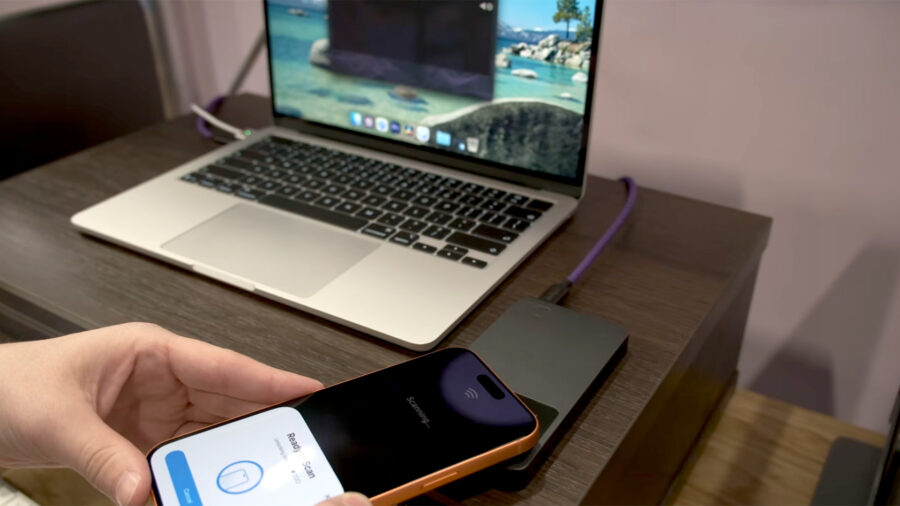 iodyne Pro Mini passkey – tap to unlock. Image credit: CineDPasskeys, tap-to-unlock, and Find My
Pro Mini uses always-on XTS-AES-256 hardware encryption with keys stored in a dedicated secure enclave, running at line speed, so there is no performance penalty. What is new is how users authenticate.
Instead of passwords written on masking tape, iodyne has implemented device-side passkeys, the same public and private key architecture that websites are adopting for password-less login. A new iOS app, linked to iodyne’s fleet-management service, lets authorized users hold a phone against the digital label and unlock the drive via NFC in a few seconds. Multiple passkeys can be provisioned per device, which matters in team environments where a DIT cart might rotate between operators.
To round out security, Pro Mini includes a Bluetooth Low Energy beacon connected to both Apple’s Find My and Google’s Find My Device networks. You can locate the drive from the native apps on iOS or Android, trigger a buzzer, and see a blinking LED. It is, in Mike’s words, effectively an AirTag built into the enclosure, useful both for misplaced drives and for tracking Pro Minis shuttled between locations.
 Image credit: CineDRAID-6 in a portable package
One of the headline technical claims is that iodyne has brought its Pro Data-derived RAID-6 engine into a single bus-powered device. Inside a Pro Mini, storage is not one monolithic SSD: the drive contains NAND packages that each stack multiple dies vertically, and iodyne distributes data with RAID-6 parity across up to 64 individual NAND chips. When pages or blocks wear out, the drive recovers transparently.
This is essentially enterprise-grade resiliency at the chip level, and as far as we are aware, iodyne is the first to implement it in a portable, bus-powered SSD. For anyone running the Pro Mini as a shuttle to a Pro Data or cloud ingest, that built-in redundancy is a meaningful protective layer before off-drive replication.
 Digital label. Image credit: CineDSolid-state cooling unlocks the rest
None of the above is possible without solving the thermal problem. Sustained SSD performance scales with power, and power creates heat. Pro Mini integrates two AirJet solid-state cooling chips from iodyne’s partner Frore Systems: millimeter-thin modules that move air through the enclosure without moving parts or audible fans. A thin exhaust vent is the only external sign they are there.
Mike described AirJet as the enabling technology that let iodyne keep the performance envelope open while adding line-speed encryption, RAID-6, the e-paper label, NFC and Bluetooth radios, and the Find My integration. The result is 3+ GB/s sustained read and write, around 2 to 10 times faster than a typical pro portable SSD under sustained workloads, with encryption and RAID protection always on.
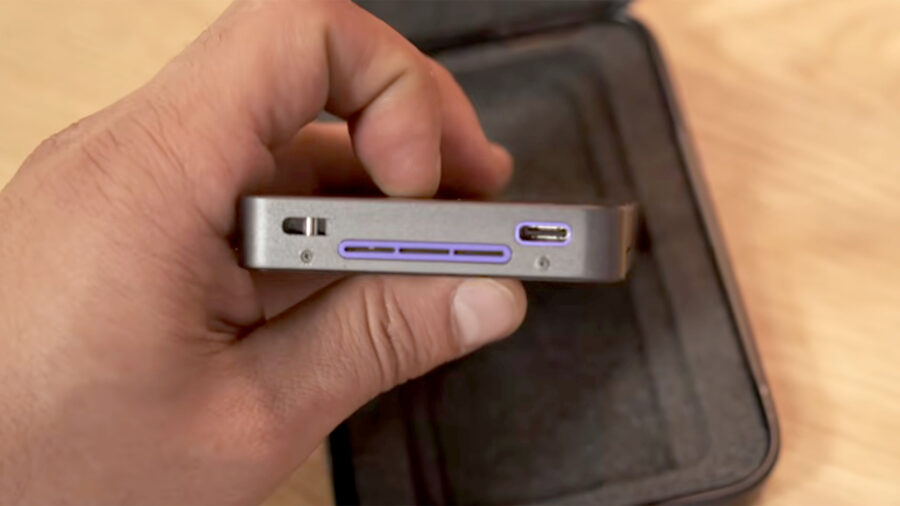 iodyne Pro Mini universal USB and Thunderbolt connectivity. Image credit: CineDUniversal connectivity and a detachable cable
The USB-C port on the Pro Mini auto-negotiates the highest available protocol (USB 2, USB 3, USB 4, or Thunderbolt) and reports the active link speed on the digital label. If a marginal cable is in play, the drive will show that a 40 Gbit/s port is running at only 10 Gbit/s, which is a genuinely useful diagnostic.
iodyne bundles a 0.3m (1ft) braided USB4 and Thunderbolt cable in the box. We reviewed iodyne’s Pro Cables and found meaningful performance differences between cable qualities, so the distinction matters. Because the Pro Mini does not use a captive, molded-in cable like many shuttle drives, users can swap lengths to suit a DIT cart, a laptop rig, or on-set ingest from a USB-C camera.
Storage prices, AI, and iodyne’s positioning
We also asked Mike about the elephant in the room: NAND and DRAM prices have jumped sharply as AI data center demand has absorbed wafer capacity that used to flow to consumer storage. He did not sugarcoat it. Fab capacity is measured in tens of billions of dollars and years of lead time, so the supply shift is not reversing quickly.
His point is that Pro Mini offers substantially more than a commodity M.2 at comparable price inflation, and that the Smart Drive architecture (a system-on-chip running iodyne’s own software) gets better over time through free firmware updates. Mike hinted that several features suggested by NAB visitors will ship as updates to current buyers, mirroring Pro Data’s trajectory since launch.
Price and availability
Pro Mini is available now, 4TB for $1,495 and 8TB for $2,195, through their website and the company’s worldwide partner network. According to Mike, a long pre-order backlog is being filled in priority order, so getting in line now is better than waiting.
For teams already running Pro Data as a post-production hub, Pro Mini slots in as a field shuttle: capture or offload on location, return to a Pro Data as the master, then hand off to the cloud. For independent creators, the combination of Find My, passkey unlock, and hardware RAID-6 in a pocket drive addresses pain points most of us simply accept today.
Would a Smart Drive approach, with digital label, passkey unlock, Find My, and hardware RAID-6, change how you manage storage on set and in post? Don’t hesitate to let us know in the comments below!