
Two others, Trish Sherson and David Cormack, give their detailed views (below) today.
Many members of the public – and National supporters especially – were more understanding, judging by Media Insider’s inbox.
“I don’t blame the Prime Minister for not wanting to be interviewed by Tova,” one reader wrote. “Quite honestly, I find her … unnecessarily argumentative and aggressive.”
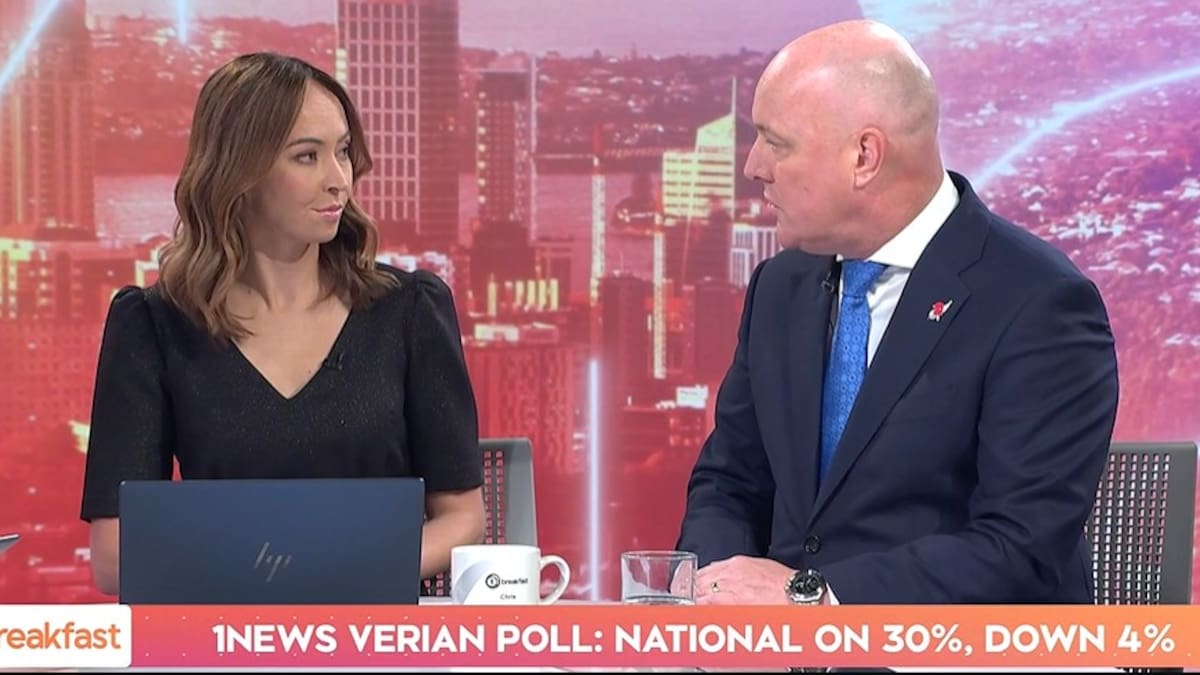
Prime Minister Christopher Luxon with Breakfast host Tova O’Brien.
But commentator and journalist Carmen Parahi observed on Newstalk ZB earlier this month that Luxon appeared flustered when he came up against O’Brien.
“My concern for Luxon is, does he have a Tova problem? Because he gets all red and he gets all flustered, and actually can he not just answer her question?”
The three encounters
There was trouble early on, even in that first Breakfast rendezvous, as Luxon explained his role to O’Brien. “My job is the CEO … ”
O’Brien interrupted: “Your job is the Prime Minister.”
A week later, Luxon struggled to name the Māori National MP in his Cabinet.
Both those moments went viral on news websites and social media, beyond the tens of thousands who watch the actual show.
This week, Luxon was in the TVNZ studio again for the third – and ultimately final – weekly date with O’Brien (there had been a fourth Breakfast interview, with co-host Chris Chang in between O’Brien’s three).
Luxon tried a slightly different – more personalised – approach with O’Brien this past week.
“That’s why I came to politics, five years ago, when I first met you … ”
And: “You were there in 2020, you used to harass me every day about how bad the National Party was and its civil war status … ”
And: “You have to understand our history a bit, and you’ve been around politics and seen that era … ”
By now, O’Brien had had enough. “You’re really sucking up to me this morning!”
Luxon: “No, no I’m not … ”
By Friday, it was all over.
A mere few hours after National had announced that it had laid a separate complaint with TVNZ over the behaviour of its political staff at Parliament, the PM’s office said he would no longer commit to the weekly Breakfast exchange.
The PM’s office confirmed that Luxon’s weekly interviews with Newstalk ZB’s Mike Hosking and RNZ’s John Campbell and Ingrid Hipkiss would remain.
Prime Minister Christopher Luxon is interviewed by Newstalk ZB’s Mike Hosking. Photo / Michael Craig
“After a review of regular media engagements late last year, we have decided to update our approach,” a spokesman for the PM said.
“Kiwis get their news in different ways – across radio, television, podcasts and digital platforms, and from next month, there will be three separate morning TV news shows.”
Media Insider sought clarification on the three shows.
The spokesman said it was Breakfast, Ryan Bridge Today – the Herald’s morning show, which will shortly screen on Three (it’s already on Three Now) – and TVNZ’s new morning business show, hosted by Mei Heron.
By that measure, there are four morning shows – NZME has its own new business show, Herald Now Business, hosted by Garth Bray. It will also shortly screen on Three.
The PM’s office said: “The PM will continue to be available to media, including Breakfast on a case-by-case basis.”
The spokesman then placed more context on its decision.
“We have separately raised concerns with TVNZ this week about the inappropriate conduct of its staff,” the PM’s spokesman said.
“New Zealanders want a fair, balanced and accurate media talking to the issues that matter to them. We respect the role of media, but there are standards, and those standards matter.”
A TVNZ spokeswoman said: “Our news team is committed to providing accurate, impartial, comprehensive and in-depth news coverage. Editorial independence is fundamental to this and critical for a free and democratic society. Part of this is holding those in positions of power to account.”
Here’s how two communication experts view the PM’s decision.
Trish Sherson, Sherson Willis
Sherson Willis co-founder Trish Sherson.
Breaking with a weekly Breakfast interview may be defensible, but timing matters. When leadership is under pressure and disputes with the media spill into public view, the risk isn’t who wins the argument – it’s that frustrated voters tune out altogether.
For most New Zealanders, this isn’t about the Prime Minister’s media schedule or press gallery rules. It’s about whether politics feels focused on the things that matter, or lost in arguments most people don’t have time for.
When a Prime Minister steps back from a regular interview, fair or not, people read it as a signal about how comfortable a leader looks under pressure. Changing media strategy isn’t unusual, and it doesn’t automatically mean avoidance. But timing matters.
Coming straight after leadership instability, many voters expect to see more visibility, not less. Breakfast is still where many voters see how leaders handle questions. Pulling back now risks looking less strategic and more about managing risk than fronting up.
The dispute involving TVNZ staff will mostly be argued out inside the Beltway. Most voters won’t follow the detail. What they notice instead is tone. When arguments with the media spill out of Parliament, the focus quickly shifts away from leadership and onto the scrap itself.
The real risk isn’t who wins the argument – it’s that ordinary voters, already frustrated with politics, tune out altogether.
David Cormack, Cormack
David Cormack with daughter Greta Cormack.
It seems to be a thing for a Prime Minister to bail on one outlet over the course of their term. So, in some respects, this is not remarkable. But to do it at a time when there’s so much focus and speculation on the Prime Minister’s performance is definitely a bold play.
It’s also a bit weird given that TVNZ is state-owned and commercial. That makes this almost a poor business decision because National feels it’s a smart political one.
There have been increasing amounts of personal “comments” from MPs about specific journalists, which feels more adversarial than I think is healthy. Who sets the terms of engagement for media and politicians?
MPs have a powerful position, and their behaviour tends to give permission to everyone else to act in certain ways; they need to be extra careful in how they talk about individuals.
The earlier complaint National lodged may or may not be valid. Saying that the reporters were pressuring whip Stuart Smith is no justification. Sorry, but the media is there to apply pressure and for MPs to be accountable. The rules thing is different, but the justification seems feeble.
So many parties cycle through a “media is against us” phase. What’s new is politicians trying to dictate what is reported. Is it a free press if that’s an accepted norm?
Trish Sherson is a director and co-founder of corporate affairs firm Sherson Willis.David Cormack advises on politics, media, and reputation. He works with leaders and organisations on high-stakes issues. He recently founded his company, Cormack.Editor-at-Large Shayne Currie is one of New Zealand’s most experienced senior journalists and media leaders. He has held executive and senior editorial roles at NZME including Managing Editor, NZ Herald Editor and Herald on Sunday Editor and has a small shareholding in NZME.