
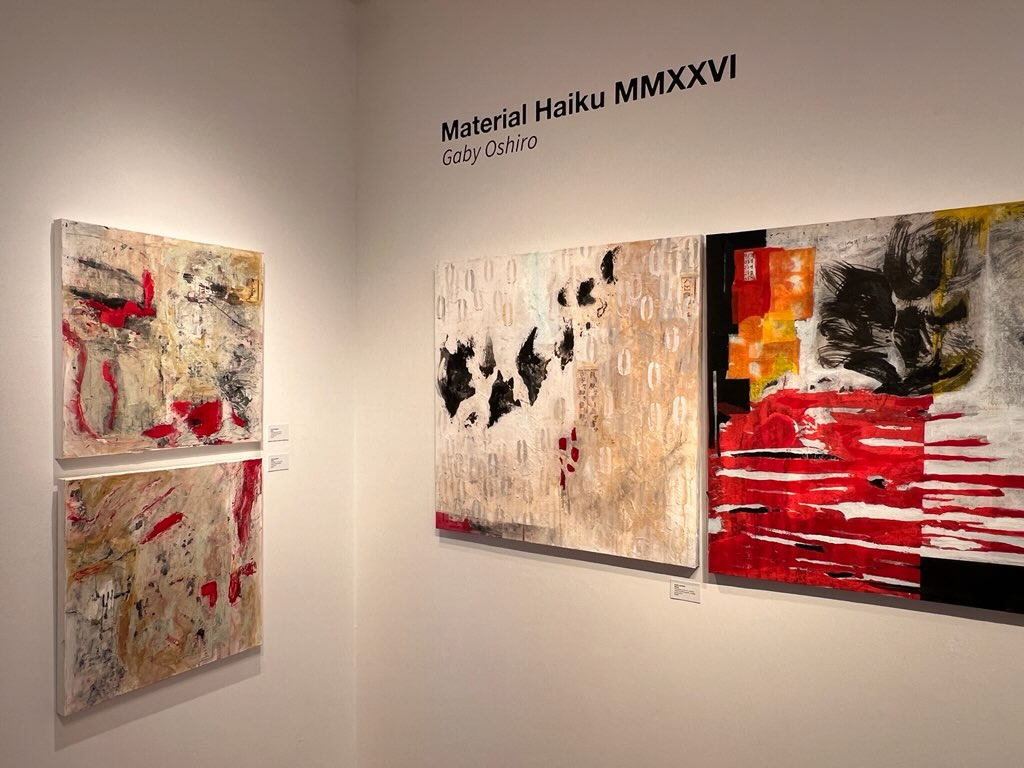
To create, Colorado-Springs based artist Gaby Oshiro first destroys.
She burns, rips, tears and stabs, using mulberry paper, pumice, bamboo and natural pigments to craft pieces composed of the scars of their creation. As Oshiro’s artist statement says, “These works do not decorate; they testify.”
Over 60 of her pieces are on display at the Carbondale Arts Gallery in “Material Haiku MMXXVI,” one of the gallery’s two current exhibitions.
The pieces she creates reflect her scars, too.
Oshiro was born in Buenos Aires. In the 1970s her father, labor lawyer Oscar Takashi Oshiro, was kidnapped by Argentina’s military dictatorship and became one of the 30,000 desaparecido, or “disappeared.” Her family never uncovered what happened to him.
“There were curfews, you couldn’t read what you wanted. They were burning books,” Oshiro said, describing what it was like to live under a dictatorship. “You couldn’t watch whatever you wanted, you had to watch what they said (You had to listen) to music that they approved of.
“It was not a nice place for a long time,” she added.
For years, her work has reflected the constant presence of her father’s absence.
“All the work that I do is connected to that absence,” Oshiro said. “The void, which is also Ma, in Japanese, is an emptiness, but it’s not negative space, like they said here in the western world.
“In that emptiness, it shows what is not there and the potential it has involved,” she added.
Two years ago, a curator from a Denver gallery asked Oshiro if she could paint about the dictatorship.
“I couldn’t, actually, because it was like remembering those people on TV giving all the rules to live by, and so I decided to do more about what I was feeling,” Oshiro said. “The first one of the series I started with Shodo, which is Japanese calligraphy with ink, you use sumi ink, which is also like char.”
It was a meditative process. But when Oshiro finished the piece, she put it on canvas and started stabbing it.
“It was a very violent kind of thing,” she said. “I remember when they took my dad, they burned all his documents in his office, so that, made me start using actual fire instead of paint.”
This idea culminated into “Material Haiku MMXXVI” which opened at the Carbondale Arts Gallery on April 17.
“I’m the eyewitness of (my dad’s) absence, the eyewitness of the dictatorship, so everything that I’ve been through, it goes into the work that I’ve been doing: the fragments, the layering.” Oshiro said. “On the other side of the (gallery) wall…it’s décollage, which is when you put in a lot of layers and then you pull them out, and it’s like time passing through it.
“It’s not perfect, but I use the wabi-sabi philosophy…beauty stands on the imperfect,” she added.
The name of the exhibition, “Material Haiku MMXXVI,” is a reference to Leonardo da Vinci’s famous ideology that painting is visual poetry. It also honors her family’s history.
Her great uncle was a painter and a poet who wrote a haiku a day. “The haiku is embedded (in my family),” Oshiro said.
When her uncle passed away at over 100 years old in 2012, Oshiro inherited many of his journals, some of which contained translations from Japanese poets.
Visual poetry, a representation of political injustice, physical transformation and scars: her exhibition is all of it. But once on display, Oshiro lets her work speak for itself.
“The work, at the end, is like a mirror,” Oshiro said. “(Viewers) bring their own experiences and they can take their own…whatever they feel, it is probably right, because we all have different walks of life.”