
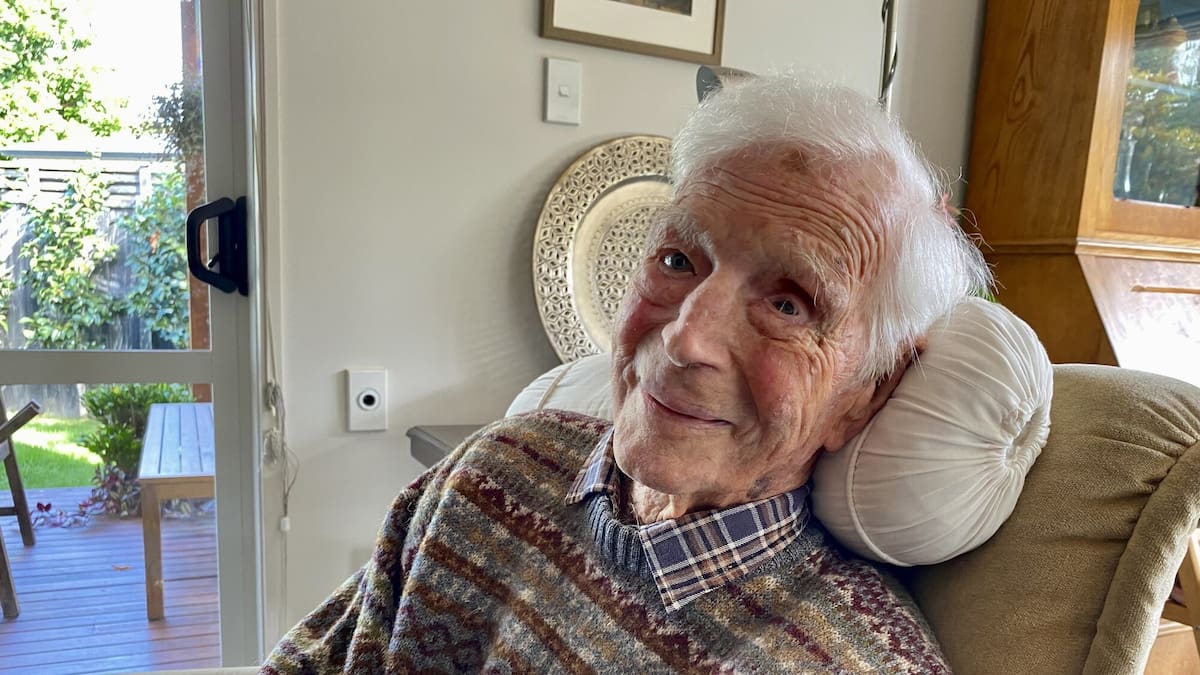
When New Zealand entered World War II in September 1939, Fox wanted to volunteer for the Air Force.
But because he was 16, two years under the minimum age, his parents said no.
Once he turned 18, Fox tried to join the Army but failed his medical due to “bunions”, he said.
So he joined the Air Force, which Fox said “didn’t want you to do as much walking as the Army did”.
For his training in 1941 and 42, Fox was stationed at the RNZAF Base Ohakea, then RNZAF Rotorua.
In 1943, he was shipped off to Canada, where he qualified as an air gunner.
In early 1944, Fox was sent to Britain and crewed up with members of the Moriarty crew at an Operational Training Unit.
The Moriarty crew were named after renowned pilot David Moriarty from Whanganui.
At the unit, the crew learned the life-saving skills of functioning as a team.
The 75 Squadron with a Stirling bomber in 1943. Photo / Alexander Turnbull Library
In June 1944, the crew was posted to RAF Mepal in Cambridgeshire, the base of the 75 (NZ) Squadron, a bomber squadron of the Royal Air Force manned mainly by New Zealanders flying Vickers Wellington bombers, Short Stirling bombers and Arvo Lancaster bombers.
The crew flew its first war operation on June 14 – a little over a week after D-Day.
At 103, Fox’s memories from this time are understandably foggy, but his son Graeme describes his father’s tour of 30 operations as “comparatively uneventful” with one exception.
On July 18, 1944, Fox was with Moriarty on the 11th operation of their tour, dropping bombs in a Lancaster on German positions near Caen during a daylight raid.
The operation was in support of the Allies’ attempted breakout from the Normandy beachhead.
Their aircraft was at 7500 feet (2.3km up) when a German shell burst.
In an interview before his death in 2010, Moriarty recalled closing the bomb doors when a “big puff of black smoke erupted in front of the cockpit” and punched a hole “about the size of a cabbage in the Perspex cockpit hood”.
Shrapnel from the explosion drove through Moriarty’s left eye and exited behind his left ear.
His crew slapped a field dressing on the wound, but Moriarty refused morphine to keep his “wits” about him while he remained at the controls with one working eye.
He called for a course back to Mepal rather than an emergency field, because he was more familiar with the airfield and others aboard couldn’t fly the bomber.
For the next 90 minutes, the bomb aimer called off instrument readers while the flight engineer worked the flaps.
Moriarty and his crew landed safely and eased to a halt as medics clambered aboard.
“It wasn’t a great landing,” Moriarty remembered.
“I didn’t smoke, but I asked for a cigarette. I must have seen too many westerns.”
Moriarty was awarded the rare Conspicuous Gallantry Medal for his act of bravery that day, which saved his crew.
But because of his injuries, the war was over for Moriarty.
Fox and the crew had to wait for a new pilot and by mid-October 1944 had completed their allocated 30 operations, achieving tour-expired status.
The crew was disbanded and Fox was sent to the air gunnery school at RAF Castle Kennedy in Scotland.
In 1945, Fox was recalled to the 75 (NZ) Squadron to join Tiger Force, the bomber command set to undertake strategic bombing against the Japanese.
But before it was deployed, atomic bombs were dropped over Japan, and the war was over.
Fox returned to his relieved parents in Oamaru around Christmas 1945.
Some years later, Fox went to see the crew’s bomb aimer Ian Ward, where he met Iris Ward, Ian’s younger sister and Fox’s future wife.
The two raised a family in Frimley, where they lived happily for decades.
Iris died in 2016, but the fiercely independent Fox lived by himself into his 100th year until Cyclone Gabrielle moved him in with his daughter Robyn in Havelock North.
When asked how to last well into triple figures, Fox had a simple reply.
“You’re either built that way, or you’re not.”
Jack Riddell is a multimedia journalist with Hawke’s Bay Today and has worked in radio and media in Britain, Germany, and New Zealand.