
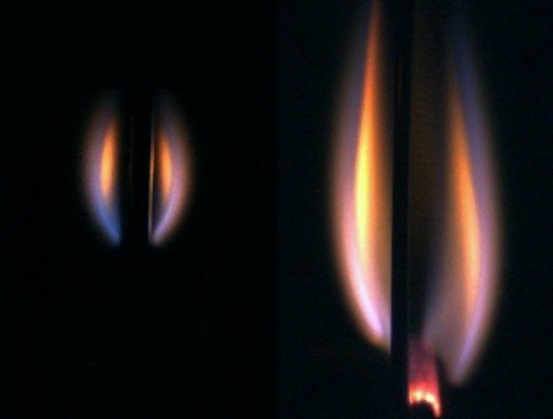
NASA is preparing to attempt something no space agency has done before: deliberately ignite fires on the Moon. The goal is to understand how flames behave in lunar gravity and how to better protect future Artemis astronauts.
Why NASA Wants to Start a Fire on the Moon
For years, NASA has studied how fire behaves in space. Experiments have included tiny flames aboard the ISS and controlled burn tests inside Cygnus cargo spacecraft. Those studies help shape NASA’s fire-safety rules, including the NASA-STD-6001B standard. It uses a six-inch flame test in Earth gravity to determine whether materials are safe for spacecraft and support equipment. However, the problem is that nearly all of these tests are done at 1 g, or normal Earth gravity.
NASA’s current standards generally assume that if a material passes on Earth, it should also be safe in space. But recent modelling and partial-gravity experiments suggest that may not always be true on the Moon. This is especially important for future lunar habitats, which are expected to use oxygen-rich environments.
The FM2 Mission
To address this gap, NASA researchers have proposed the Flammability of Materials on the Moon (FM2) mission. FM2 would send a sealed combustion chamber to the lunar surface aboard a Commercial Lunar Payload Services (CLPS) lander, potentially in late 2026.
Inside the chamber, four solid material samples would be ignited under tightly controlled conditions. Some tests would use oxygen levels similar to those planned for future Moon habitats. The payload would include cameras, radiometers, and oxygen sensors. These instruments would track:
flame shapeburn speedheat outputgas changes inside the chamber
All data would be collected in real time. Because the Moon’s gravity is only about one-sixth of Earth’s, it is difficult to reproduce for long periods in laboratories, drop towers, or rocket flights. FM2 would provide the first sustained fire tests on another rocky world.
Why Fire Could Behave Differently on the Moon
Earlier studies suggest lower gravity may actually make some materials easier to ignite. One reason is a process known as blowoff. On Earth, rising hot gases and fresh oxygen flow can destabilise a flame and sometimes extinguish it. In lower gravity, that circulation is weaker. As a result, flames may burn longer or spread differently.
FM2 will test whether materials considered only marginally safe on Earth could become flammable in lunar conditions, especially in oxygen-enriched habitats. The findings could directly influence future NASA fire-safety standards. They may also shape the design of lunar habitats, spacesuits, cables and wiring, wall panels, and interior fabrics
Closely Linked to Artemis
The timing of FM2 is no coincidence. Artemis II has recently demonstrated a crewed mission around the Moon. Later Artemis flights are expected to support a lasting human presence near the lunar south pole. That means fire safety is becoming a real operational issue, not a theoretical one.
Researchers behind FM2 describe the mission as a way to gather “benchmark data” for future fire models in partial gravity. They also note that full-scale fire testing on the Moon will likely only happen once a permanent outpost exists. Robotic missions like FM2 are therefore the first step.