
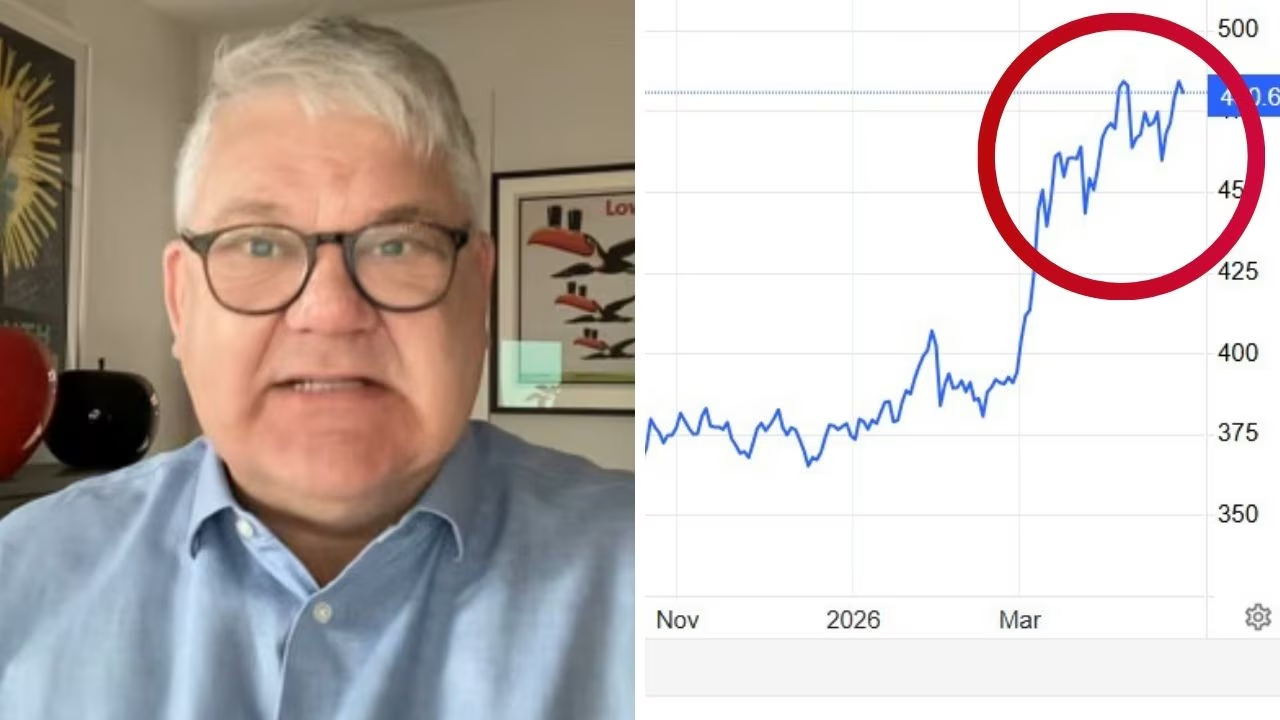
A leading economist has issued a stark warning as a key global index hits levels that spell trouble for households across Australia.
Spiking commodity prices across the board, from oil to agriculture and base metals, mean higher global inflation is “as certain as night follows day”.
That is the call from leading economist Stephen Koukoulas, who said his favourite leading indicator for future inflation was at “near record highs”.
The CRB index has risen more than 80 points since the outbreak of war in Iran and was up 6.68 per cent in the past month.
But looking longer term, it has spiked by 32 per cent compared to the same time last year, and Mr Koukoulas said this could spell a change of tack from central banks around the world.
“Now, why I like the CRB index is that it’s a broader measure than the Reserve Bank index of commodity prices,” he explained in a video posted on Monday.
“This is a global index. So, for example … it has a very high weighting towards energy commodities, oil, gas, heating oil and those sorts of things.
“It has an even higher weight of weights for agriculture goes into food production, of course, and that’s things like corn, wheat, coffee, orange juice, those sorts of things which are very important for food and other clothing manufacture – an important part of inflation.”
He said the index also took the price of base metals such as copper, nickel, aluminium and precious metals such as gold and silver into account.
Then there were livestock indicators for lean hogs and live cattle: “So it’s a broad index of commodity prices.
“And when it’s going up and accelerating, it points to higher inflation,” he said.
“Because all of those things that I mentioned and several more … when they go up, you see the price of food, for example, going up.
“So if the wheat price increases or lean hogs increase, you’re going to get some inflation pressures there.
“But even a lot of the base metals … if those prices increase, they’re important inputs into a lot of the manufacturing process that’s going around.”
Australia faces a crucial fortnight with new inflation data, the next Reserve Bank interest rate call and the federal budget all due in the first two weeks of May.
AMP chief economist Shane Oliver told NewsWire that headline inflation could jump by as much as 1.5 per cent when the official data is released on Wednesday.
“We are going to see a spike,” he said.
“On our rough estimates, fuel prices rose by 30 per cent in the month of March – a bit less for petrol, a lot more for diesel – and that is on its own going to add more than one percentage point to inflation.”
Several top economists have predicted at least another two rate rises in 2026, potentially taking the cash rate up to 4.85 per cent.
Consultancy firm KPMG said in its quarter one 2026 economic outlook that the implications of the oil price shock felt across the world would take some time to fully play out.
It is expected, however, that the economic crisis will fuel higher prices across the globe.
“Inflation is expected to surge globally as oil is a ubiquitous input across virtually every sector within an economy; with food prices likely to feel the impact first, followed by other goods and services later in the year,” its report stated.
It forecast world inflation to rise from 3.4 per cent in 2025 to 4.8 per cent this year, before falling back to 3.5 per cent in 2027.
The US was predicted to hit a 4.7 per cent inflation rate, up from 2.7 per cent last year, according to the report.
Europe would also spike from 2.1 per cent to 3.6 per cent in 2026, KPMG’s forecasters have said.
The US Federal Reserve is set to hold a two-day meeting this week, with the central bank predicted to hold cash rates steady.
That is despite inflation concerns with US consumer inflation hitting its highest point in two years during March, fuelled by elevated energy costs.
It is one of a host of major central banks sitting down this week, with the European Central Bank, Bank of Japan, Bank of England and Bank of Canada all meeting.
Mr Koukoulas wondered if the US central bank “will sound a little bit hawkish” at its next meeting and flag an intention to put up interest rates.
“So keep watching commodity prices,” he said.
“They’re a really good leading indicator of global inflation.”