
Thank you for subscribing to my posts. If you’re not yet a paying subscriber, please consider becoming one. That’ll allow you to DM me with questions and comments. I plan to move my posts behind a paywall in coming months. Subscribing now locks you in at a low rate. Thank you so much for your support and feedback!
As a former currency strategist, I have more than my fair share of spectacularly wrong forecasts. One of these was a Goldman Sachs top trade for 2015. I recommended going long the Swedish Krona and to fund this long position by going short the Swiss Franc. My rationale was that the Swiss central bank had a cap on how much the Swiss Franc could strengthen, while the Swedish Krona was very undervalued. This sounded good on paper, but then reality intervened. On Jan. 15, 2015, I was presenting Goldman’s FX outlook to local investors at the Hilton in Frankfurt. My presentation was supposed to go from 8:30 am to 9:15 am, but five minutes into my spiel there was huge commotion and the conference room emptied in the space of seconds. What was left over looked like a disaster movie. Overturned chairs, spilled cups of coffee and breakfast Danishes with bite marks on them. Switzerland’s central bank had given up on its commitment to cap Swiss Franc strength and my top trade – within seconds – was down 80 percent. I got back to my hotel room to find a message from Lloyd Blankfein’s office that he’d like to talk to me. I spent the rest of the week zigzagging across Europe, convinced I was about to be fired. When I finally did talk to Lloyd, he wanted to be briefed on the Euro, which was falling sharply in anticipation of ECB quantitative easing (which is what had driven Switzerland’s central bank to abandon its cap on the Franc). I didn’t get fired and the next few months were some of the most exciting of my life.
Forecasting currencies is tough, but forecasting GDP growth is just as treacherous. In today’s post, I’m going to kick the tires on the growth consensus for Europe. The IMF a few weeks ago projected annual average growth of 0.8 percent this year for Germany, 0.9 percent for France, 0.5 percent for Italy and 0.8 percent for the UK. None of these numbers look that bad, but – when you look at the quarterly path for GDP they imply – growth is basically flatlining in all of them. This means it doesn’t take much to tip them into recession and there’s a high risk this shock does exactly that.
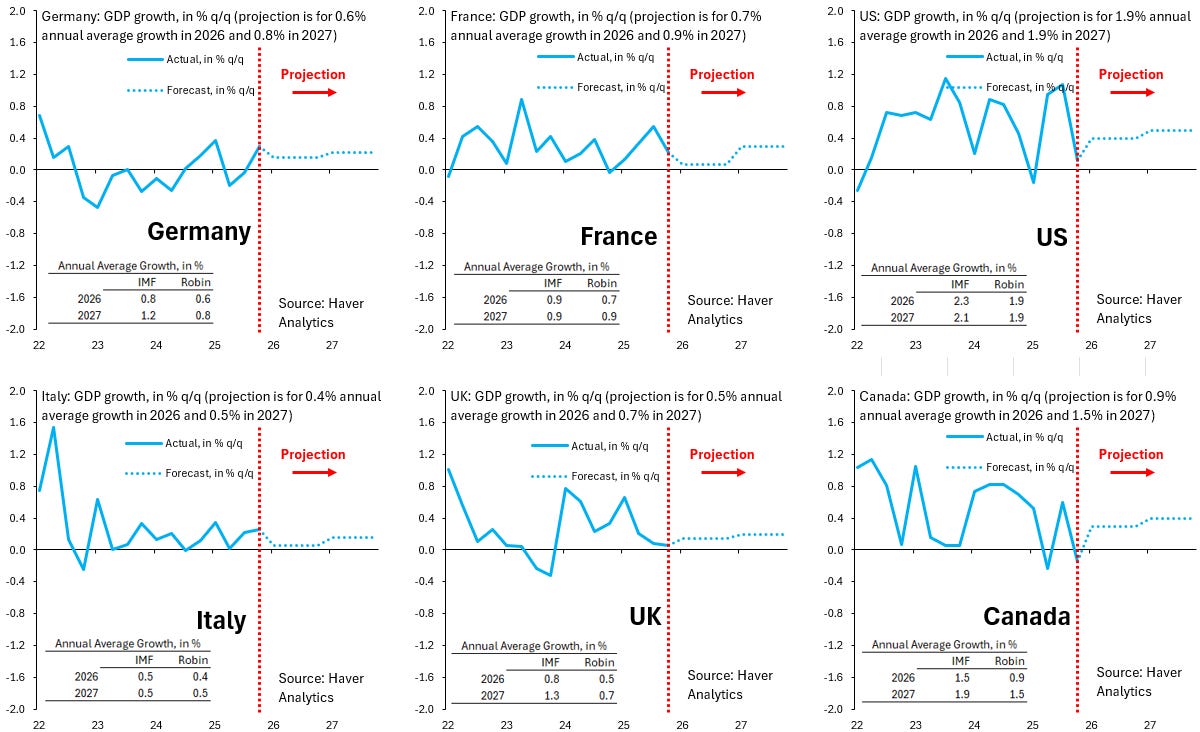
The six charts above all have the same scale and format. They show quarter-over-quarter real GDP growth (not annualized) for Germany (top left), France (top middle), the US (top right), Italy (bottom left), the UK (bottom middle) and Canada (bottom right). The solid blue line is actual growth, while the dotted line is the pace of growth needed to meet annual average growth in the bottom left table of every chart. I’ve weakened things a bit from the IMF forecast, but what stands out regardless is that projected growth for Germany, France, Italy and the UK barely slows from its recent pace. If anything, it looks like it’s on the optimistic side for Germany and the UK. Contrast that with the US, where projected growth is clearly weaker compared to recent years. If the US is going to weaken in the current environment, then it only stands to reason that Europe will too. This means that recession risk for Europe is material. Growth has been so anemic that it takes little to push the region into recession. This shock might just do that.