


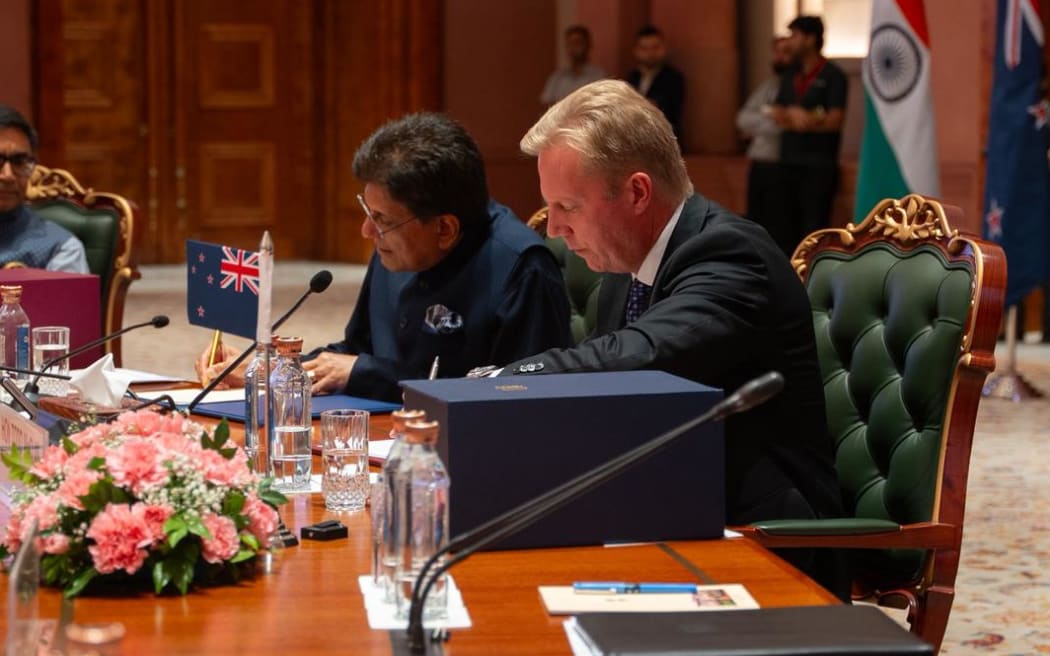
Indian Commerce and Industry Minister Piyush Goyal and New Zealand’s Trade Minister Todd McClay sign the free-trade agreement.
Photo: Supplied
New Zealanders will be able to see the full details of the India free trade agreement for the first time on Tuesday, after a formal signing ceremony in New Delhi overnight.
Trade Minister Todd McClay signed the deal alongside India’s Commerce and Industry Minister Piyush Goyal in New Delhi on Monday night, which means the deal can go through Parliament – setting up a race against the EU for Favoured Nation access.
Just ahead of the ceremony, he told RNZ the deal was very important to New Zealand’s economic future.
“It’s a great day and very exciting for New Zealand. We are taking the next step to have unprecedented access to 1.4 billion consumers,” he said.
“The very first negotiation ever between India and New Zealand was 16 years ago this month, there’s been many stops and starts … this is quite significant.
“We’re seeing India doing trade deals with Australia … the EU; the UK. This not only levels the playing field so New Zealand exporters can be treated fairly in this market, in some areas it gives us advantage.”
That would be particularly true if New Zealand’s FTA came into force faster than the EU’s, because that would mean securing access to a Most Favoured Nation clause for wine and services exports.
McClay said that would be worth tens of millions of dollars in additional exports, and last week said he had not had formal advice on when the EU agreement was set to take effect.
“Generally it takes them quite a long time on their side although they have a new procedure where they can implement it early … but we do still have time between now and when Parliament rises to get it in place.
“This is a very straightforward agreement.”
McClay also signalled to RNZ that businesses were expecting to make announcements imminently.
“You’re likely to hear in the next couple of days about some businesses up here that will be announcing their own investment in India, setting up offices here – because they can see real opportunity on the ground as a result of the FTA.”
With the signing complete, the deal would be tabled in Parliament on Tuesday – giving the public a chance to read the full detail of the agreement – alongside an analysis of whether it met a national interest test.
New Zealanders will be able to see the full details of the India free trade agreement for the first time on Tuesday, after a formal signing ceremony in New Delhi overnight.
Photo: Supplied
That provided for public submissions before the text returned to Parliament, after which enacting legislation would also be passed – with the usual process for submissions – to lower tariff rates and set up quota systems.
McClay acknowledged, however, there would be little opportunity for change to the agreement itself.
“If there are views about the way that the quotas should be administered that actually make more sense, the committee has the opportunity to report to Parliament of any changes there,” he said.
“The process we go through is the same for every other trade agreement New Zealand has entered into force … it’s very high quality agreement, it upholds the reputation that New Zealand has. I think people are going to be quite surprised by just how detailed and how much opportunity there is.”
Labour and New Zealand First had raised concerns the deal was signing New Zealand up to a clause committing to US$20 billion in private investment within 15 years, but McClay said he and the business sector were unconcerned.
He said the text only required the government to promote that investment.
“It is to promote only. The text is very clear, as are legal advice and I think the Labour Party has had a chance to go through all of that and you will have heard them last week also confirm or recognise it is a commitment to promote.
“New Zealand takes its obligations under trade agreements very, very seriously – probably one of the best in the world for the way that we honor those commitments. I and the business community have told me they have no concerns about what’s in the agreement.”
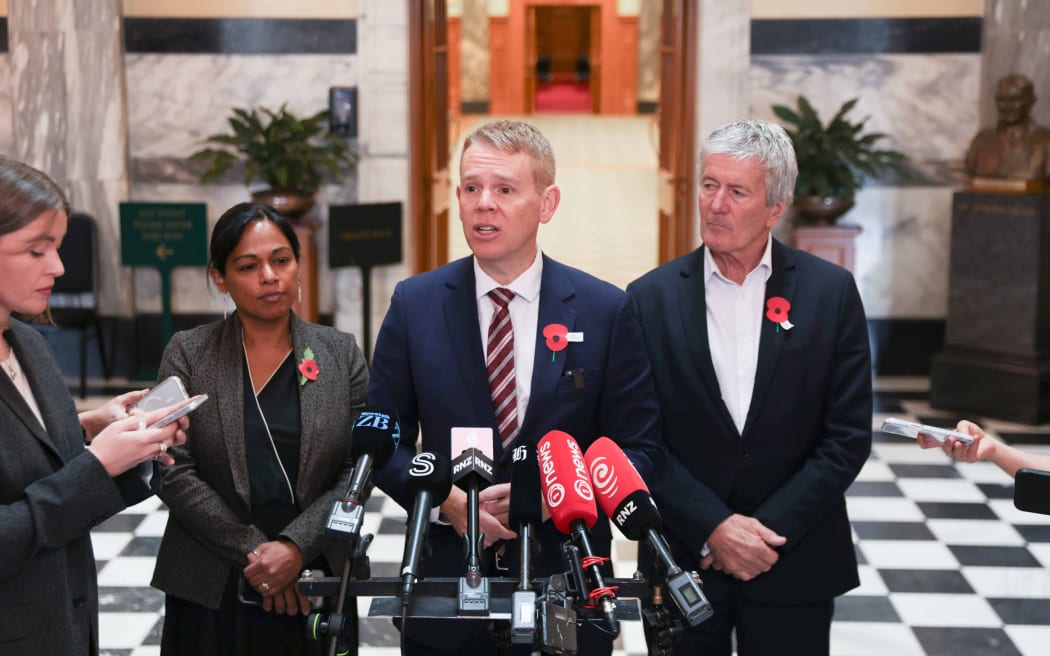
Photo: RNZ / Samuel Rillstone
He said that if at the end of the 15 years India believed New Zealand had not honoured the commitment, it could begin “a very long process over the number of years … where we enter into dialog and discussion, including at ministerial level”.
“Should they still believe that, then they have the ability … to put in place some temporary and proportionate measures around access.
“I think that actually, you know, the relationship is going to start growing significantly.”
Documents from India’s government said it was one of the fastest deals the country had secured.
It was New Zealand’s second-fastest, behind the UAE deal McClay secured in just three months.
Despite that, McClay was confident it had not been rushed.
“We have taken what would normally be a three or four year negotiation and compressed it into nine months. This is my eighth visit to India. My negotiators were here 21 times.
“We have worked around the clock to deliver for New Zealand exporters. It hasn’t been rushed. We’ve just rolled our sleeves up and worked as hard and fast as we can.”
Labour says deal is ‘totally unrealistic’
Despite giving its blessing for the coalition government’s free trade agreement with India, Labour has concerns New Zealand’s obligations are “totally unrealistic”.
The Council of Trade Unions said signing the deal before the public had a chance to see it could mean exploitative labour conditions could be enshrined. President Sandra Grey said there had been a complete lack of consultation with unions and the public.
And the The Maritime Union of New Zealand last week called on the government to hold off signing the deal until it publicly released the text.
Labour leader Chris Hipkins echoed those concerns on Tuesday.
“I wouldn’t say we were happy to support it. We certainly weren’t going to block it. There’s some very good news for New Zealand exporters there – the increased access for things like kiwi fruit, New Zealand wine and so on, New Zealand lamb, these will be very good things for New Zealand exporters,” he told Morning Report.
“But there are some risks in it, and so we’ve said to New Zealand exporters, ‘You’ve got to do your own due diligence and go into this aware of those risks.’ … It’s not a deal that Labour would have negotiated.”
Under the deal there was an expectation the New Zealand government would promote up to $33 billion of private sector investment in India over the next 15 years. If it fell short, India could revoke market access for some agricultural sectors.
“The idea that we could spend up to $34 billion [sic] in India over the next 15 years is totally unrealistic,” Hipkins said. “We don’t have $34 billion to send out of the country to India. You know, if we have that kind of money, we need to be investing it here in New Zealand first and foremost.
“But also, compared to outbound investment to every other country, it’s just totally unrealistic… I think had they got us on board, we would have said, ‘Look, we think these are things that New Zealand shouldn’t be signing up for.’ They didn’t do that.”
He said New Zealand had for several decades ensured major trade deals were bipartisan efforts.
“Simply negotiating a deal and saying to the other side, ‘Here, you have to support this now and be bipartisan,’ that’s not bipartisanship.
“I think these investment provisions are ones that we would have pretty strenuously resisted because they are unprecedented. We haven’t had them in other trade agreements. And New Zealand won’t be able to meet those requirements.
“And so hence, you know, there’s a real risk to our exporters that the gains that they’ve made through this trade deal could be clawed back on the India side because we haven’t met our obligations.”
Hipkins was not concerned about what New Zealand First’s Shane Jones controversially described as a “butter chicken tsunami” of immigration, saying Indian workers allowed in under a new visa “could come to New Zealand under our existing skilled migration visa settings anyway”.
Sign up for Ngā Pitopito Kōrero, a daily newsletter curated by our editors and delivered straight to your inbox every weekday.