
Have you ever had someone close to you – a sporting team-mate, a work colleague, a family member – succumb to a full-on meltdown in your presence?
Plenty of you have.
Drugs, mental illness and stress all create a black void into which human beings dive.
Sometimes it is self-inflicted, sometimes inevitable gravity.
Football has plenty of examples.
The toll of expectation, of pressure, of being outstandingly good at something beyond the capacity of 99.9% of the population, builds and builds.
And then it all falls down.
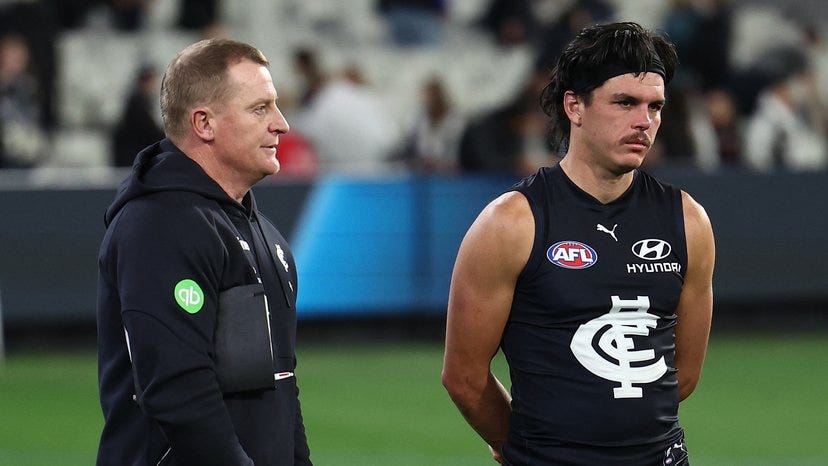
That appears to be what happened to Carlton footballer Elijah Hollands last Thursday in front of 78,000 live spectators and several million people watching on television.
No episode of the confected reality shows that pollute our TV screens has ever been as raw or mesmerising.
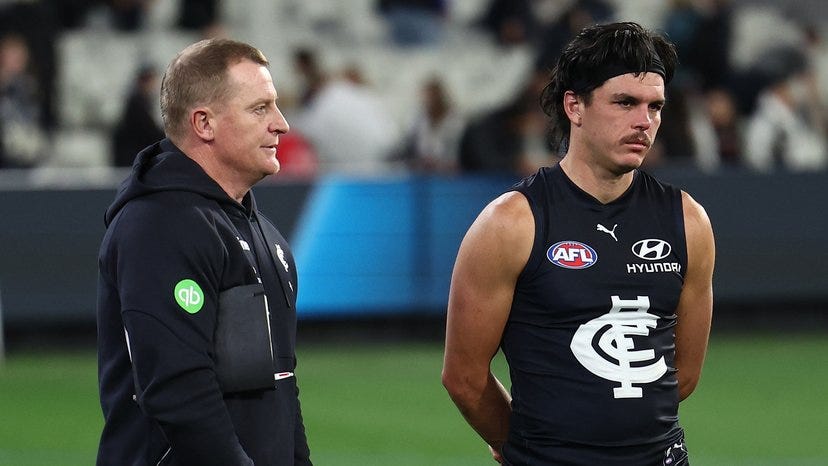
Michael Voss and Elijah Hollands after the match against Collingwood.
OJ Simpson’s low-speed cop chase through Los Angeles in 1994 had nothing on the Hollands show.
A day or two after an AFL captain, his family and his club went into mourning over the suicide of his brother, Hollands freelanced an exhibition that underlined the fragility of the individuals who underpin the nation’s most brutal and scrutinised sport.
Geoff Hayward’s gazing at seagulls while play continued around him, a staple of the insightful movie The Club, came to mind as Hollands wafted around the MCG.
A morality tale garbed in footy jumpers conceived by playwright David Williamson and brought to life by film director Bruce Beresford, Hayward’s naïve character is ostracised by his team-mates and criticised by his coach as he struggles to deal with the expectations of his high-priced recruitment.
The Club was half a century ahead of its times.
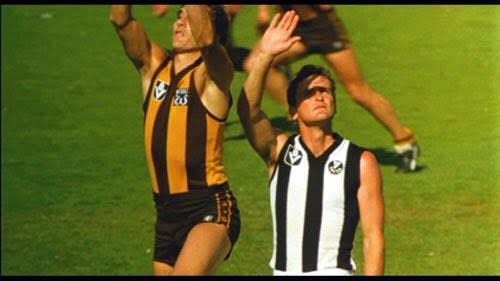
Geoff Hayward’s gazing at seagulls was channelled 50 years later.
There is no suggestion that Hollands was offside with his fellow Blues but his breakdown, in front of seemingly oblivious club officials, coaches and players, was no less confronting.
He has since checked himself into hospital for a break from the spotlight as much as the chance to regain his equilibrium after what might have been an out-of-body experience.
Part of the shock that reverberated from Hollands’ scene was that it occurred in an arena where the participants are lauded so widely and rewarded so handsomely for their rare athleticism, discipline and skill.
Human frailty is such an unexpected character on football’s biggest stage that it seems impossible to recognise its presence.
Yet the challenges that exist for ordinary people in normal life, those people who grind their way through their working days and somehow find a way to play their mortgages on time no matter the distractions, still resonate with the stars on the MCG.
Nine Australians kill themselves every day. They each decide that ending it all is a better solution to their woes than continuing to battle them day by day.
No matter whether those members of the deadly nine are AFL premiership players or ordinary citizens without a profile, the demons that overwhelm them are indifferent to their fame or exquisite hand-eye co-ordination.
Let’s hope that Hollands can find a way through the maze that was pressing in on him last Thursday.
It is a different story for his club and the league that oversees the game at the elite level.
“The health and wellbeing of every player is the AFL’s highest priority,” head office said in the fallout of the Hollands affair.
It was still reeling from the farcical Butters tribunal hearing when Hollands fired another warning shot about its operational capacity.
This is a body that embraces gambling as an ever-present part of the football environment, that actively designs methods for players to avoid the consequences of illicit drug taking, that compromises on integrity matters yet puts brand protection above all.
And their culpability is not even as significant as that of Carlton.
It is impossible to reconcile the club’s actions with the AFL’s words.
Every day that passed after the Carlton match ushered in another breath-taking revelation.
CEO Graham Wright started it.
“We’re looking into all that right now,” he said after admitting that Carlton were aware on the night that Hollands was struggling to keep it together.
Hollands would have been taken off the ground in an instant if he had twisted his ankle.
He would have had a compulsory concussion test had he received a knock to the head.
Yet dance around the field unconscious of the action around him while jittering and waving his arms as though he was in a tiny confused universe of his own imagining, and the club was not prepared to do anything until the very last minutes of the two-hour match.
What if Hollands had run heedlessly into a pack and been catastrophically hurt?
What if he had caused, whether through an accident or clumsy participation, a team-mate or opponent to sustain a career-ending or life-changing injury.
Players take a calculated risk that the 100kg monsters forever charging at them at 30kmh will actually act in their best interests should they end up in the same place at the same time.
But if the other player is incapable of making that split-second assessment?
Where would the liability lie if a loose cannon fired a deadly shot on the field without knowledge or care for the result?
Carlton abandoned player safety and adequate risk management in the most cavalier fashion last Thursday.
When Melbourne allowed Christian Petracca to return to the field with broken ribs, a punctured lung and lacerated spleen after an on-field collision in 2024, the turmoil created a wave that eventually forced the player, his coach and several team-mates from the club.
That was simply one injured player. This incident is much worse.
Carlton is already dealing with a squalid defamation matter involving the most recent president and his estranged wife that could entangle high-ranking AFL officials in its grubby net.
Now the Carlton CEO, football manager, coach, medicos, players and support staff are likely to be scrutinised about what they knew and did with Hollands.
It is impossible to see every one of them surviving this ordeal; it would not surprise if one or more of the most prominent names found their positions untenable within days or weeks.
Geoff Hayward’s pivotal line in The Club revealed that he “was sick of football”.
Elijah Hollands might not be sick of football but his episode underlines that there is certainly something sick about the game at the moment.