

Earth formed billions of years ago through a gradual process of accretion, gathering dust, rocks, and planetesimals over tens of millions of years. That process left behind asteroids and meteorites, which still carry chemical clues about the early Solar System and its structure.
Researchers have long debated whether Earth’s composition reflects local material or a mixture that includes contributions from outer regions. A recent study led by Paolo Sossi and Dan Bower of ETH Zurich uses isotopic evidence to clarify this question, offering a more precise picture of how our planet came together.
Isotopic Evidence Reveals Two Distinct Material Reservoirs
The study focuses on nucleosynthetic isotope anomalies, subtle chemical signatures inherited from the stardust that formed the Solar System. These anomalies differ between meteorites and planetary materials, allowing scientists to trace their origins.
According to the study published in Nature Astronomy, meteorites fall into two main categories: carbonaceous and non-carbonaceous. Carbonaceous meteorites, rich in carbon and often containing water and embedded fragments like graphite and diamond, are associated with the outer Solar System. Non-carbonaceous meteorites, by contrast, originate in the inner Solar System and contain less carbon.
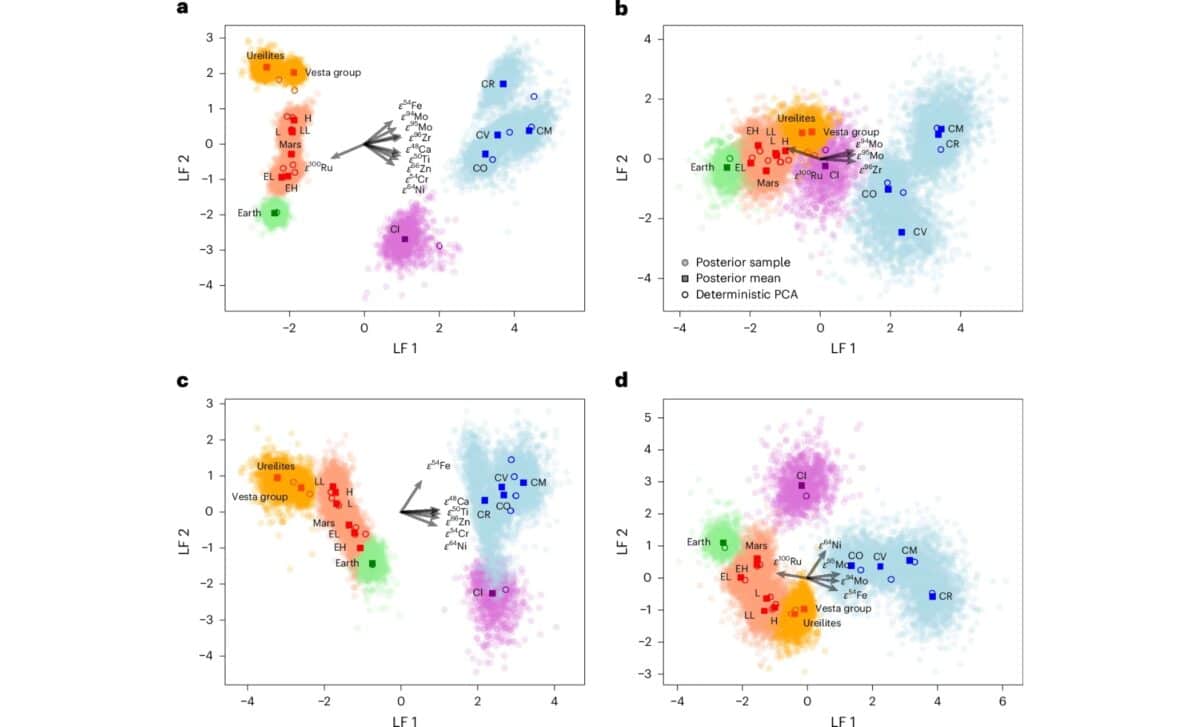 Results of the B-LFA and deterministic PCA – © Nature Astronomy
The researchers analyzed isotopic variations in meteorites, planetary samples, fragments from the asteroid Vesta, and meteorites linked to early Mars. Their work builds on what they describe as an “isotopic dichotomy,” a division that has reshaped understanding of how planetary materials are distributed across space.
Jupiter’s Formation Created a Barrier in the Early Solar System
The study highlights the role of Jupiter in shaping this distribution. As the gas giant formed, it accumulated massive amounts of gas and dust left over from the Sun’s formation. Its gravitational influence became strong enough to disrupt the surrounding protoplanetary disk.
According to Popular Mechanics, Jupiter effectively acted as a barrier, preventing material from the outer Solar System from moving inward. This separation created two distinct reservoirs of matter, limiting the mixing of carbon-rich outer material with the inner region where Earth was forming.
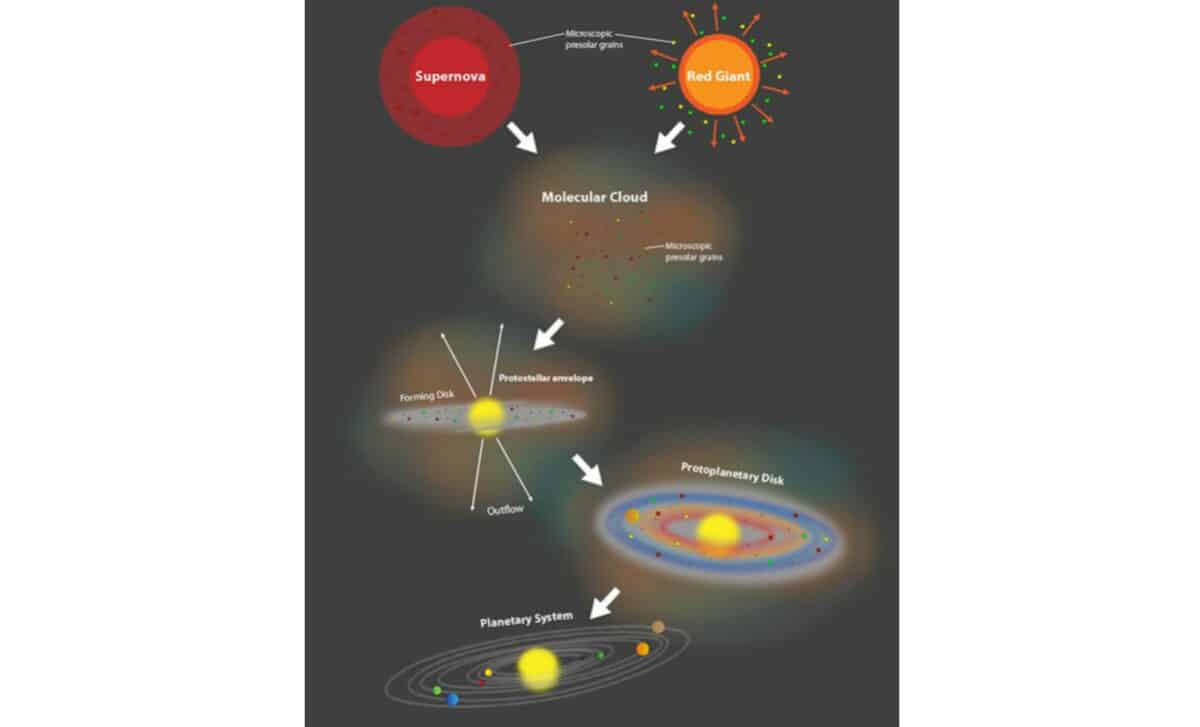 A schematic depicting the main stages of Solar System evolution – © Oxford Research Encyclopedias, Planetary Science.
While some uncertainty remained about whether material could cross this barrier, the analysis by Sossi and Bower indicates that very little, if any, outer Solar System material became part of Earth’s original composition.
Earth Formed Mostly From Local Material Despite Later Additions
The findings suggest that Earth is largely composed of material from the inner Solar System. Despite being made of diverse components, the planet is considered isotopically homogeneous, meaning its building blocks share a common origin.
“Our analysis shows that all elements, irrespective of their geochemical character or nucleosynthetic origin, record the same isotopic origin,” the researchers state in their paper. This consistency supports the conclusion that Earth formed locally, around 4.6 billion years ago.
At the same time, the study acknowledges that some elements essential to life may have arrived later. Water, and possibly carbon, could have been delivered by impacts from outer Solar System bodies during the later stages of Earth’s formation or shortly afterward.