
“I’m completely aware of the creditors that we have and payments outstanding. But we do have a plan about what we’re doing and we haven’t stopped fundraising,” he said.
Diarmuid Hudner, the founder and group chief executive of CyberSmarties, says he “refutes” the allegations but acknowledges unpaid debts.
Wellington-based Aisling Waldron, formerly the leader of digital safety at the Department of Internal Affairs (DIA), was headhunted by Hudner in early 2025 to head global monitoring at CyberSmarties, but later found herself becoming chief whistleblower.
Hudner had presented a report to the DIA claiming CyberSmarties had a million users and was a solution to the growing problem of youth harm caused by social media use.
He claimed to be endorsed by the Irish police and prominently used the Garda crest on his website and in company documents – an endorsement the Garda told the Herald had lapsed.
“I was led to believe that it was a really robust company that had users across the world,” Waldron said.
“I was really flattered, this sounded like an incredible company and he seemed to be a really successful businessman, really well-connected. Seemed to know his stuff,” Waldron said of Hudner.
“Everyone I met, any people working in the online safety space, friends, family, my husband and every single person just said, ‘you’d be crazy not to take it’,” she said.
She signed on for an agreed €100,000 ($198,202) salary, soon bumped up to €150,000.
And then the cracks started appearing.
In the middle of last year, newly-hired staff, including Waldron, found their salaries weren’t going through and attempts to chase this up with Hudner were met with an increasingly bewildering series of stories about imminent billions.
The Herald gained access to over a thousand internal and external company communications, including executive group WhatsApp chats and emails, that show Hudner spent six months in 2025 putting off paying staff and other creditors while chasing a range of extraordinary investment deals that can at best be described as hopeful.
There was a signed “Letter of Intent” said to show the Portuguese Government was to invest €1.3 billion to buy 45% of the company. That document, shown on a video call to staff, records the counterparty as an individual living in Luxembourg who the Herald has been unable to find on LinkedIn or corporate databases.
Another purported deal saw Hudner send four pictures of stacks of used Indian bills tied together with multi-coloured rubber bands.
This was said to be a downpayment on a purported £375 million investment being made by an Indian telecommunications giant.
Images of Indian cash shared by Diarmuid Hudner to Cybersmarties staff purporting to show the downpayment on an imminent £375m investment into the company. The cash never arrived.
Waldron said at the time, in response to the images Hudner posted: “Jesus Christ, that looks like an illegal drug deal.”
Then there was a proposed €150m contract with the Crown Prince of Bahrain – staff were told they’d have to imminently fly to Manama for “protocols” – and €15m was due from the Vatican Bank.
None of these “investment deals” culminated and staff remained unpaid.
Waldron resigned in October after not being paid a cent in salary for six months of work.
Hudner insisted all the proposed deals were legitimate, but declined to discuss details.
“For NDA [non-disclosure agreement] reasons, I can’t discuss individual investment discussions. I’m not allowed to,” he said.
Hudner denied he traded while insolvent and said he had only erred by scaling up in good faith – and hiring staff like Waldron – in anticipation of receiving promised investment funding.
“At that point in time, contracts have been signed … We went on full-scale on that basis,” he said.
But back to earlier in 2025, when Waldron was starting work: one of her first jobs was putting out a fire at Howlett’s CSNZ.
Internal company documents record concerns about posts by CSNZ users at Pakūranga Intermediate.
Hudner told staff there had been a breakdown in monitoring and he was intending to close down Howlett’s CSNZ: “I will be axing him,” he said. “He will be relieved of his duties.”
The chats record Hudner saying he followed through the following week in an “awkward” meeting with the former All Black.
This week, Hudner backtracked from his earlier communications and said blame for problems at CSNZ was later apportioned to a “new monitoring staff member who didn’t understand the platform properly”.
He added that Howlett was a “person of very high ethical standards” and he looked forward to continuing to work with him.
Doug Howlett during his playing days. Howlett, a prolific winger for the All Blacks and Munster, set up the New Zealand franchise of CyberSmarties in 2022. Photo / Photosport
Howlett also had a distinctly different recollection of that period than portrayed in Hudner’s contemporaneous messages.
“I’ve been continuing on as normal for the last year or so, and in contact with Diarmuid around this, actually, so I’m surprised to see that messaging,” he said.
Howlett said CSNZ had gone into “hibernation” around this time, given proposed social media bans in Australia, and later New Zealand, posed an existential threat to the CyberSmarties business model.
Investigations by the Herald also show a significant part of CSNZ’s business to date has been funded by Howlett’s own charity – the Doug Howlett Outreach Foundation.
Charities Register accounts filed for Howlett’s foundation show its primary activity in recent years – $75,000 across 2023-24, accounting for 99% of expenditure – has been to fund CSNZ.
Notes to the accounts state Howlett was a related party as a director of CSNZ, but do not disclose his management and shareholding.
Charities Services registrations manager Metua Sadler said: “This matter has not previously been brought to our attention and we are therefore not in a position to comment substantively. While related-party transactions are not prohibited in themselves, care does need to be exercised to ensure they are managed within the rules.”
She added: “As this matter has now been brought to our attention, we will be looking into it to determine whether further inquiries are needed.”
Howlett defended his charity’s spending and said the conflict was properly declared.
“It’s there in black and white,” he said.
“We can follow the paper trail – funds directly to the schools for the product and the schools benefited from this product. I can stand over this wholeheartedly that was for its purpose, which was to help New Zealand children,” he said.
Howlett said recent heavy weather led him to compare his past and current careers: “Oh, look, it certainly has its challenges. There’s times where, you know, I’d love to just belt into people like I did on the field,” he said.
Doug Howlett presenting CyberSmarties NZ to the School Trustees Association conference in 2023.
In Australia, a year before Waldron started at CyberSmarties, educator Shari Brewer and her partner inked a memorandum of understanding and paid A$100,000 ($121,000) – their life savings – to start the Queensland franchise of the company.
She engaged lawyers to ensure a no-fault refund clause but, after suffering a family health crisis, elected to withdraw. She says she found difficulties in getting Hudner to repay them.
Brewer said she was placated with claims of imminent Saudi or Turkish millions that ultimately never eventuated.
Waldron said it was only in hindsight she could now properly recognise the situation she was in.
“I know that anyone can be a victim of these things, but you also never think it’s going to be you. I think when you’re in it, it’s a little bit like a case of the frog and boiling water. If somebody presents you with all of it at once, of course, it looks fake, but when it’s being drip-fed to you, it’s so believable.”
Waldron also contrasted the claimed million CyberSmarties users across a number of countries with what she found when given access to the company’s back-end as head of global monitoring.
“I saw a very, very bare-bones infrastructure. There were some users – I couldn’t tell you the exact amount – I would say there were a hundred users in Ireland, across a handful of schools. No users in Turkey, none in India, none in the US. None in South America or South Africa. None in Australia,” she said.
She said the number of New Zealand users were only “a couple of hundred”.
Hudner said the “million” claim referred to users since the company’s founding.
“We’ve been at this for 10 years, yeah, so, so it’s the cumulative over 10 years that we’ve had these numbers of users,” he said.
After leaving the company, Waldron started researching CyberSmarties and found a similar experience to hers – including Brewer – and the pair began to herd other CyberSmarties complainants from around the world.
“Aisling and I, I guess we sort of put the guts and the bones of this together, because we’re stubborn bitches who went on a mission and we had permission from everyone else who said, ‘yes, please, could you dig deep’,” Brewer said.
The pair said during this process, they grew to distrust Hudner further.
In April last year, Brewer was told by Hudner her refund had been delayed, again, this time by illness.
“I’ve got double pneumonia and haven’t been able to [do] much. I have to physically meet the accountant,” Hudner said on WhatsApp.
Three days later, with funds still not transmitted, he told Brewer: “I will get sorted as soon as I can get up and down the stairs without stopping to catch breath.”
But when Brewer and Waldron began comparing stories, they realised their dealings with Hudner crossed over. The week of the double-pneumonia claim was the beginning of Waldron’s employment with CyberSmarties, when she was in Limerick with her new boss.
“I met him in person. I was in Ireland for that first week I joined the company. He was perfectly fine. We had a great time: he was full of chat, we went out for lunch, he was absolutely in flying form,” she said.
Hudner said he could not recall this particular bout of illness and his simultaneous time working and lunching with his new hire.
“But what I mean, just the thing is, I can’t, I can’t remember. I mean, I can’t do it. I mean, I don’t know. I can’t recall it. I can’t recall it,” he said.
Waldron, Brewer and a number of other complainants in Australia and India have filed a criminal complaint of fraud with Irish authorities about Hudner and his company.
The Irish police said: “An Garda Síochána does not comment on named entities or persons.”
Waldron and Brewer both said they have recently given statements to a detective.
Hudner said he was unaware of the complaint and had “zero contact” with authorities.
“I’m sure if they thought there was something incorrect or improper, you know, or inappropriate or anything like that, they’d be at the door, and they haven’t [been],” he said.
He said he understood the position of Waldron and Brewer, and their lack of trust in him.
“I can understand where that’s come from. All I can do is continue to say this: once we have done that, they will get paid and [to] be honest, I would love that. I would love to have done that, like a year ago or whatever, it’d be the first thing that I’ll be doing, because I can do [it] without the pressure of it, with everything else.”
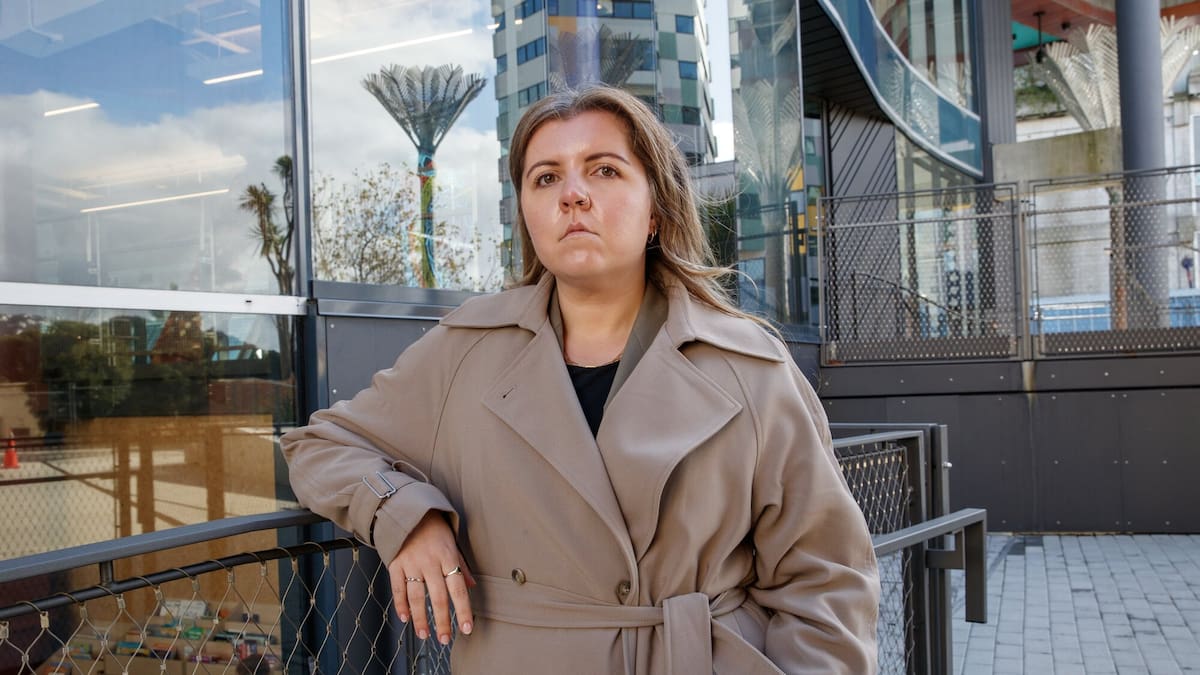
Aisling Waldron says she hopes going public, and to authorities, about her experience with CyberSmarties will result in justice being delivered. Photo / Mark Mitchell
Waldron said she hoped her complaint resulted in justice.
“I truly cannot explain the detrimental impact this had on my mental, emotional and financial wellbeing. It completely destroyed me. I felt ashamed, stupid. I didn’t want to leave the house,” she said.
“It completely ruined me and it’s only from connecting to other people and speaking out about it that I’ve realised that there’s at least 15 other people in the exact same position as me across multiple countries. And if I didn’t speak out, I would have never connected with those people, and they would have never known that they weren’t alone either.”
Matt Nippert is an Auckland-based investigations reporter covering white-collar and transnational crimes and the intersection of politics and business. He has won more than a dozen awards for his journalism – including twice being named Reporter of the Year – and joined the Herald in 2014 after having spent the decade prior reporting for business newspapers and national magazines.
Stay ahead with the latest market moves, corporate updates, and economic insights by subscribing to our Business newsletter – your essential weekly round-up of all the business news you need.