
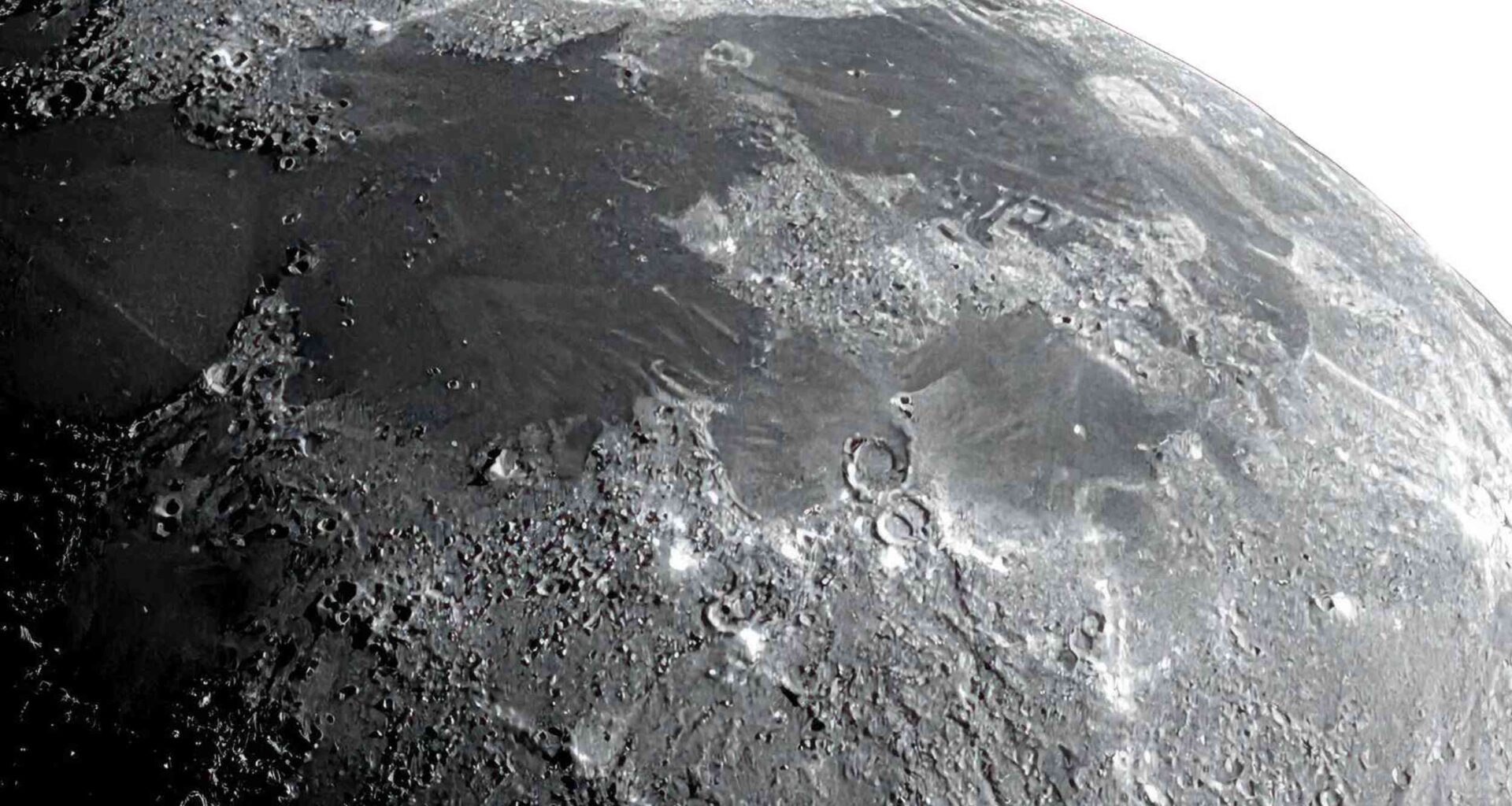
Researchers have found that newly formed lunar craters disturb the Moon’s surface over distances more than 1,000 times wider than the craters themselves.
That reach reveals a faster and more widespread reshaping of lunar soil, changing how scientists read the surface as a record of time.
Fresh scars revealed

Before-and-after views from the Lunar Reconnaissance Orbiter Camera (LROC) capture fresh impact sites surrounded by faint, far-reaching dark rays that extend tens of miles across the surface.
By tracing those patterns, Emerson Speyerer and colleagues at Arizona State University (ASU) documented how each new crater leaves a broad zone of subtle disturbance rather than a sharply bounded scar.
Across six recent impact sites, including one about 230 feet (70 meters) wide, the disturbed regions stretched far past the visible debris fields mapped in earlier work.
That mismatch between visible ejecta and the full extent of surface change shows that impacts reshape far more terrain than standard crater measurements alone would suggest.
Lunar dust color
Lunar impacts do more than dig holes. They churn up the Moon’s surface, disturbing layers of loose soil and broken rock known as regolith.
Over time, that exposed material does not stay the same. Sunlight, charged particles from the Sun, and constant micrometeorite strikes slowly wear it down in a process called space weathering.
As this process continues, weathered grains grow nanophase iron – tiny iron specks – and glassy clumps that make older soil darker and redder.
Fresh impacts reset that aging record by lifting cleaner grains and burying others before they age in place again.
Rays travel farther
Far from the rim, some new craters made dark rays that stretched far beyond maps of ejecta, thrown-out crater debris, even without thick blankets.
Earlier temporal imaging, before-and-after pictures of the same ground, had already found 222 new craters and faster soil overturn.
A March 17, 2013, impact had already shown thrown debris making small pits around a new 62-foot (19-meter) crater.
New 230-foot (70-meter) crater rays now extend that pattern beyond 1,000 crater diameters, exposing a wider disturbance zone.
Color marks limits
Color measurements narrowed the cause because distant dark zones did not turn bluer, redder, or visibly different.
A real coating of new material would have changed the spectral slope, how brightness varies across colors.
For the 230-foot (70-meter) crater, a thin layer would require 375 times more material than the crater excavated.
That mismatch points to scattered particles roughening the surface instead of painting it with fresh dust.
Angles expose roughness
Viewing angle revealed the dark rays because they looked stronger when sunlight struck and reflected obliquely during orbital observations.
Researchers tested that behavior with phase angle, the Sun-surface-camera angle, which changes how shadows appear.
Low-phase views could hide the marks, while higher-phase views made roughened dust stand out against calmer ground.
This contrast identified photometric roughness, or light-sensitive surface texture, rather than a chemical stain.
Crater rims differ
Near the crater rim, brighter and darker zones told a different story from the distant rays.
Blue-sensitive images showed cleaner subsurface grains in bright zones, meaning impact excavation lifted less-weathered material upward.
Darker nearby zones lacked that color change, which linked them to churned mature dust and small shadows.
Rim areas therefore carry both kinds of evidence: fresh material from depth and rough material from local fallout inside the ejecta blanket.
Apollo images help
Apollo astronaut photographs offered a ground-level check on how rough lunar dust affects brightness.
Boot scuffs darkened some soil because kicked grains made tiny shadow-casting textures across the surface.
Wheel tracks sometimes looked brighter after compaction crushed loose structure and reduced the number of small shadows.
Those human-made marks support the impact results, although rover tracks and crater rays form by different forces.
A younger surface
Young craters may fade from view faster than their sharp rims alone would suggest, especially in faint outer zones.
Earlier LROC work found that new impacts churned the top inch (2.5 centimeters) of soil in about 81,000 years.
Phase-dependent splotches, small bright or dark impact marks, now imply that some small disturbances went unseen when images used gentler lighting.
A crater’s age signal can therefore depend on when and how a spacecraft camera looked.
Lunar ice signals
Fast churning also matters for polar ice clues, not just for dating cratered ground.
Micro cold traps, tiny sunless pockets that can preserve water ice, may survive only thousands of years when smaller than 3 feet (1 meter).
If surface dust overturns rapidly, fresh ice signs may mark recent delivery rather than ancient storage.
Future landers will need lighting history, surface texture, and depth together before reading those frozen records.
A dynamic lunar surface
The fading rays, color limits, angle tests, and Apollo comparisons all point to a Moon with an active surface.
Better maps of young craters can sharpen space-weathering models and guide future sampling. However, optical images still cannot reveal how deep every disturbance reaches.
The study is published in The Planetary Science Journal.
—–
Like what you read? Subscribe to our newsletter for engaging articles, exclusive content, and the latest updates.
Check us out on EarthSnap, a free app brought to you by Eric Ralls and Earth.com.
—–