
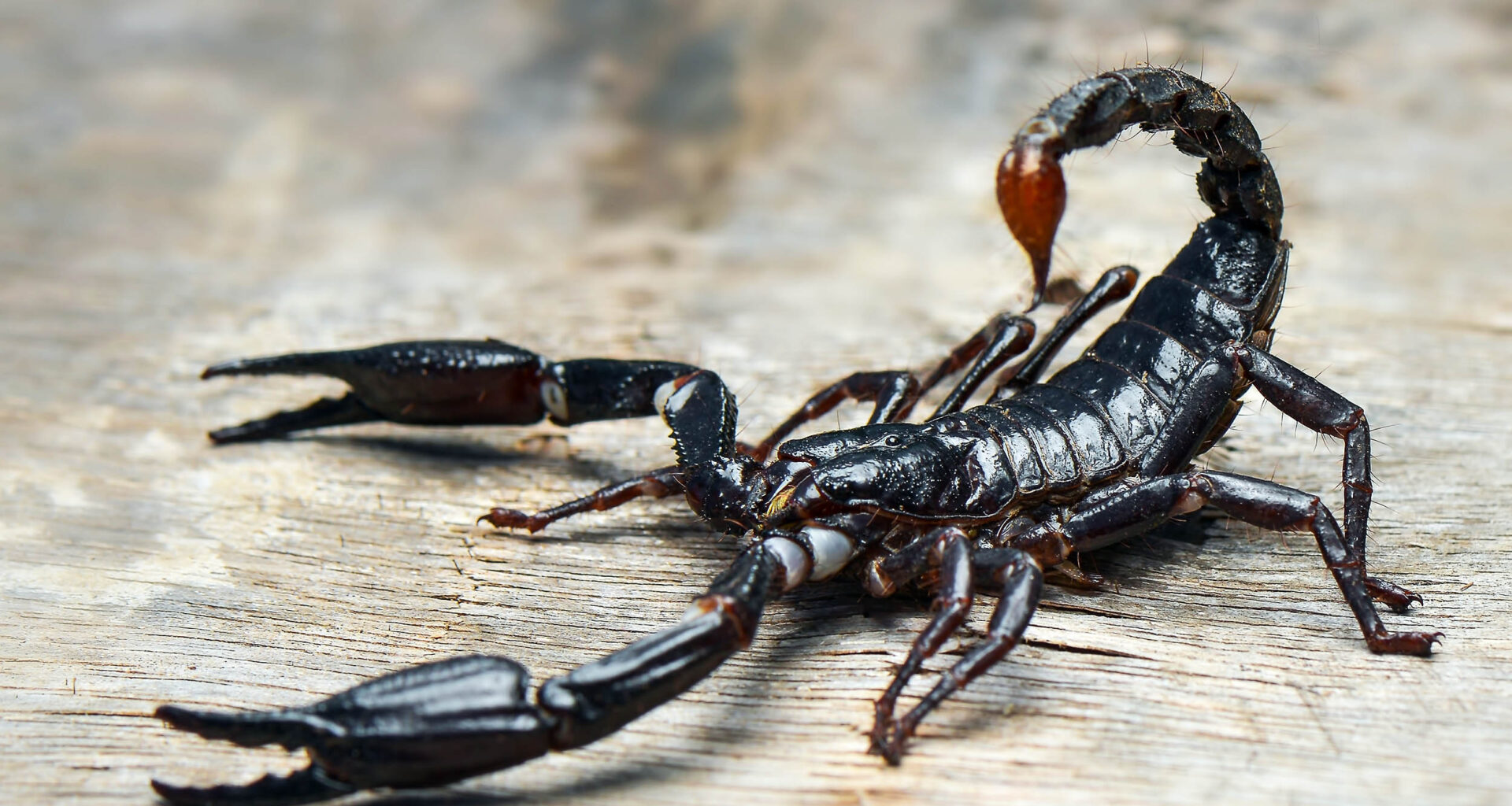
Scorpions have always captured attention with their curved tails and sharp stings. Most people see them as venom specialists, armed with chemical weapons designed to paralyze prey.
But recent research reveals a deeper layer to their biology. These animals do not rely on venom alone. They build their weapons using metals, turning their claws and stingers into finely engineered tools.

A recent study explores this hidden design. Researchers used advanced X-ray techniques to examine 18 scorpion species.
They found that metals such as zinc, iron, manganese, and calcium are placed in precise patterns inside the animals’ weapons. This discovery changes how we understand scorpions.
Scorpions are not just venom users. They are also skilled material engineers shaped by evolution.
The outer body of a scorpion is made of chitin, a tough material found in many arthropods. In areas that face high stress, this material becomes reinforced.
Metals mix into the structure during development, making those parts harder and more durable.
Scientists call these reinforced areas heavy-element biomaterials. They behave more like ceramic than simple biological tissue, giving scorpions a major advantage when gripping prey or delivering a sting.
“While we knew that metals strengthen the weapons in some species’ arsenals, we don’t know if all scorpions’ weapons contain metal, and if so, whether this metal enrichment relates to how they hunt,” said Sam Campbell, first author of the study.
“We decided to use microanalytical techniques to unravel where and how these metals are distributed in the scorpions’ weapons to offer a clue as to how and why metal enrichment has been carried through the scorpion family tree.”
Two weapons, two roles
Scorpions rely on two main tools. The stinger injects venom, while the pincers grab and crush prey. Both face intense physical stress, but they serve different purposes.
This difference led researchers to an important question: if a scorpion invests heavily in one weapon, does it reduce investment in the other? The answer turned out to be yes.
Zinc shifts between weapons
Zinc showed a clear pattern across species. Scorpions with zinc-rich pincers often had zinc-poor stingers. Others showed the opposite trend.
This suggests a trade-off. Adding metals to the body costs energy. The animal must gather these elements and place them precisely.
It cannot maximize both weapons at the same time, so evolution pushes a balance based on hunting style.
Iron varies across species
Iron followed a different pattern. It appeared mainly in the teeth of the pincers and mostly in one family called Buthidae.
This group includes many dangerous species such as deathstalkers.
This pattern likely began millions of years ago when this lineage split from others. Since then, iron has remained a key feature of their claw design.
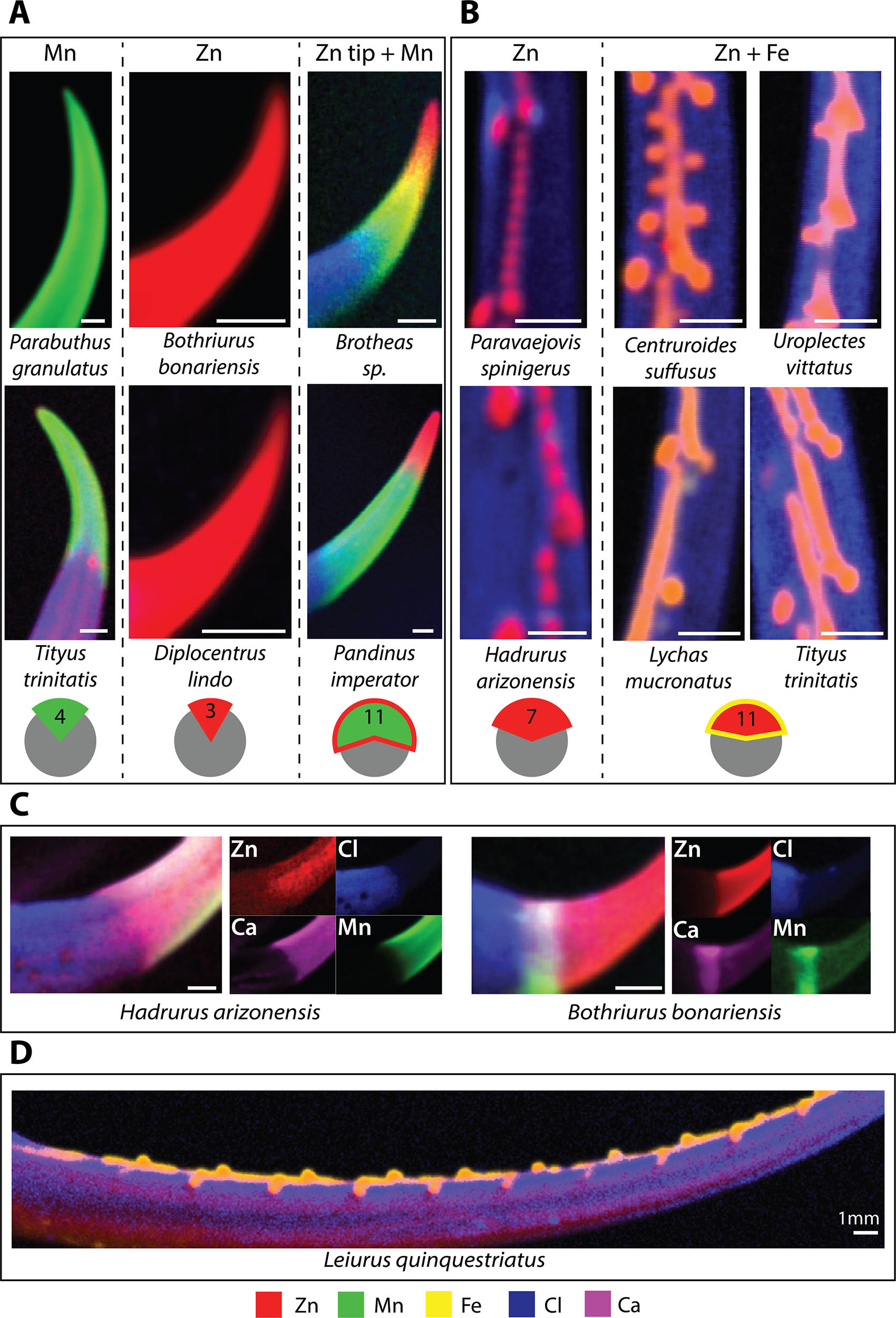 Scorpions’ body weapons, stingers and claws, are enriched with metals. Micro X-ray fluorescence microscopy of the telson and tarsus denticle enrichment patterns are shown here. Zinc (Zn) is shown in red, manganese (Mn) is shown in green, iron (Fe) is shown in yellow, chlorine (Cl) is shown in blue and calcium (Ca) is shown in purple. Credit: Journal of the Royal Society Interface. Click image to enlarge.
The stinger showed one of the most striking features. Metals concentrate heavily at the tip, where penetration happens. But halfway up the structure, the metals stop suddenly.
This creates a boundary between hard and softer material. Interestingly, many broken stingers in museum collections snap at this exact point. The boundary acts as a weak zone where stress builds up.
“The National Museum of Natural History’s large scorpion collection allowed us to analyze metal enrichment in a wide range of scorpion species, more than have ever been studied before using these techniques,” said Edward Vicenzi, research scientist at the Museum Conservation Institute.
“The microscopic-scale methods we used allowed us to identify individual transition metals in extremely high detail, showing us how nature skillfully engineered these metals in the scorpion’s weapons.”
Calcium and manganese often appear together in the stinger. Their overlap suggests they work as a team to improve strength and flexibility.
However, not all species follow this pattern. Some show calcium linked with zinc instead. This means there is no single formula.
Each species has its own design, and scientists still do not fully understand what drives those differences.
Weaker claws use more zinc
One surprising result involved claw shape. Thin, long pincers, which are weaker, contained more zinc than thick, powerful ones.
This goes against expectations. Strong claws might seem like they need more reinforcement. But the data shows that weaker claws rely on metal at key points to stay effective.
Zinc may do more than increase hardness. It may also improve durability and resistance to wear. This helps slender claws grip prey without damage.
“This points to a role for zinc beyond hardness, perhaps playing a bigger role in durability,” Campbell said.
“After all, long claws need to grasp prey and prevent it from escaping before being injected by venom. This is an interesting finding because it suggests an evolutionary relationship between how a weapon is used and the specific properties of the metal that reinforces it.”
Inside some stingers, the venom ducts had zinc-rich linings. This may not be just for strength. Zinc plays a role in certain enzymes found in venom.
Its presence near the venom pathway may help chemical processes during venom delivery.
The researchers introduced a new way to compare metal content. They call it the heavy-element biomaterial ratio. It measures metal levels relative to carbon.
This method helps scientists compare results across species and studies more easily.
Many mysteries still exist. Scientists do not fully know how scorpions gather these metals. Diet likely plays a role, but details remain unclear.
Environmental factors may also matter. Soil composition and habitat could influence metal availability. Age and life stage may also change how metals are used.
A long evolutionary story
Scorpions have existed for over 300 million years. Over that time, they have refined both venom and structure to survive.
“Not only does our work illustrate the material properties of scorpions’ weapons, but it establishes a new approach toward analyzing the role of metal enrichment across the tree of life,” said Hannah Wood, senior author of the study.
This research adds a new dimension to how we view these animals. Their weapons are not just biological. They are carefully built structures shaped by chemistry and physics.
The study is published in the Journal of The Royal Society Interface.
—–
Like what you read? Subscribe to our newsletter for engaging articles, exclusive content, and the latest updates.
Check us out on EarthSnap, a free app brought to you by Eric Ralls and Earth.com.
—–