
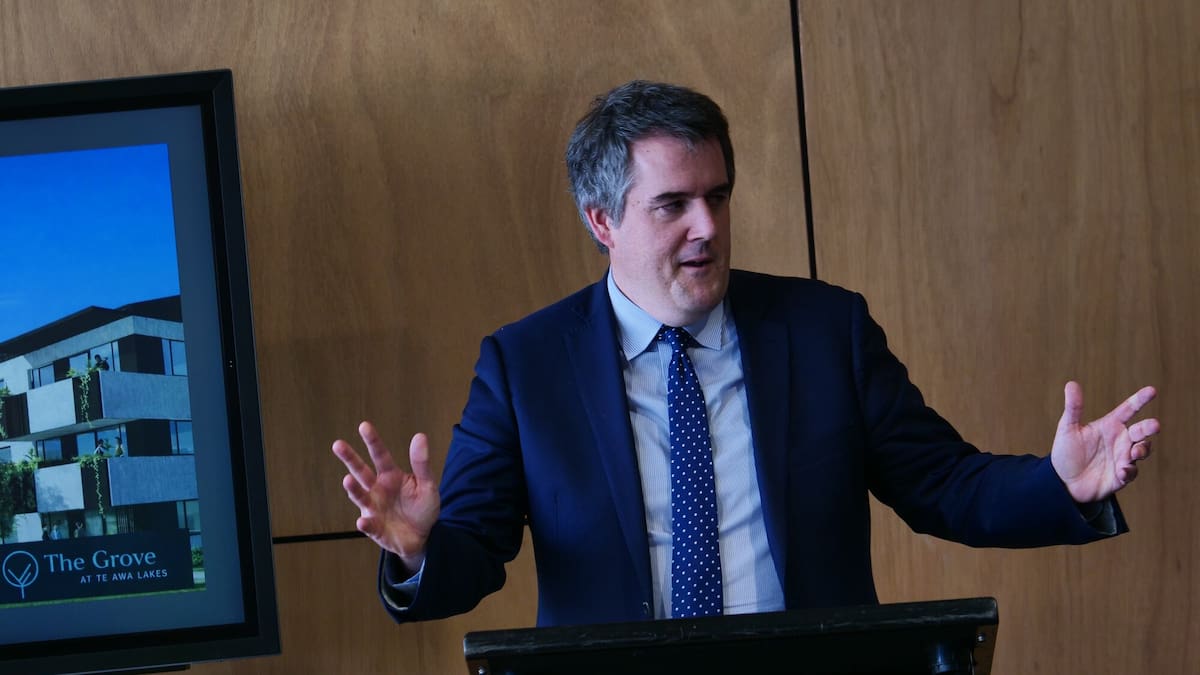
Developer Simon Perry, a director of the Perry Group, said home ownership in New Zealand was declining, and the Waikato region had some of the lowest ownership rates in the country.
He said the Te Awa Lakes development highlighted the scale of the housing challenge and the need for a coordinated response.
“We can’t rely on the market alone,” Perry said.
He said Perry Group was ensuring up to 20% of homes in Te Awa Lakes were affordable.
But what “affordable” means remains contested.
Under Hamilton City Council’s definition, affordable housing is priced about 90% of the median house price.
Drone aerial of Te Awa Lakes. Photo / Stephen Barker, Barker Photography
However, industry measures typically define affordability as homes costing no more than five times the median household income, or mortgage repayments of below 30% of gross income.
In Waikato, that ratio is currently closer to 6.4 times the median household income, indicating affordability has worsened in recent years.
Perry said the cost of building homes in New Zealand was high, making it difficult for the private sector to deliver cheaper homes without support.
The reasons for high costs include limited zoned land supply, infrastructure bottlenecks, council fees and high construction costs.
Bishop acknowledged the issue.
“It’s an intergenerational issue, it’s a moral issue, it’s a fiscal issue,” he said.
The Government spends about $5.5 billion a year on housing subsidies, a figure Bishop said reflected the depth of the crisis.
“It’s also a growth issue for government and for the economy, because when we constrain our cities from growing, we hold back the possibility of reacting to the underlying jobs and higher living standards,” Bishop said.
A key barrier in Hamilton was infrastructure capacity, which limited how quickly new housing could be brought to market.
Recent Government funding initiatives tied to Te Awa Lakes are aimed at addressing those constraints.
Perry said while this was great, there was no silver bullet.
He said a sector-wide approach was needed, with Government incentives supporting developers and first-home buyers, alongside partnerships with community housing providers.
One option previously used was the Progressive Home Ownership Fund, which helped buyers into homes through shared equity or leasehold arrangements.
Another tool gaining attention was inclusionary housing, where developers were required to provide a portion of land or homes specifically for affordable housing.
Te Awa Lakes would incorporate some of these ideas through partnerships with organisations such as Bridge Housing Trust, and by offering a mix of housing types and price points.
Indicative pricing for the early stages included one-bedroom apartments starting at around $555,000 and two-bedroom units at about $620,000, while terraced homes were expected to be in the mid-$600,000 range.
The development would also include standalone houses, with a mix designed to appeal to a range of buyers, from first-home purchasers to retirees seeking low-maintenance living.
Beyond housing, Te Awa Lakes included plans for workplaces, amenities and a riverfront precinct developed in partnership with iwi, with land set aside for cultural and community use.
“This is a true master-planned community,” Perry said.
Waikato District Mayor Aksel Bech.
Waikato District Mayor Aksel Bech said the project reflected years of collaboration across the region.
“If you want to travel fast, travel alone. But if you want to travel far, you travel together,” Bech said.
“We’ve taken this journey together through the Future Proof development strategy, and the sub-region is very focused on working as one.”
Tom Eley is a multimedia journalist at the Waikato Herald. Before he joined the Hamilton-based team, he worked for the Weekend Sun and Sunlive. He previously worked as a journalist at Black Press Media in Canada and won a fellowship with the Vancouver Sun.