
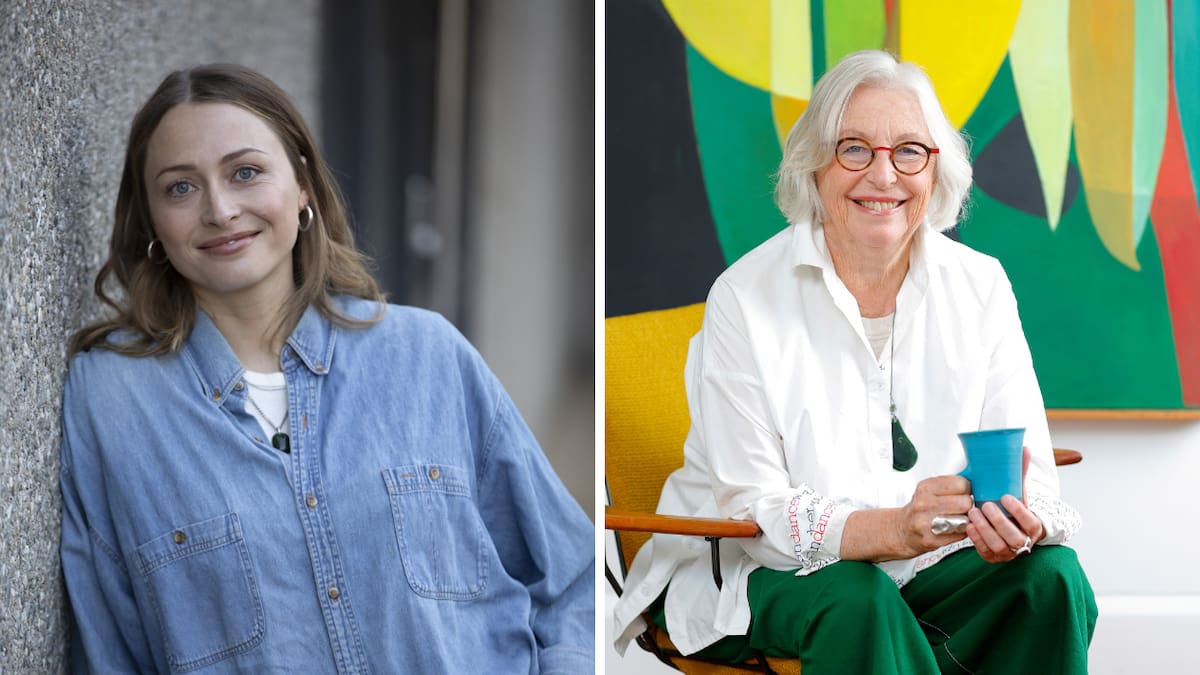
For her feature-directing and writing debut Chelsie Preston Crayford has kept things close to home. Kind of.
Caterpillar, she says, is a work of autofiction in its story of three generations of women in the same Wellington house: a sulky teenager with acting aspirations, a harried film-maker mother
and a grandmother facing the onset of dementia.
Preston Crayford, the acting daughter of director Dame Gaylene Preston, grew up in such a place with her mother and her grandmother Tui, who died in 2006.
Gaylene Preston had been inspired by her mother’s life in her films Home by Christmas and War Stories Our Mothers Never Told Us. Now her daughter has added a third to the Tui Preston trilogy, though it’s a fictionalised drama with the three leads playing characters with soundalike names. It stars veteran NZ actress Lisa Harrow as “Huia”, up-and-comer Anais Shand as “Cassie” and Australian star Marta Dusseldorp as “Maxine”.
The film arrives three years after Preston’s memoir Gaylene’s Take charted her struggle to juggle her life at home with Tui and Chelsie, with a precarious arts career. Preston Crayford addressed the struggles of her own young motherhood in her 2018 short film Falling Up, not long before starting the Caterpillar script.
The senior film-maker’s only credit on the new film is “stunt driver” when Huia ill-advisedly gets behind the wheel of the family car. Given the intriguing line between family history and fiction, we asked the two directors if we could eavesdrop on a conversation about a film that is, partly, kind of, set in the space between them.
Lisa Harrow as Huia. Photo / Supplied
Chelsie Preston Crayford: How are you feeling with Caterpillar about to be out there?
Gaylene Preston: Ah, well there’s a thing. What you’ve done is really interesting. You have trawled a lived life. Yours and everyone else’s. While the context is the same – yes, the house was falling down around our ears; yes, our bedrooms reflected our different worlds, Tui’s all pink and floral with yours electric blue with a drum kit in the window and mine full to the brim of scripts and scribbled notes – you have built fictional characters and a plot that is entirely made up. No event in your film actually happened, but it could have. You have elevated and heightened the story to make it more enlightening, more entertaining, and more universal. But somehow you have kept the relationships true to us. It’s not necessarily easy for me to look back on but it’s definitely truthful. That space between us that made that time so difficult for us will illuminate to many what many mothers and daughters often face. I don’t know how you did it. But you have.
CPC: Did you ever feel worried when I was exploring this territory and these characters?
GP: Well, I haven’t got a leg to stand on, have I? I could worry my way through it but what’s the point? I mean, I’ve done it myself to Tui twice, so I can’t very well stand on ceremony if you want to do it. The characters are enhanced, they’re embellished. And they’re made more entertaining than us.
CPC: Yes, although you are pretty entertaining. It was an interesting challenge to take this territory of our lives and make it into a story. The characters are not exactly us because they can’t be. They have to serve a dramatic purpose. The antagonist of the film really is dementia, that’s what’s putting the family under threat, and forcing them to grow. Tui’s dementia took three years, probably longer. But it’s a 90-minute film and you have to force those characters to all hit up against each other. That is why I wanted to work with all three generations, even though I was told so many times to choose one character and make it their story. It would have been much easier.
Anais Shand as Cassie. Photos / Supplied
GP: I was very impressed with how you stuck to your guns on that one, through making a script over, was it four years?
CPC: Actually, it was six for the writing of it.
GP: That’s crazy.
CPC: You must have done that.
GP: Oh yeah, but I don’t expect anyone else to. When you told me you wanted to make a film about a maternal line living separate lives under the same leaky roof, generations transitioning through the main stages of womanhood, I thought, “That’s a brilliant idea. I wish I had had it.” Then I thought, “Hmmm. How do you make that work?” Three equal characters intertwined, living separate lives together. A serious comedy full of the drama of small things.
CPC: It was definitely not the easiest choice for my first time writing a feature. To make a narrative weaving their three experiences and make it complex but not complicated. That took me many years to crack.
Tui’s third film
GP: Do you realise Tui has had three feature films made about her now?
CPC: Yes! She’s inspired three whole films. Isn’t that amazing?
GP: She’s probably setting some sort of record.
CPC: What do you think that’s about?
GP: Well, being the mother of a film-maker and the grandmother of a film-maker is probably somewhere to start. It’s unavoidable really.
My two mothers
CPC: I wonder if it’s also that both you and I have ended up making work primarily about women. I’m very obsessed with and inspired by motherhood in my work. And the complex relationship between mothers and daughters. And Tui was my other mum for a good while there.
GP: Well, she was. You were 7, when she moved in and she was completely grief-stricken and actually quite sick. She was deeply depressed because she was so missing her mate, my father. So, when she moved in, I thought she’d only be alive for another three or four months. But I got her a doctor who could do house calls. And then you cheered her up. You know, having this little bouncing kid around, it healed her. So, I sort of gave her to you, and I gave you to her.
CPC: Wow. That’s a beautiful way of putting it.
GP: That allowed me to be able to work. Which allowed me to pay the bills and keep the roof over our heads. So somehow the infrastructure all worked.
Chelsie with grandmother Tui. Photo / Supplied
CPC: Yes. You guys didn’t have the easiest relationship but you struck a real harmony in terms of co-parenting me during that period.
GP: Yes. Tui and I were not really aligned on many things. She thought I was a bit cocky but we were rock solid on parenting. She would never overrule me. I knew I was the boss. And I appreciated that.
CPC: When I was writing and trying to understand the characters, I realised where a lot of that tension could have come from. If you think about the eras in which you grew up and what you both had to contend with, they were so vastly different. Tui left school at 13 and had to raise her siblings. She was very clever, but she couldn’t have ever imagined doing what you, and therefore the character Maxine and now me, do. In your life, you have had the courage to ask yourself what it is you want and then go after it in a sort of bloody-minded fashion. You believe in your ideas enough to make them into a real thing.
GP: In my case, no choice. Probably in yours, too. You have a bent bit of wiring when you’re an artist. Tui thought I was selfish. People say, “When did you become an artist?” I’ve noticed that touring with Robin White [for Grace: A Prayer for Peace, the 2025 documentary Preston made about the artist] we get asked that question. She’ll say, “Well, I didn’t, I just never decided not to be one.” If it’s in there you can’t do a thing about it, you have to surrender to it. With Tui, we had an Edwardian in the front room, who was actually a very tolerant Edwardian, but an Edwardian, nevertheless. And I was Dora the Explorer. Look Ma, no hands!
CPC: Yes. You were forging a new path in so many ways. Particularly in that time in New Zealand.
Back to the noughties
GP: This film’s set in the 2000s. There’s a film industry by then, sort of. I think Caterpillar is quite an interesting snapshot of that time in the evolution of feminist film-making. It takes the piss beautifully through Maxine trying to get finance for a film in which menopause is the main antagonist.
CPC: There was another thing that got questioned a lot throughout the development of the script. Does it have to be set in the 2000s? You suddenly can’t shoot anywhere that you can see a car, but it felt really important because technology changes all of their stories. Maxine would have had Zoom. She wouldn’t have to be away as much. But most importantly, Cassie would have had social media and the internet.
GP: I’m so glad we didn’t have to cope with all that. We were already in separate worlds under the one roof. But if you added social media to the situation we were in, I think it would have been very isolating.
Marta Dusseldorp as Maxine. Photo / Supplied
CPC: And I was an anxious kid, I think. That’s where Cassie’s at when we meet her; she’s kind of spiralling all the time and she’s impossible. She’s on the precipice of womanhood but still a kid. She needs her mum to be there, but at the same time she doesn’t want her mum anywhere near her.
GP: Yeah, I used to be in Sydney, or be somewhere and I’d go, “Look, I’ve got to race home now so they can ignore me.”
CPC: Oh, that makes me feel so sad … what is so interesting about Caterpillar is that when I started writing it, I remember thinking, “What is this about for me? Why am I interested in this time?” I wasn’t interested in making a coming-of-age. And I knew I was fascinated by these relationships, particularly between the grandmother and the granddaughter, because I do think that’s the pivotal relationship of the film.
GP: Well, it is. If you’re thinking of an idea, it better have enough meat on the bones to sustain you for the years it could take while you’re developing it.
CPC: Exactly. You can’t know everything about it. I was hunting around in the very early stages for what it was that kept me coming back to this material. And then you had your head injury [in 2019, Preston was knocked over by a mountain biker in Wellington], and I had a little kid, and I was a single mother. And I just suddenly realised, “Oh, I’m Maxine. I’m the mother in the middle.” And it became not just about us, but about this rite of passage. The cyclical nature of our roles as women.”
GP: These stages are elemental. They’re not by choice. Childhood, young womanhood, motherhood, the crone, the elder, the wise woman. The best thing is to actually get a bit strategic about it and work out how it’s going to go if you possibly can.
CPC: I think that aspect of you is the most remarkable thing. You are completely obsessed and dedicated to your artistry, but you bring everyone with you. You’re certainly never out for yourself. Maxine could be interpreted as out for herself. I do think women are interpreted like that far more often. I often think about if Maxine was the dad, how that character would be interpreted.
GP: If Maxine was Max, he’d have so much sympathy. The plot could stay exactly the same and Max would be Saint Max, wouldn’t he? They wouldn’t mind that he couldn’t cook a chook.
The cast
CPC: Let’s talk about Lisa Harrow. What’s amazing about Lisa’s performance is that she’s very like Tui and she’s nothing like Tui.
Caterpillar stars a sulky teenager with acting aspirations, a harried film-maker mother and a grandmother facing the onset of dementia. Photo / Supplied
GP: She is quite extraordinary.
CPC: I just couldn’t believe my eyes when I saw her audition. She’s such an extraordinary actress. And she was so uncomfortable in all Huia’s costumes. She’s such a stylish, worldly woman, and that’s not Tui. Tui was stylish in her way but she was, as you say, Edwardian and very working class. She loved a purple tracksuit.
GP: She did.
CPC: I was editing the film at my house with Jonno Woodford Robinson. Lisa came over to the house and Jonno couldn’t believe it. Because she’s nothing like Huia, who he had spent the last 12 weeks with, in the edit suite. Transformative. And then Marta Dusseldorp is just a powerhouse, and Anais Shand is total magic. The crazy thing about the casting is they were all no-brainers. Thank god they all said yes. Anais is just going to knock everyone’s socks off.
GP: Absolutely.
CPC: You are credited in the film as being the stunt driver, because we used your real car from that period, a 1987 Fiat Panda you still have, and you are the best at driving it.
GP: And the terrible thing about that wasn’t driving the car, it was putting on Huia’s costume. I just about had a nervous breakdown.
CPC: That was a big moment. I feel that was the most confronting part of the whole thing for you. Not Maxine or Cassie or the story or the mother-daughter relationships or the conflict. The scariest part was actually dressing up as your own mother.
GP: It was. Dressing up as your own mother to be in a film. I wouldn’t recommend it. Psychologically, you need the strength of an elephant.
CPC: Well, thanks for having this conversation. It’s been a real joy for me to talk to you in this way about the film.
GP: Isn’t it good? We’ve never done it.
CPC: It’s very liberating because it’s a work of autofiction. People don’t know where the line is between reality and fiction. Maybe that’s the point.
GP: And for the record, I can cook a chook.
CPC: For the record, I cannot cook a chook, so there you have it. Who’s who? We will never know.
GP: I never taught you how to do it. I blame the parents.
Caterpillar premieres in Wellington on May 6, in Auckland on May 7 and has Mother’s Day screenings at selected cinemas on May 10 before general release on May 14.
SaveShare this article
Reminder, this is a Premium article and requires a subscription to read.
Copy LinkEmailFacebookTwitter/XLinkedInReddit