
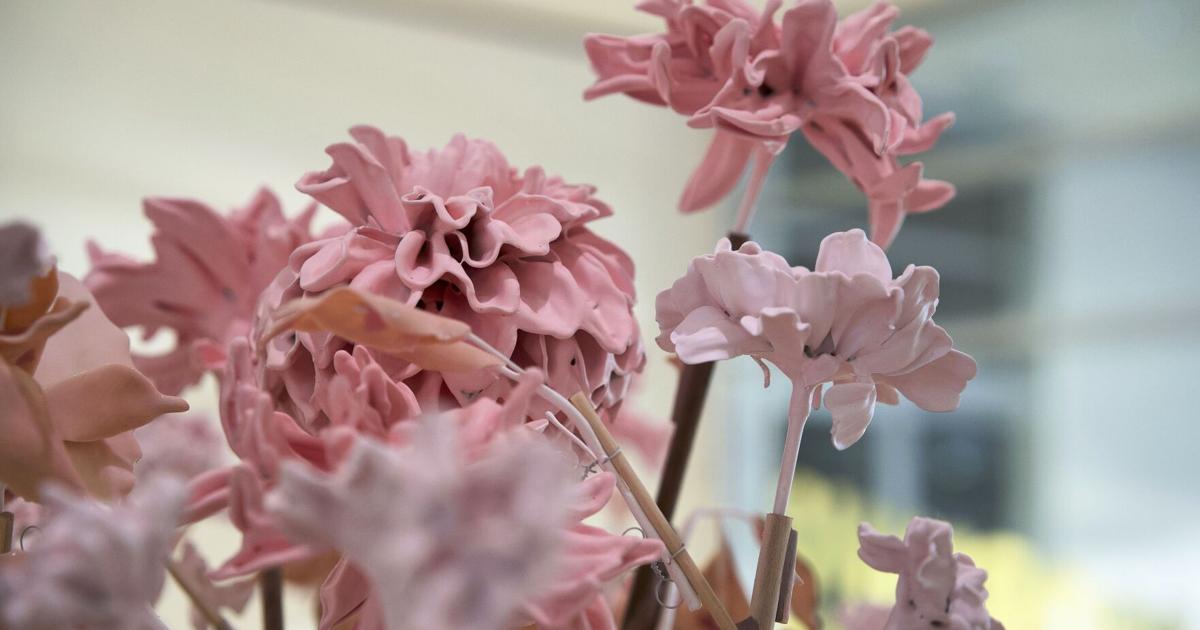
For Milwaukee-based artist David R. Harper, work and sleep are not separate things, but two actions that are deeply intertwined.
“Even when I’m asleep and dreaming, I’m working,” Harper said. “It may actually be when I’m working the hardest.”

David R. Harper’s “She Drank the Water That Was Meant for the Orchids” from 2019 is on display at the Madison Museum of Contemporary Art.
DAVID R HARPER
Harper’s interdisciplinary art is largely influenced by dreams and memory, with pieces produced through sculpture, textiles and ceramics. Harper earned his bachelor of fine arts degree from the Nova Scotia College of Art and Design and an MFA in fiber and material studies from the School of the Art Institute of Chicago.
Earlier this month, Harper’s “Good Morning Sweetheart” exhibition opened at the Madison Museum of Contemporary Art (MMoCA). Extending through the State Street Gallery into the museum’s Icon staircase, this exhibition evokes themes of time, sleep, memory, longing and stillness, taking shape through the careful curation of sculpture, stained glass, ceramic re-creations and found materials. It will be on view through Aug. 30.
David R. Harper works in large-scale sculpture, textiles and ceramics.
RICH MACIEJEWSKI
‘Memory as a living thing’
Each piece contains its own uncertainties and complexities, challenging the viewer to take another look. What may appear alluringly familiar from afar gains nuance as the viewer steps closer. This type of illusionary work, in which pieces of cereal become ceramic fragments and glass vitrines become barriers, allows Harper to capture the disoriented feeling associated with dreaming.
“There’s this push and pull,” said Harper. “Lending a little bit of uncanniness to something slingshots it back into the dream world. But then the tangibility of the materials, like the fact that I’m working with things that are so recognizable, pulls it back to familiarity.”
Harper’s work dances the line between memory and reality, playing into the idea of dreams and the reconstruction of memories as uncanny. In a cultural landscape teeming with concepts of time as a distant past, MMoCA Gabriele Haberland Director and exhibition curator Paul Baker Prindle finds Harper’s fluid depiction of memory refreshing.
David R. Harper’s exhibition runs through Aug. 30 in Madison.
COURTESY OF MMOCA
“Memory is fascinating in that it is an illusion,” said Baker Prindle. “Whenever we remember something, we’re not remembering it as it was. We’re remembering it by looking backwards through all these layers of things that have happened since we first deposited that memory in our brain.
“There’s a sort of liberatory beauty in coming to a place like David’s exhibition where we’re actually OK with memory as a contemporary past rather than a kind of frozen or mausoleal endeavor. I love memory as a living thing.”
Art from cicadas and cereal boxes
From travel-size cereal boxes to motel soap and vintage folding lawn chairs, Harper relates to his audience through familiar objects that connect to a shared Midwestern identity. Thanks to Harper’s continued efforts to connect to his audience, viewers can encounter these familiar objects in the exhibition and conjure up a range of personal associations that tie back into the larger themes within each piece.
“I always say that first there’s a dream, then there’s my research, and then there’s finding a way for me to give it to people,” Harper said. “All those things are very important, but that connection to other people is the most important. I think there’s this power in understanding how other people approach the world and approach things that you yourself might be grappling with. I look to that in art making.”
Patrons visit David R. Harper’s “Good Morning Sweetheart” exhibtion at the Madison Museum of Contemporary Art.
COURTESY OF MMOCA
For Harper, this exhibition started back in 2017 when he first began developing “She Drank the Water That Was Meant for the Orchids” (2019). Combining a form made from dehydrated milk with palm fronds, a taxidermy bird and a glass vitrine among other elements, this piece serves as a central piece in the exhibition both physically in the gallery space and thematically as it relates to the other pieces.
“‘She Drank the Water That Was Meant For the Orchids’ was partially inspired while looking at marble statuary who lived outside, left to the elements over time,” said Harper. “While protected by glass and laid down, pressed into an enveloping cloud, the form is made of dehydrated milk. There is a tension created between the attempt of preservation and the reality that even the moisture in the air could feed this form, and we could watch it wash away.”
In addition to recurring themes of milk and cereal, many pieces in the exhibition are connected through cicadas. By dipping the cicada exoskeletons in porcelain before attaching them to ceramic jars that now cover the gallery wall in orderly shelves, Harper created “Brood,” a new piece made specifically for the exhibition.
The loud, buzzing sound of summertime cicadas is an undeniably Midwestern experience. Harper’s use of cicada exoskeletons within both “Brood” and “The Boy Who Slept Through Summer” draws viewers into the piece, encouraging deeper contemplation about the complex notion of time.
“There’s something so emblematic about (cicadas) as a representation of time passing,” said Harper. “You can measure your life by three cicada cycles. It’s phenomenal. Using the molts of cicadas in ‘Brood’ made these jars like time capsules in a way, representative of these large swaths of time.”
Patrons visit David R. Harper’s “Good Morning Sweetheart” exhibtion at the Madison Museum of Contemporary Art.
COURTESY OF MMOCA
“Good Morning Sweetheart” will be open to MMoCA visitors through the end of summer. While some photos of Harper’s work are available online, witnessing the interaction of the different pieces within the gallery space provides a different experience.
“I think David’s practice is a perfect argument for why you really must see art in person,” said Baker Prindle. “Yes, it’s beautiful in reproduction. It looks great on a screen. But when you see it in person, meanings emerge that you never anticipated.”