
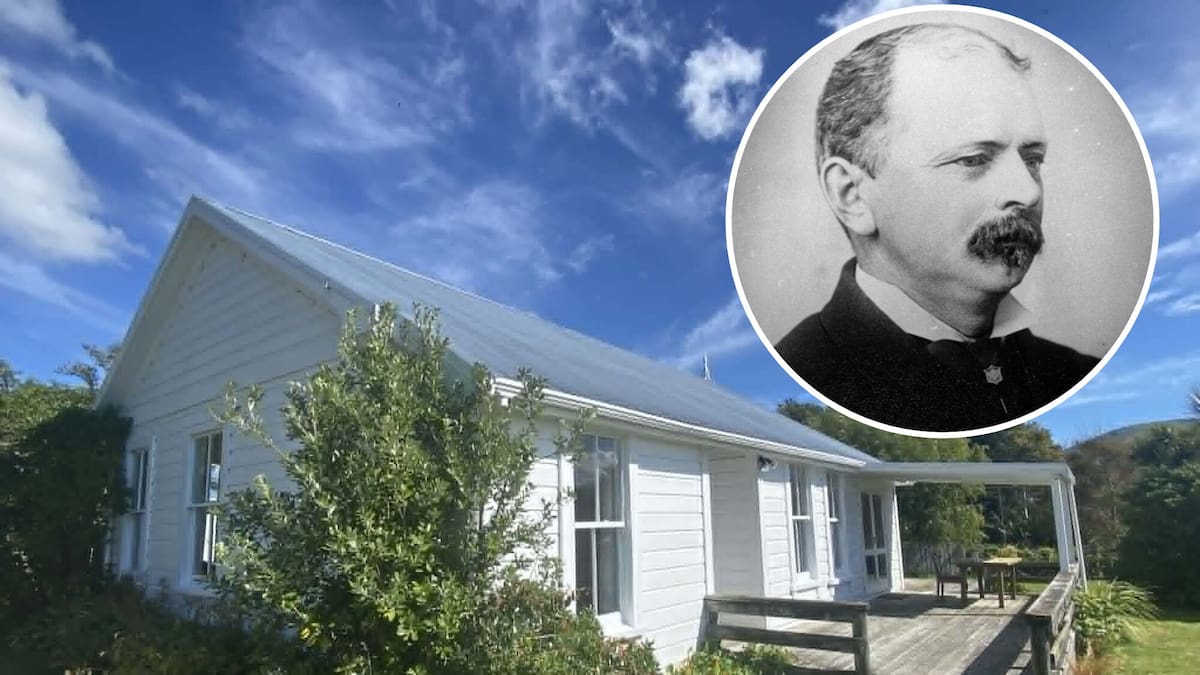
The 1905-built Cook’s Cottage is an endearing example.
Originally part of the Aramoana Station farming operation of McHardy Estate, it’s now a standalone private getaway. And, as it happens, it’s on the market.
In a former life it housed cooks who were tasked to feed about 20 of the station’s working men. Big appetites and a big ask given electricity didn’t arrive until 1957.
Hence for the first half-century of its life, coal and wood-fired ranges were a cook’s only option.
The cottage’s interior ‘weatherboard’ lookalike is more likely tongue and groove profile panelling. Photo / Mark Story
The three-bedroom, two-bathroom holding isn’t a classic bach in scale — but it has many of the vibes.
For starters, there’s not a clock in the place; timeless and unrushed.
Sections of the indoor and outdoor weatherboard cladding are almost identical, making for informality.
Curious about the interior cladding, I sent a photo to executive member of Historic Places Aotearoa, James Blackburne.
He said the cladding was more likely tongue-and-groove panelling.
“Weatherboards were often used on the interior, except usually as skirtings and door or window architraves. They simply turned them around.
“This is an unusual profile in that the board is a lot wider than normal, but that would make it quicker to install.”
Frankly, it should be employed more often. Interior weatherboards are infinitely cosier than modern internal cladding — and far better at storing memories.
If you’re quiet, and if you listen, they’re walls that can speak.
I’ve never had a conversation with plasterboard.
The cottage’s design is courtesy of architect and former mayor of Palmerston North (via Denmark) Ludolf Georg West.
It’s a reminder that New Zealand’s colonial architecture is more than just British vernacular.
More often than not it’s a medley.
In this case, the home has been shaped by a mix of Scandinavian, Manawatū and Scottish influence.
There’s also an endemic element as it sits at the foot of the imposing Ikatere hilltop, and is built of heart kauri floated south from Coromandel.
The Cooks’ Cottage section was a great place to forage. Ti kouka leaves (fire starter), kawakawa, feijoa, nasturtium, walnuts and limes. Photo / Mark Story
Listing agent Linda Watson wrote that it “connects the property to a much deeper story”.
Bang on. So storied.
I’d love to know what dishes the cooks plated up.
I’m thinking primarily mutton (not sure when beef was introduced to the station), rabbit, hare, duck, maybe turkey, home grown vegetables and, of course, seafood.
A large concrete base in the middle of the dining and kitchen area once bore the weight of a big bread-baking oven.
Given its culinary pedigree I thought it only right to see what I could forage for dinner using only fire, like the cottage’s powerless pre-50s.
New Zealand cooks’ quarters were often accompanied by a stand of cabbage trees, tī kōuka.
The theory being they were purposely planted nearby as their dry leaves were great for starting the fire. Sure enough, a string of tī kōuka lined the cottage’s fenceline.
My protein was in hand (half a chook) but it needed jazzing up given the ghosts of old cooks were watching me.
The section didn’t disappoint: walnuts, feijoas, edible nasturtium flowers, kawakawa, an abundance of limes and a bundle of tī kōuka leaves to spark the fire.
I’m hoping my overdone grilled chook with foraged fruit and nasturtium butter may have made the old quarter’s cooks smile. Photo / Mark Story
Thanks to friends down the road Rob and Jane, who gifted me a knob of butter and some firewood for the brazier, it was cook time.
Grilled chook (with some wafts of kawakawa smoke), nasturtium and feijoa butter with toasted limes and walnuts.
Truth be told, the fowl was overdone. But I’m just hoping, somewhere, it was enough to make an old Aramoana cook smile.
Do you know of a Hawke’s Bay bach that you think deserves a profile? If so email mark.story@hbtoday.co.nz.