
When the deal was signed, McClay said, it would open significant opportunities for New Zealand exporters, delivering “thousands of jobs and billions of dollars in additional exports”.
The delegation in India at the signing of the free trade agreement.
The deal will eliminate or reduce tariffs on 95% of New Zealand exports to India. Eventually, 82% of exports will be tariff-free, with 57% becoming duty-free from the day the deal comes into effect.
Exceptions include many dairy products, which still face high tariffs.
Immediate tariff elimination will apply to exports including sheep meat, wool, coal and 95% of forestry and wood products.
Zespri’s global head of public affairs, Michael Fox, said the company welcomed the FTA, with its chief executive, Jason Te Brake, in India for the signing.
Under the FTA agreement, New Zealand growers – including those in the Bay of Plenty where about 80% of New Zealand’s kiwifruit was grown – would see the tariff on kiwifruit exports removed on up to 15,000 tonnes per year. Exports over that would be subjected to a reduced tariff of 16.5%, Fox said.
Fox said the tariff cost New Zealand growers $9m on $27m of sales last season.
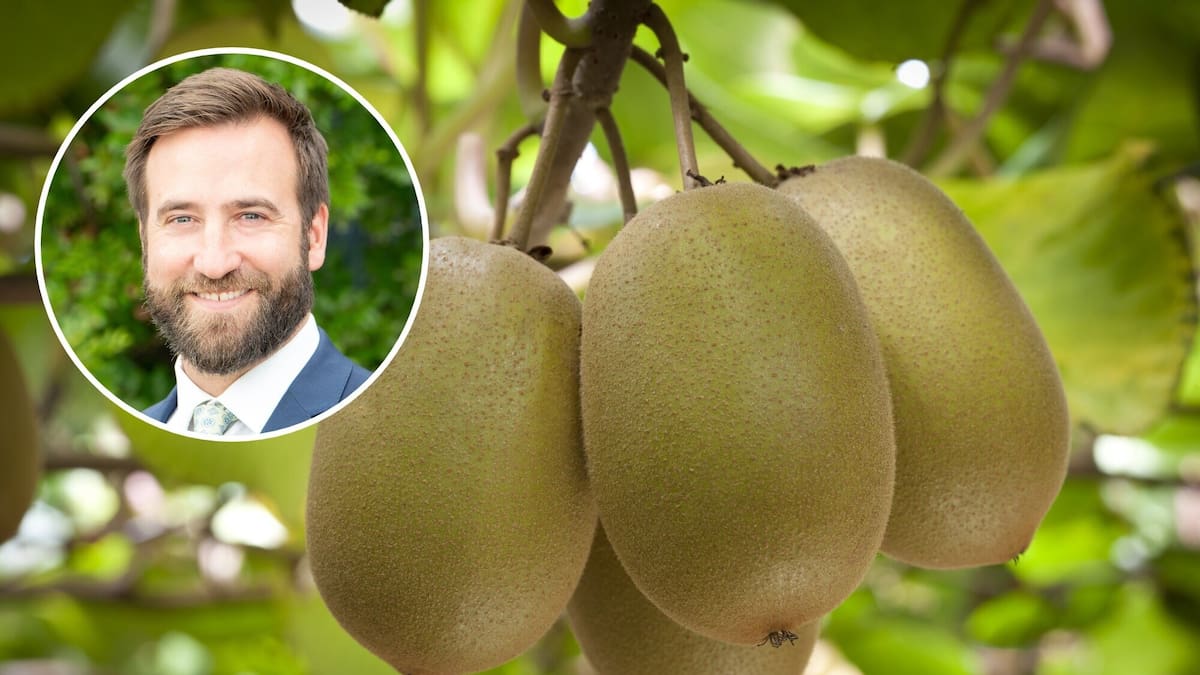
Zespri’s global head of public affairs, Michael Fox.
Fox said India had the world’s largest population and fastest-growing large economy, with consumers increasingly focused on health and wellbeing and looking for high-quality, nutritious products.
“The market access delivered through the FTA will allow us to invest to build high-value demand, providing the world’s best kiwifruit to more Indian consumers and delivering leading value to growers.”
Fox said Zespri had been operating in India for more than a decade, building partnerships with supply chain partners, working with local retailers, and building brand awareness.
He acknowledged the efforts of those who helped make the FTA happen, including Prime Minister Christopher Luxon, McClay, their teams, and the Labour Party’s support for the agreement.
More sales to benefit regional economies
Luxon, who visited Whakatāne on Thursday, told the Bay of Plenty Times he met with people who would benefit from the FTA, including one couple who knew they could sell “a lot more kiwifruit into India”.
Selling more kiwifruit meant they could hire more workers and pay higher wages, benefiting regional economies, Luxon said.
Asked what Bay of Plenty businesses could do to take advantage of the FTA, Luxon said Zespri had done well to understand the Indian market and how it would reach different consumer groups.
“There’s a lot of opportunity, but [for] a lot of them it’s about building their familiarity with India and the consumer and how best to communicate and tell their story to them.
“That requires you to jump on a plane and get over there and understand the market and also work with New Zealand Trade and Enterprise to build your knowledge of the place.”
Christopher Luxon says Zespri has done well to understand the Indian market. Photo / Mark Mitchell
Luxon said India had a “rapidly growing middle class”.
“That just means that they’ve got enough income that they want to buy better quality food and products and services. And of course, we sell some of the best in the world.”
Luxon said the agreement created more opportunities for New Zealand exporters to sell to more consumers, drive bigger businesses and more growth, “and more money comes back home to New Zealand”.
“That powers up jobs and income”.
Whakatāne Hospital’s maternity services
Secondary obstetrics and gynaecology services at Whakatāne Hospital resumed last month after a specialist workforce shortage led Health New Zealand to move the hospital to a primary birthing service in January last year.
Asked how the FTA could help address healthcare staffing issues in Whakatāne, Luxon acknowledged it had been “challenging”, and the Government was aware that regional New Zealand needed more medical workers.
The Government was building a third medical school in Hamilton, “deliberately” designed so people did their placements in regional New Zealand.
“The learning is that if you do your placements there, you often get attached to the community and as a consequence, you tend to stay.”
RNZ reported the FTA included a quota of 5000 visas for skilled Indians to stay in New Zealand for up to three years in sectors of interest, including healthcare.
Luxon said, “Anything that drives the local economy creates opportunity”, thereby making it a more attractive place for doctors and nurses to live due to greater wealth and prosperity in the region.
Megan Wilson is a health and general news reporter for the Bay of Plenty Times and the Rotorua Daily Post. She has been a journalist since 2021.