
Astronomers have spent years chasing distant, Jupiter-like planets while keeping their eyes on a bigger prize: finding a planet that looks and behaves like Earth.
Along the way, they’ve had to start with the basics. What are these planets made of? What do their skies look like? And how different are they from the ones in our own solar system?

A new finding adds an unexpected twist. Scientists have spotted water-ice clouds on a faraway gas giant called Epsilon Indi Ab.
It sounds simple, but it pushes against what many models predicted. Even better, the way they found these clouds hints at how future researchers might study planets that are much more like our own.
Studying worlds in new detail
For a long time, astronomers were focused on one main goal: finding planets beyond our solar system.
Starting in 1995, they looked for small hints, like stars wobbling slightly or dimming when a planet passed in front of them. That method helped them spot thousands of planets, but it didn’t tell the full story.
In 2022, things started to shift. The James Webb Space Telescope (JWST) began full operations, giving scientists a way to study these planets in much greater detail, especially what’s in their atmospheres. They could pick apart light and see what gases were present.
This opened a new phase of research, one that moves closer to answering a big question: could life exist elsewhere?
“JWST is finally allowing us to study solar-system analogue planets in detail,” said study lead author Elisabeth Matthews of the Max Planck Institute for Astronomy.
“If we were aliens, several light-years away, and looking back at the Sun, JWST is the first telescope that would allow us to study Jupiter in detail. For studying Earth in detail, we would need much more advanced telescopes, though.”
Studying gas giants like Epsilon Indi Ab
You might think Jupiter-like planets would be easy to study. They’re easier to find because they’re so big. But most gas giants discovered so far orbit very close to their stars.
That makes them extremely hot and easier to spot when they pass in front of their stars from our point of view.
Cooler planets, the kind that sit farther out like Jupiter, don’t show up as easily. They don’t line up neatly for those transit observations, and they don’t glow as brightly in the data scientists usually rely on.
Epsilon Indi Ab breaks that pattern. Instead of using the usual method, the team captured a direct image using Webb’s mid-infrared instrument.
They blocked out the star’s light and focused on the faint glow of the planet itself.
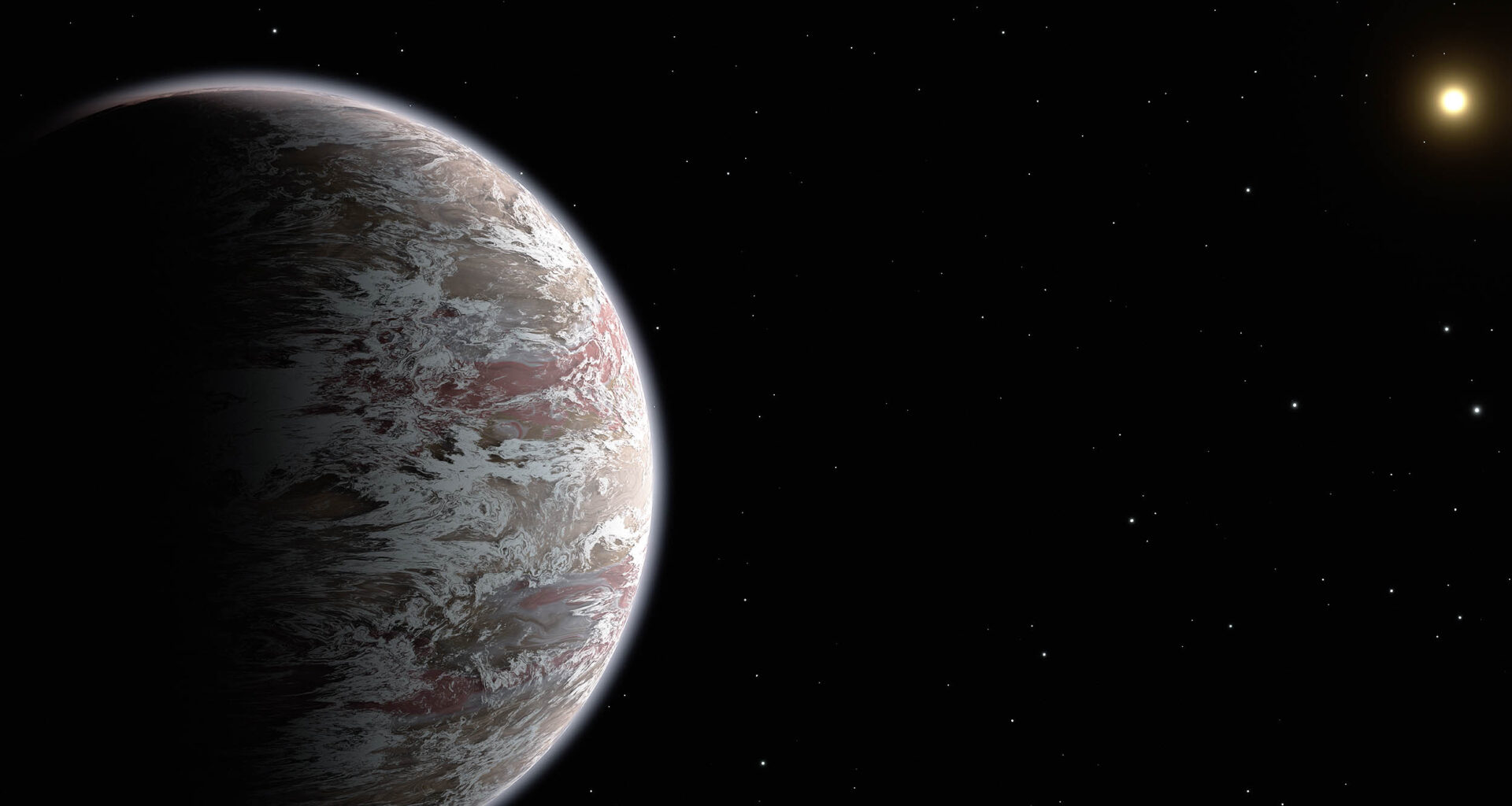
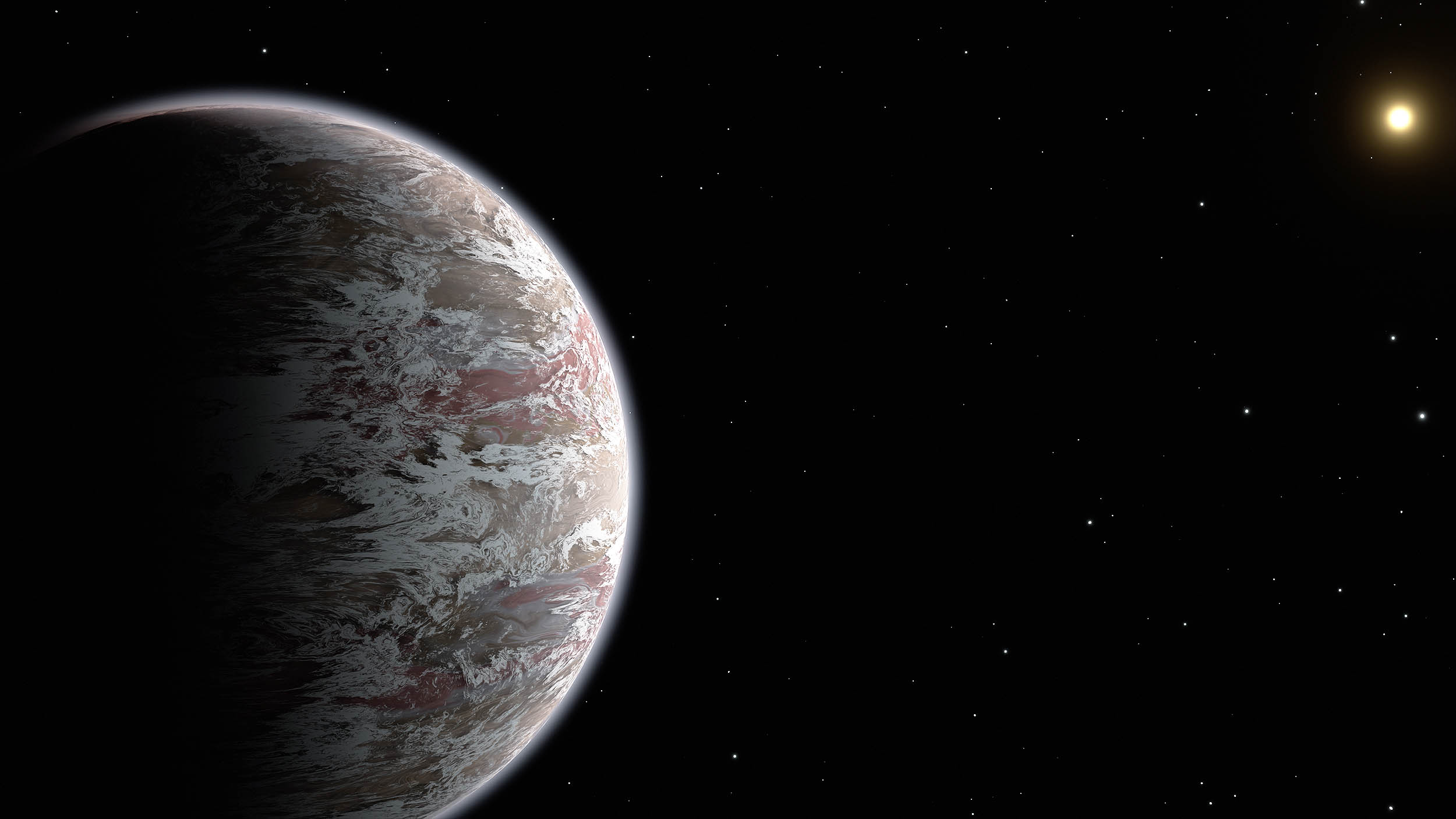 Artist’s impression of the exo-Jupiter planet, Epsilon Indi Ab, with water clouds atop its ammonia-dominated atmosphere. Credit: E. C. Matthews, MPIA / T. Müller, HdA. Click image to enlarge.A heavier cousin of Jupiter
Epsilon Indi Ab is no lightweight. “This planet has a considerably greater mass than Jupiter – the new study fixes its mass at 7.6 Jupiter masses – but the diameter is about the same as its solar system cousin,” said Bhavesh Rajpoot, a PhD student involved in the work.
The planet orbits much farther from its star, about four times the distance between Jupiter and the Sun. Its star is a bit cooler and smaller than our Sun, which helps keep the planet itself fairly cold.
Even then, Epsilon Indi Ab isn’t as cold as you might expect. Its temperature ranges from about –94°F to 68°F.
That’s warmer than Jupiter because it’s still holding on to heat from when it first formed. Over time, it will slowly cool down
Clouds on Epsilon Indi Ab
The team looked closely at specific wavelengths of light linked to ammonia, a gas expected to dominate in the upper layers of such planets. By comparing different infrared images, they estimated how much ammonia was present on Epsilon Indi Ab.
What they found didn’t match expectations. There was less ammonia than predicted.
The best explanation points to thick, uneven layers of water-ice clouds. These clouds likely sit high in the planet’s atmosphere, similar to thin cirrus clouds on Earth.
Their presence changes how light moves through the atmosphere, which can make ammonia appear less abundant than it really is.
This matters because many atmospheric models don’t fully include clouds on planets. They’re hard to simulate and add complexity. But this discovery shows that skipping them leads to incomplete results.
“It’s a great problem to have, and it speaks to the immense progress we’re making thanks to JWST,” said James Mang at the University of Texas at Austin.
“What once seemed impossible to detect is now within reach, allowing us to probe the structure of these atmospheres, including the presence of clouds.”
“This reveals new layers of complexity that our models are now beginning to capture, and opens the door to even more detailed characterization of these cold, distant worlds.”
More discoveries on the way
The discovery doesn’t just tell us about one planet. It points to a bigger shift in how astronomers study distant worlds. Direct imaging, careful filtering of light, and better models are starting to work together.
There’s also a new telescope coming soon. NASA’s Nancy Grace Roman Space Telescope, set to launch between 2026 and 2027, should be able to spot these clouds on distant planets more clearly.
At the same time, scientists are planning more observations of similar cold gas giants. Each one adds a piece to the puzzle.
The full study was published in the journal The Astrophysical Journal Letters.
—–
Like what you read? Subscribe to our newsletter for engaging articles, exclusive content, and the latest updates.
Check us out on EarthSnap, a free app brought to you by Eric Ralls and Earth.com.
—–