
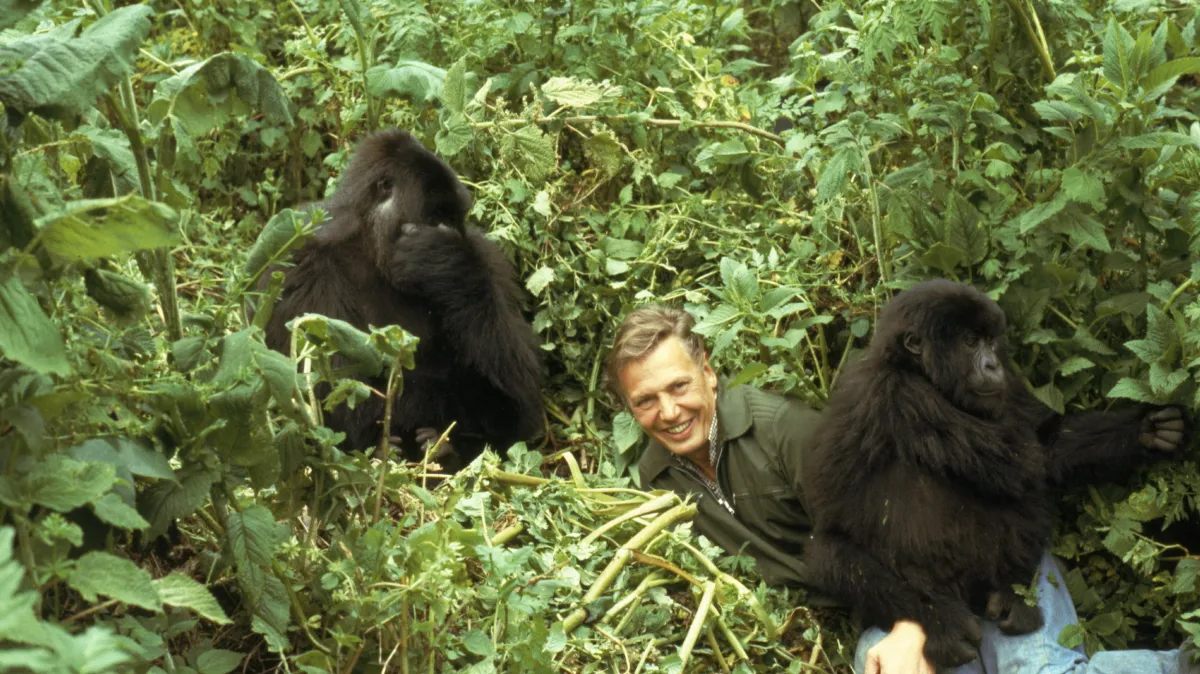
London Zoo was founded in 1828 by men of science who were, at that time, still concerned with the important but almost impossible task of compiling a catalogue of all the species of animals alive today. Some specimens were sent to it, dead. Others arrived alive and were put on display in the society’s gardens in Regent’s Park. Needless to say, special attention was paid to finding species that no other zoo had ever possessed, and that ambition, to some extent, still lingered on even in the 1950s when I visited one of the zoo’s curators with an idea for a new kind of television programme.
Television then was also very different from what it is today. There was only one network, produced by the BBC. The programmes were almost entirely live. Animal programmes were already established. They were presented by George Cansdale, the superintendent of the London Zoo. Week after week, he transported some of the more reasonably-sized and amenable of his charges from Regent’s Park to the BBC studios at Alexandra Palace and put them on a table covered with a doormat, where they sat blinking, while Mr Cansdale demonstrated their anatomy.
Then, in 1953, a new kind of animal programme appeared. A Belgian explorer and film-maker called Armand Denis, together with his glamorous British-born wife Michaela, came to London from Kenya to publicise a feature-length documentary they had made. They had put some of the footage they had not used in the film into a half-hour programme for television, showing elephants, lions, giraffes and other spectacular big game. It was a huge success.
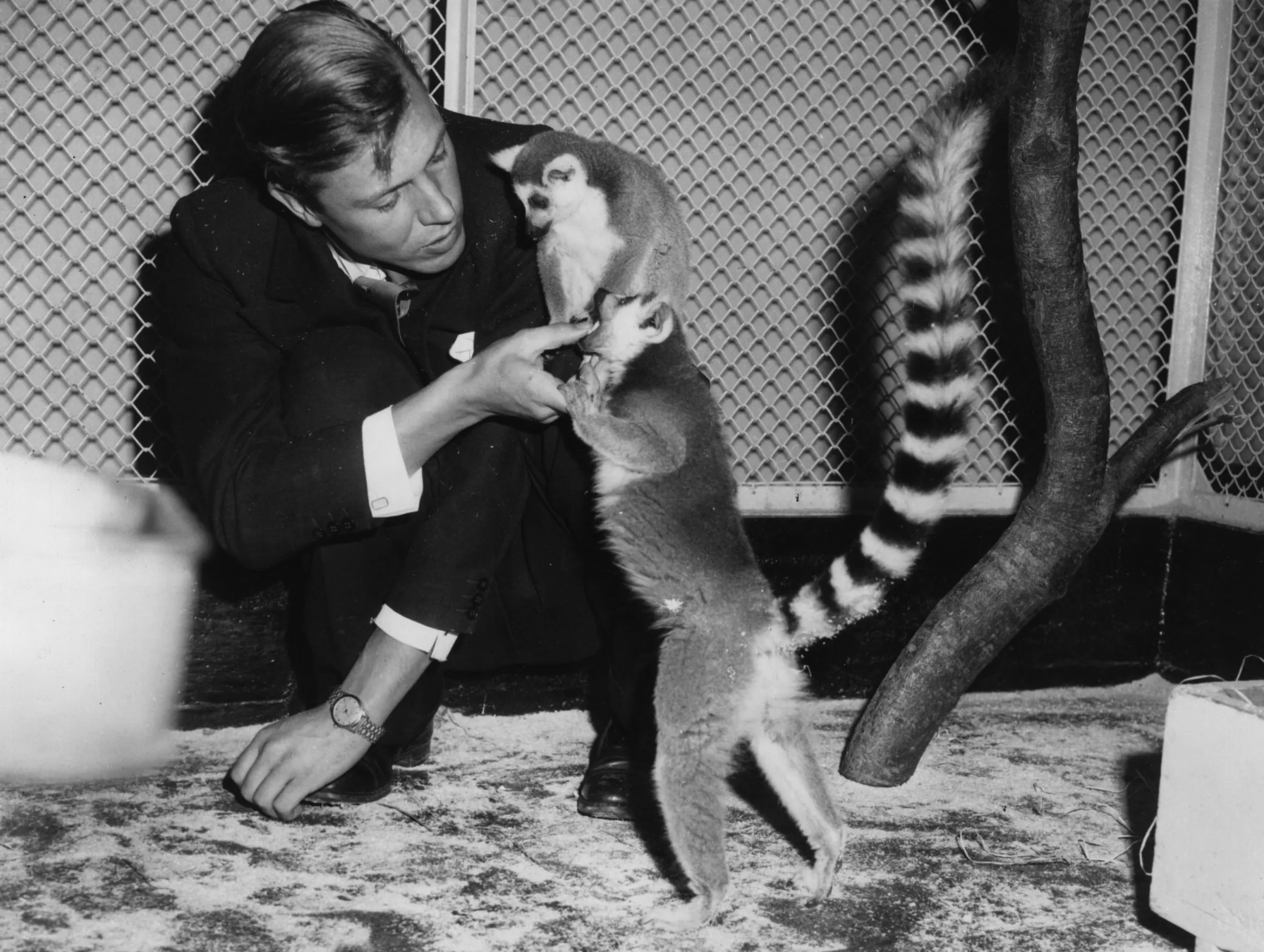 Attenborough with two ring-tailed lemurs at London ZooKEYSTONE/Getty IMAGES
For me, a 26-year-old novice television producer with two years’ broadcasting experience and an unused zoology degree, it seemed that each of these formats had its own attractions — and its own limitations. Surely, I argued to myself, it should be possible to combine the two styles and get the benefits of both. I had already directed music recitals, archaeological quizzes and political discussions. Most recently, I had devised a series of programmes about the purpose of animal patterns and had borrowed some of the animals from Mr Cansdale’s London Zoo. And in doing that I had met the zoo’s curator of reptiles, Jack Lester.
Jack, from his earliest days, had had a passion for animals, but lacking any formal training, he had first taken a job in a bank. However, he soon persuaded his employers to send him to a branch in west Africa, and there he was able to indulge his enthusiasm for collecting and keeping reptiles. After the war he got a job in a private zoo in the west of England and from there he had come to Regent’s Park. His office was a small room in the Reptile House, heated to a suffocating temperature and filled with cages containing dwarf bush babies, giant spiders, chameleons and burrowing snakes.
My plan was simple. The BBC and the London Zoo should mount a joint animal-collecting expedition on which we should both go. I would direct film sequences showing Jack searching for and finally capturing a creature of particular interest. The sequence would end with a close-up of the animal in his hands. The picture would then dissolve into a similar shot of the same creature, but this time live in the studio.
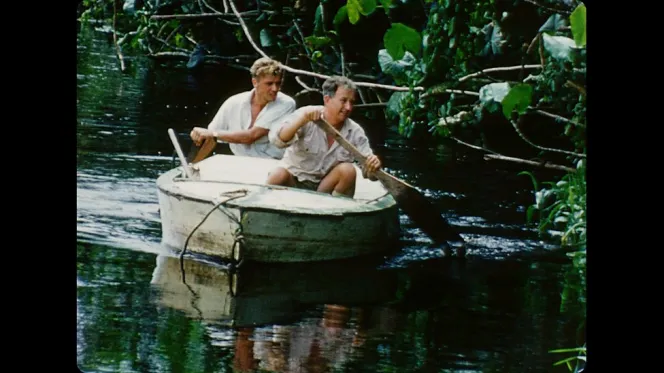 Attenborough with Jack Lester in Guiana
The only problem was that the zoo at the time had no intention of sending out a collecting expedition. Nor had the BBC any intention of embarking on the highly specialised and certainly expensive business of making natural history films. That minor difficulty, however, might be overcome with a single properly stage-managed lunch at which bosses from both the zoo and the BBC would meet, under the impression that the other already had such a scheme in mind. The lunch duly took place in the zoo’s restaurant. Jack and I were there to prompt and steer our seniors. Both bosses left after coffee, each convinced that his organisation had a lot to gain from joining in the other’s plans, and to our incredulous delight the very next day we were both told separately to go ahead.
We agreed on the jungle without any difficulty. Jack’s bank had been in Sierra Leone. He knew the country and he knew the fauna. I was convinced, however, that the expedition should have one particular objective — a rare creature that had never been seen in any zoo anywhere else in the world; an animal so romantic, rare and exciting that the quest for it would keep viewers watching programme after programme. We could call the series “Quest for …” something … But what? The only animal that Jack could think of in Sierra Leone that might remotely qualify was a bird called Picathartes gymnocephalus. It seemed to me that rousing the British public into a frenzy of excited anticipation to see a creature with such a name might be difficult. But Jack could think of no other. So Picathartes became our ultimate target and I called the series Zoo Quest.
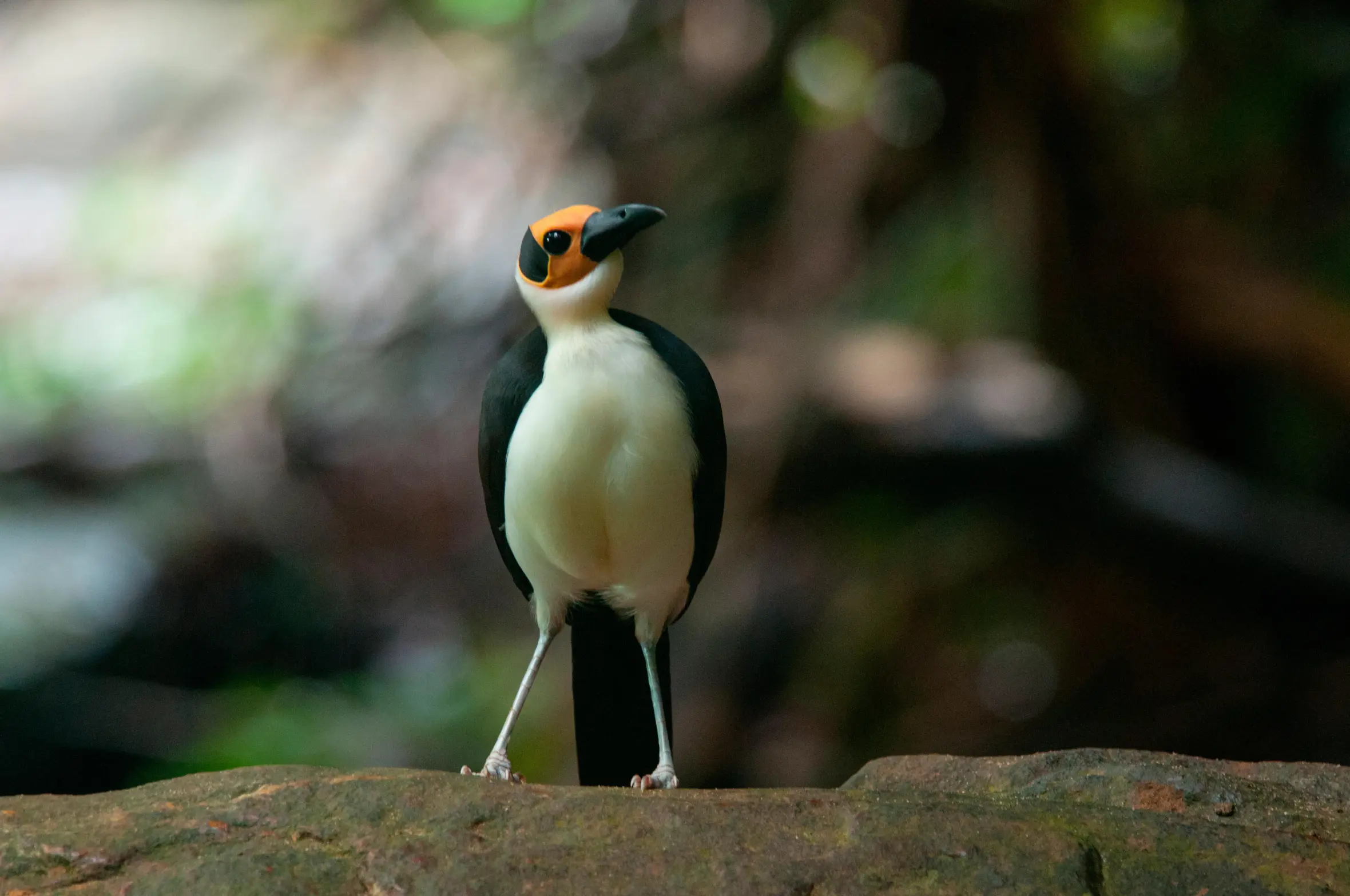 Picathartes gymnocephalus in Sierra LeoneAlamy
I recruited Charles Lagus as cameraman and Jack too enlisted a recruit, Alf Woods, a wily and sagacious head keeper who was then in charge of the zoo’s Bird House. So, in September 1954, the four of us departed for Sierra Leone. After a few days in Freetown, the country’s capital, we set off for the rainforest. Jack had brought with him a small watercolour drawing of Picathartes that an artist had made from a museum specimen, and wherever we went he showed it to people asking if they had ever seen anything like it. People looked at it in bafflement, but eventually we found a villager who recognised it. The bird, he said, built mud nests, rather like those of swallows only very much larger, which it attached to the flanks of great stone boulders buried in the forest.
To capture it we were obliged to use our precious hypersensitive black-and-white film and at last succeeded in getting the first pictures ever taken of a living Picathartes gymnocephalus. The first programme reached television screens in December 1954. Jack showed the animals in the studio and I directed the cameras. But there was a great sadness. The day after the transmission, Jack collapsed and was taken to hospital. The series was, of course, live. So the following week, someone else had to take his place. The head of television instructed me to do so. “You are on the staff,” he said, “so there will be no extra fee.” The following week I did my best to take Jack’s place, handling the animals, while one of my director friends sat in the control gallery directing the cameras.
The Africa we showed was very different from the one presented by the Denises. Potter wasps building their astonishing cup-shaped nests and columns of army ants attacking a scorpion were much smaller than the big game of east Africa, but Charles, with his skilful photography, had made them look extremely dramatic and the series attracted a remarkably big audience. My bosses were delighted. A month or so after the series finished, Jack had recovered sufficiently to be discharged from hospital and we decided to propose another series. Rather to our surprise in March 1955, a mere eight weeks after the last west African programme had been transmitted, we set off again, this time for South America and what was then called British Guiana.
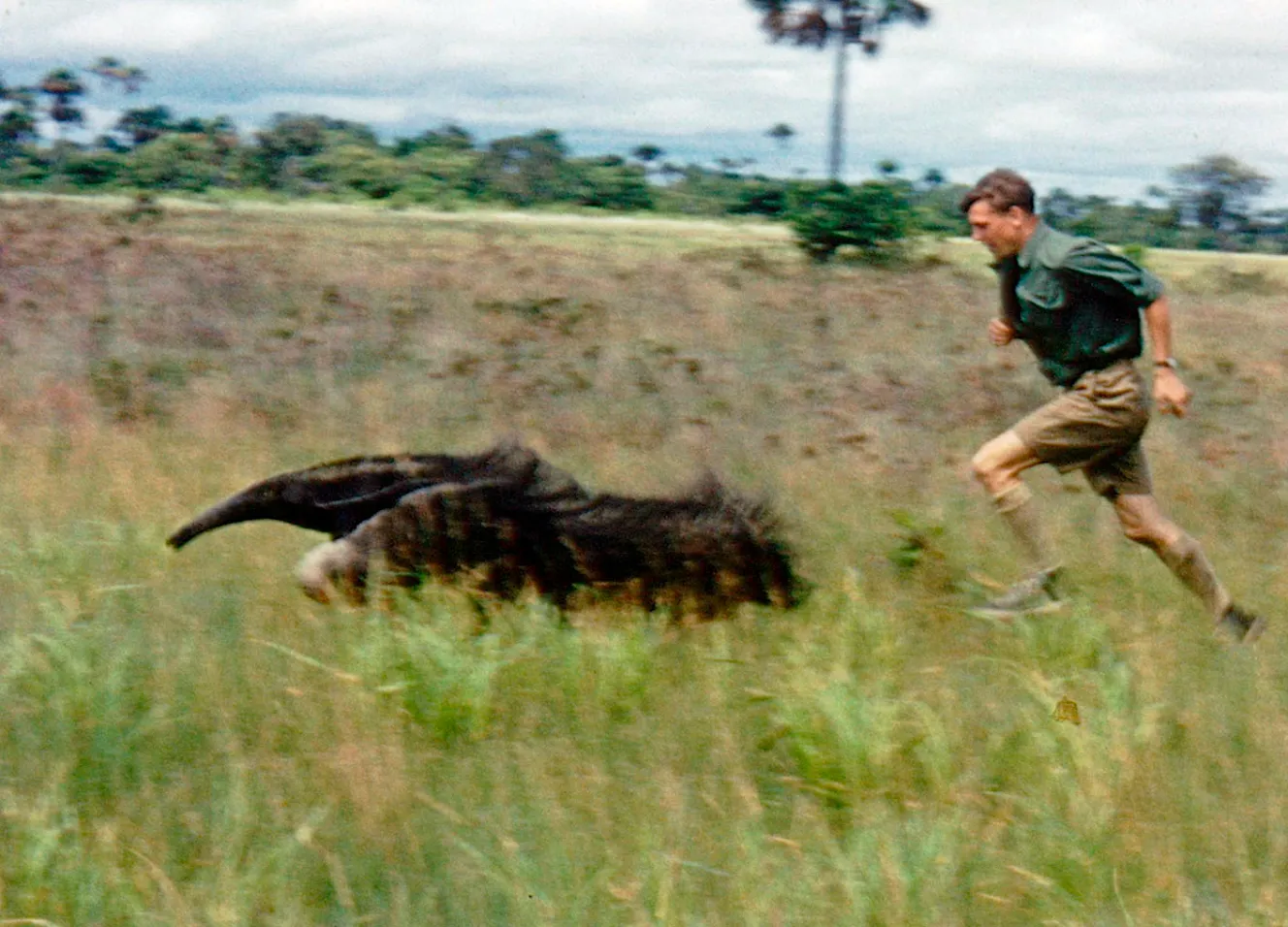 Attenborough in pursuit of a giant anteater in the Rupununi Savannah, British GuianaBBC
But soon after we had arrived there Jack’s illness returned, and he had to fly back to hospital in London. So, once again, I had to take on his role, this time as an animal collector. Jack had still not properly recovered by the time we got back and I once again presented the series. It, too, was a success so we proposed a third trip. This time we decided on Indonesia. Jack would plainly not be fit enough to travel, but he urged us to go without him. So we did. He died while we were away at the tragically early age of 47.
Indonesia, 1956
Every day an old man came to see us. Sometimes he brought a small lizard or a centipede with him. Once he produced a bowl full of puffer fish, each furiously inflating itself into a creamy-coloured ball. Two days before we were due to leave the village, he marched jubilantly up to our hut at the head of a small delegation. “Selamat pagi,” I said. “Peace on the morning.” In reply, he pushed forward a young boy who spoke to us in Malay.
Laboriously we discovered that the lad had been gathering rattan cane in the forest when he had seen an enormous snake. “Besar,” said the boy. “Big. Big.” To demonstrate the dimensions of this monster, he drew a line with his toe in the dust of the floor, took six long paces away from it and drew another. “Besar,” he repeated, pointing from one line to the other. We agreed.
There are only two snakes found in Java which attain such a size and both are pythons. The Indian python grows to a length of 25 feet and the reticulate python even longer. If the snake the boy had seen was indeed 18 feet long, it would be a formidable creature to tackle, for a man caught in its coils would almost certainly be squeezed to death.
I recalled promising the London Zoo that if we could catch a “nice big python” we would do so. The accepted method of capturing such monsters is simple. It requires a minimum of three men and, for preference, the recipe recommends one man for each yard of snake. One man must be made responsible for the head, one for the tail, and the rest for the intervening coils. Then, on a word of command, every man leaps at the snake and grabs the section for which he is responsible.
For complete success, it is important that at least the head-man and the tail-man should grab simultaneously, for if the snake has one free end, it is able to wrap itself round the man dealing with the other end, and begin squeezing. It follows, therefore, that a vital ingredient of the recipe is complete mutual confidence between all members of the team.
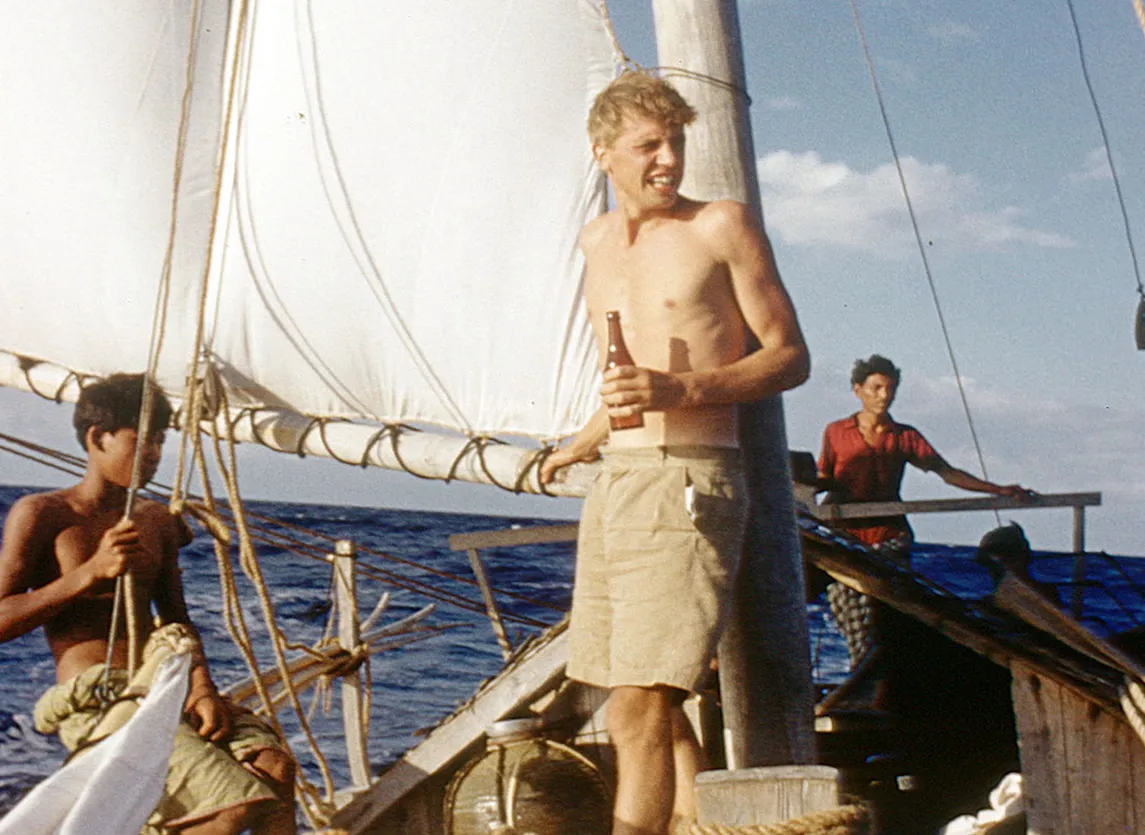 In Indonesia in 1956 for the Zoo Quest for a Dragon series
I looked at the turbanned group in front of me with a certain amount of misgiving. I was not doubtful of their courage individually, but I was very unsure of my ability to convey to them, without any possibility of a misunderstanding, my plan of campaign. I talked for a long time. I drew patterns in the dust. At the end of a quarter of an hour I had succeeded in explaining enough of my plan to convince five of the men that they would have no part of it.
There remained only the old man and the boy. Charles was duty-bound to be filming the operation. I proposed that the old man should leap for the tail, the boy for the middle and I would be responsible for the head. A python’s fangs are not poisonous. On the other hand, the man dealing with the tail is liable to have a rather more unpleasant time, for a snake when it is being attacked nearly always ejects from its rear a large quantity of particularly foul-smelling excreta.
The boy walked ahead cutting a path through the dense undergrowth with his parang.
I walked behind him with a large sack and a rope. Behind me came the old man, and Charles brought up the rear. It would be untruthful to pretend that I was not a little nervous. I was not overwhelmingly confident that the men who were to help me had anything but the dimmest idea of what I expected them to do when my plan went into operation and I shouted “Mendjalankan”. I had culled this word from my dictionary which assured me that it meant “make go: execute”; I devoutly hoped that it was right.
As we passed through a clearing I had a sudden glimpse over the crowns of the trees growing on the slope below us. We walked onwards, higher up the side of the hill. At last the boy stopped. He had seen the snake near here, he said. We dumped our equipment and each of us took a different path through the bush, searching. It seemed a hopeless task.
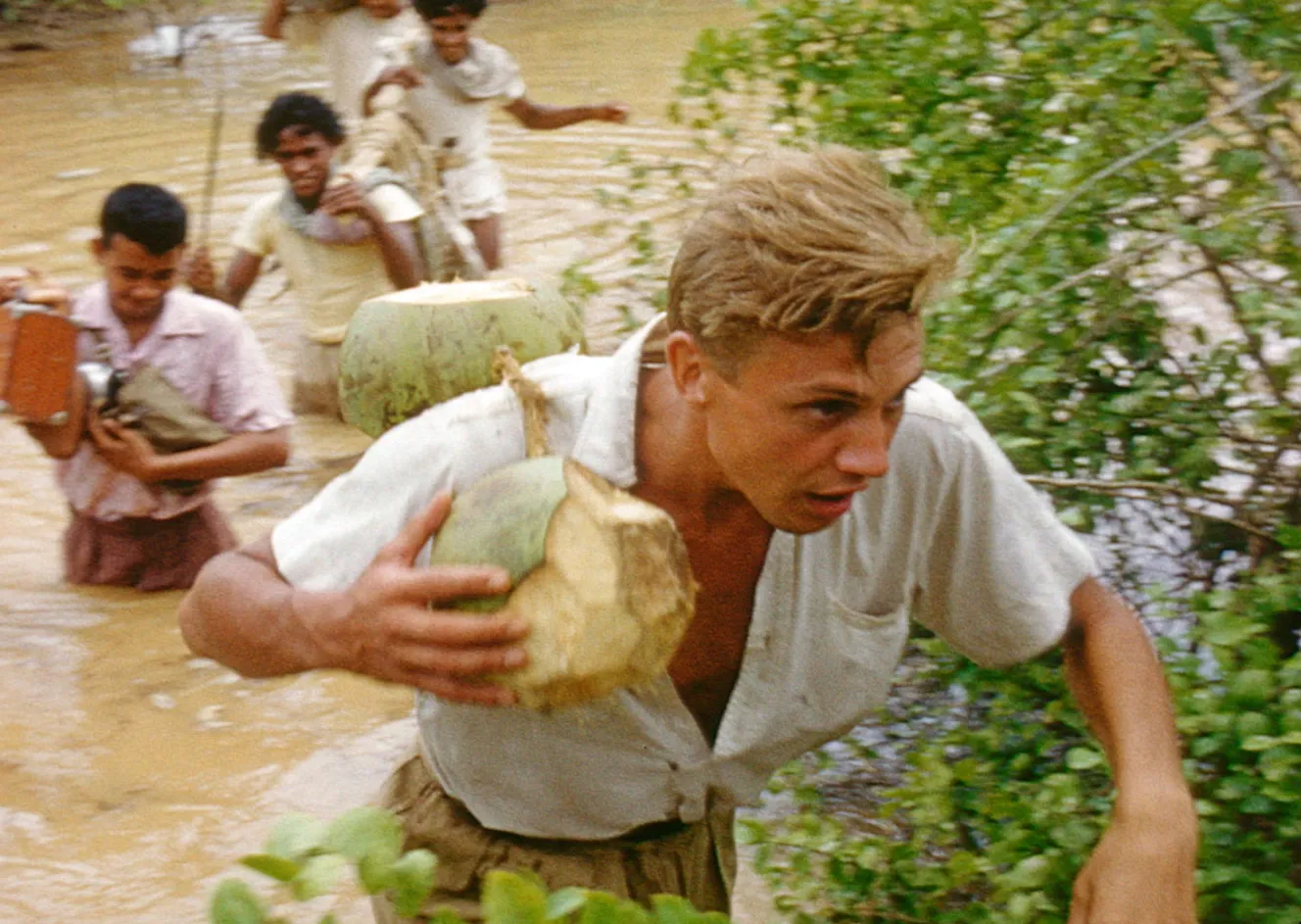 The python was located while the team were searching for a komodo dragonBBC
Suddenly I heard the old man calling excitedly. He was standing at the foot of a small tree in a clearing. As I reached him he pointed into the branches above. Looped over one of the boughs I saw the glistening flank of a giant snake. This was inconvenient: my snake-catching recipe made no mention of how to deal with giant snakes when they were in trees. The only solution was to get it on to the ground so that we could put our carefully arranged plan into action.
With my parang in my hand, I swung myself up into the tree. The branch around which the snake had draped itself was about 30 feet above the ground. As I approached it, I saw to my relief that the reptile was lying at least 10 feet along it, looking straight at me with its yellow button-like eyes. I braced my back against the trunk behind me, and began cutting. As the branch shook beneath my parang the reptile lifted its head, hissed and flickered its long black tongue. One of its coils began slithering smoothly over the branch. I redoubled my efforts. The bough creaked and slowly hinged downwards. With two more blows, it fell clear, carrying the python with it, and landed with a crash close by the boy and the old man.
“Mendjalankan!” I roared. “Make go: execute.”
They gaped at me uncomprehendingly. I saw the snake’s head appear from between the leaves of the fallen branch and it began sliding out, heading for a clump of bamboo on the other side of the clearing. If it reached it and succeeded in entwining itself among the massive bases of the bamboo stems, we should never catch it.
I began scrambling down the tree, as fast as I could. “Mendjalankan!” I bawled in exasperation at my team who were standing beside Charles and his camera, watching dumbfounded. With a final jump, I landed on the ground, seized the sack and ran after the snake which was now within three yards of the bamboo. If we were going to catch it, I should have to tackle it myself.
I caught up with it just before its head entered the bamboo. I snatched its tail and jerked it backwards. It turned on me, opened its mouth and drew its head back in a striking position, its black tongue flickering in and out. I took the sack in my right hand and threw it, like a fisherman casting a net, so that it dropped neatly over its head.
I pounced on the sack, and fumbling in the folds gripped the snake by the scruff of its neck. Then quickly, remembering the recipe, I grabbed its tail with my other hand. I stood up in triumph. The snake’s body, which I estimated was at least 12 feet long, was so heavy and cumbersome that though I raised its head and tail above my head, its middle coils still lay on the ground.
It was at this moment, as I held the snake aloft, that the boy at last decided to come to my assistance. He arrived just in time to receive a jet of foul fluid all over his sarong. The old man sat down and laughed until tears ran down his cheeks.
This is an edited extract from Adventures of a Young Naturalist: The Zoo Quest Expeditions by David Attenborough, published by John Murray.
Ocean: Earth’s Last Wilderness by David Attenborough and Colin Butfield, published by John Murray, is available now.