
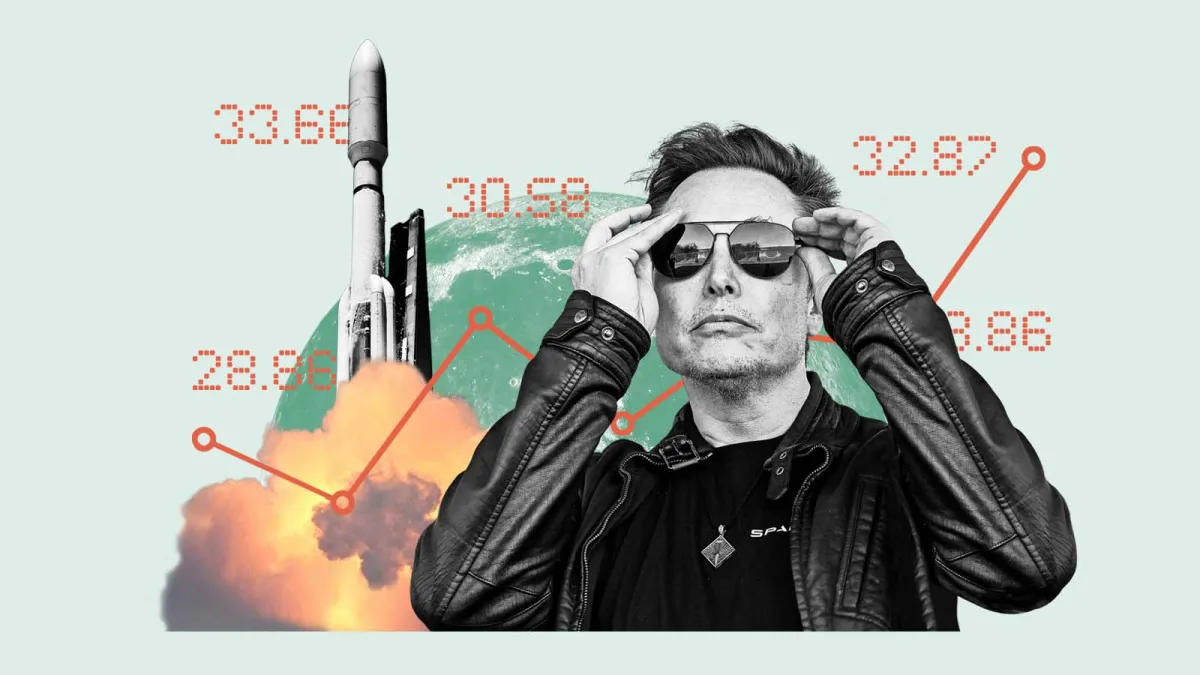
Nobody rings a bell at the top of a bull market — or period of rising share prices — but the biggest share issue yet might send up a warning flare this summer. Space Exploration Technologies, or SpaceX, the eccentric billionaire Elon Musk’s extraterrestrial venture, plans to raise $75 billion (£55.6 billion) with a stock market flotation this summer.
If successful, that would value the rockets to satellites and antisocial media group at an eye-stretching $1.75 trillion (£1.3 trillion). To put that mind-boggling number in perspective, it would mean this business was worth substantially more than the seven biggest shares on the London Stock Exchange put together.
That’s HSBC, the pharmaceutical giant AstraZeneca, Shell, the consumer goods group Unilever, the aerospace and defence engineer Rolls-Royce, British American Tobacco, and the miner Rio Tinto.
Money newsletter
The latest personal finance and investment news from our money team.
Sign up with one click
Coming down from the clouds of macro-economic speculation, if SpaceX can get airborne anywhere near its self-valuation it would be good news for shareholders in several investment trusts that own stakes in the Yankee stargazer. Step forward Scottish Mortgage, the Schiehallion Fund, Baillie Gifford US Growth and Edinburgh Worldwide, which hold the stock, valuing this business at “only” $1.25 trillion.
So, if SpaceX hits its target initial public offer (IPO) valuation, that would mean a 40 per cent uplift for these investment trusts’ shareholdings. To be specific, Edinburgh Worldwide, where I used to be a shareholder, has 20 per cent of its net asset value (NAV) in SpaceX and Scottish Mortgage, where I am a shareholder, has invested 19 per cent of its NAV here.
Less happily, there is a long history of big stock marketing events boosting investor euphoria immediately before bubbles burst. British Gas encouraged millions of people to become shareholders with its Tell Sid campaign in 1986, just in time for the Black Monday stock market crash of 1987.
Back then, as a cub City reporter on Fleet Street, I remember well the abrupt transition from a market driven by greed to one dominated by fear. Never mind the ancient history, here and now we have the government-backed and City-funded campaign to encourage stock market investment with Savvy the Squirrel adverts.
No wonder pessimists fear the worst. History rarely repeats itself but it often rhymes.
Even the Bank of England, which is usually keener to build confidence than question it, is sounding a note of caution. Sarah Breeden, its deputy governor, said: “There’s a lot of risk out there and yet asset prices are at all-time highs. We expect there will be an adjustment at some point.”
Sad to say, she did not elucidate where, when or by how much she expects share prices to fall from their present peaks. However, she added: “The thing that really keeps me awake at night is… what happens in that environment and are we prepared for it?”
One way investors can prepare for the possibility that harsher times are ahead is to sell some funds or shares, while they are still priced near record highs. As I point out here from time to time, paper profits are all very well but you haven’t really made a penny until you sell.
For example, I have never regretted selling half the Fever-Tree Drinks shares I bought for £2.11 in March 2015 for £36.52 each in October 2018 as reported here at both those times. That helped pay for a cottage on the coast and many happy days, while shares in the tonic-maker have subsequently gone a bit flat to finish trade on Friday at £8.25.
More recently, I am also glad to have taken profits from a five-figure parcel of shares in the weight-loss wonder-drug maker, Novo-Nordisk (stock market ticker: NOVO) that I bought for 254 Danish krone in June 2021 and sold for DKK926 in August 2024, as also reported here at those times. Both prices allow for an intervening share split. Since then Novo has lost pounds, and not in a nice way, to trade at DKK278 on Friday.
Both experiences demonstrate the volatility of share prices. Despite such worries, this long-term investor continues to believe that a diversified portfolio of shares is likely to deliver higher returns than bank or building society deposits over most periods of five years or more.
That is the fundamental lesson from more than a century of stock market analysis, annually updated in the Barclays Equity Gilt Study. However, as mentioned earlier, shocking setbacks do happen and can hurt short-term speculators or investors with too much invested in too few businesses.
That is why I spread my forever fund over more than 50 shares. Even if one were to plunge to zero, as happened with the Gloucestershire-based graphene-maker Versarien, or lose more than a tenth of their value — like Cowie’s Clangers such as Helium One Global and Schroders Capital Global Innovation — it should not destroy more than 2 per cent of my life savings.
On a happier note, while we can’t make a decision about SpaceX until the precise terms of its IPO, which is expected to happen in June or July, are announced, another extraordinary extraterrestrial business requires more urgent attention. Seraphim Space Investment Trust is offering more stock for sale in what is called a “C” share issue of separate shares valued at a lower price of £1, which is due to close for retail investors at noon next Wednesday, May 6. Some platforms may require you to buy before then.
The news that this space technology specialist hopes to raise up to another £350 million from individuals and institutions through these shares, which would more than double its stock market capitalisation or value, caused the share price to slump on Monday. But I really mustn’t grumble after paying 53p in March last year, as reported here at that time, for regular Seraphim shares that finished trade at £1.91 on Friday.
That makes this high-risk tiddler the second-most valuable shareholding in my portfolio, accounting for more than 7 per cent of its total value. Regular readers may recall that three quarters of Seraphim’s NAV is defence-related and two thirds is invested in Europe, including the United Kingdom.
So it is a double beneficiary of European fears about the Russian threat and our unpredictable American friends. While the UK still dithers about turning talk into action on defence, the Baltic states, Germany and Poland are spending with both hands. Many folk there still have vivid family memories about what it was like the last time the Red Army was in town.
Today, satellites — or “eyes in the skies” — have changed the nature of violent conflict. Even if peace were to break out in Ukraine tomorrow, which doesn’t seem very likely, this trust might continue to gain from European state spending switching from welfare to warfare.
Seraphim is the only London-listed fund focused on this boom sector and has demonstrated expertise in asset allocation. So, despite my earlier comments about diversification, I have subscribed for some C shares. It isn’t rocket science, is it?
Full disclosure: Ian Cowie’s shareholdings