
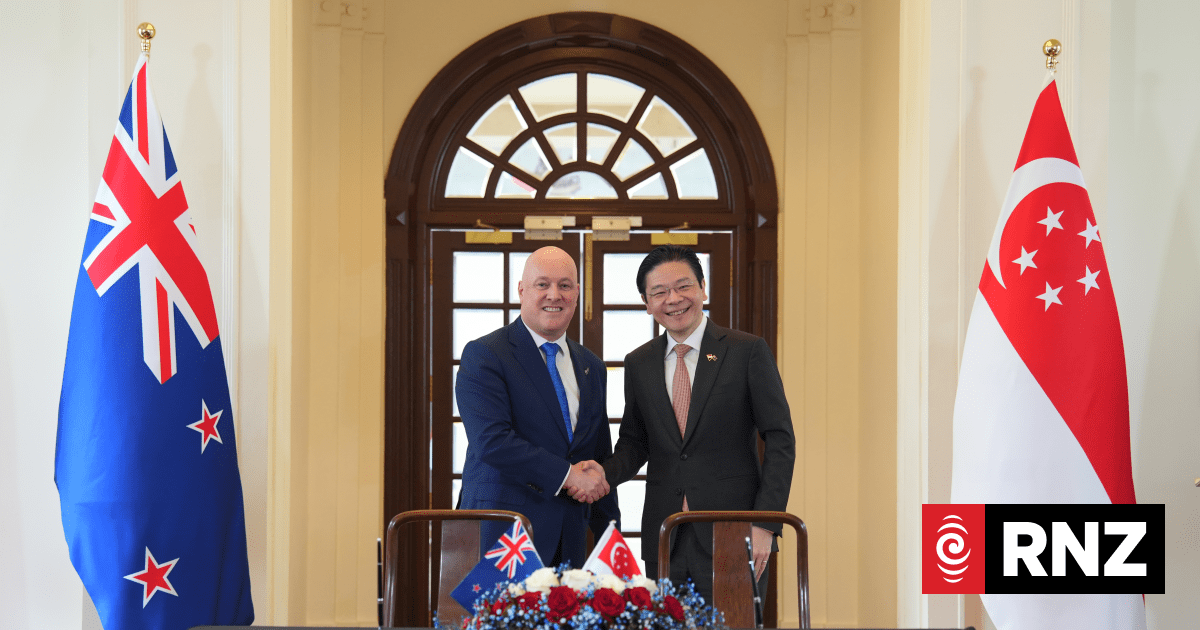
New Zealand and Singapore have inked a deal to ensure the trade of essential goods like fuel and food continue in times of crisis.
It guarantees neither country will impose export restrictions on the other and formalises supply chain resilience cooperation.
Prime Minister Christopher Luxon and his Singaporean counterpart Lawrence Wong shook hands on the agreement in October, and Trade Minister Todd McClay signed it in Singapore on Monday.
Luxon, who witnessed the signing with Wong, said it had already proven its worth and shown the two countries can rely on each other in crisis.
“The past few months have shown we live in a volatile world – Kiwis are seeing that every time they fill up their car. That is why we are hustling in the world to protect New Zealand and build our resilience in uncertain times,” he said.
“With a third of New Zealand’s fuel refined in Singapore, this Agreement turns trust into action – and right now, that’s keeping fuel flowing to New Zealand when it matters most.”
The agreement leveraged New Zealand’s “special skill” as the “best food producer in the world”, he said.
The list of goods exempt from export restrictions include fuel, food, and construction materials.
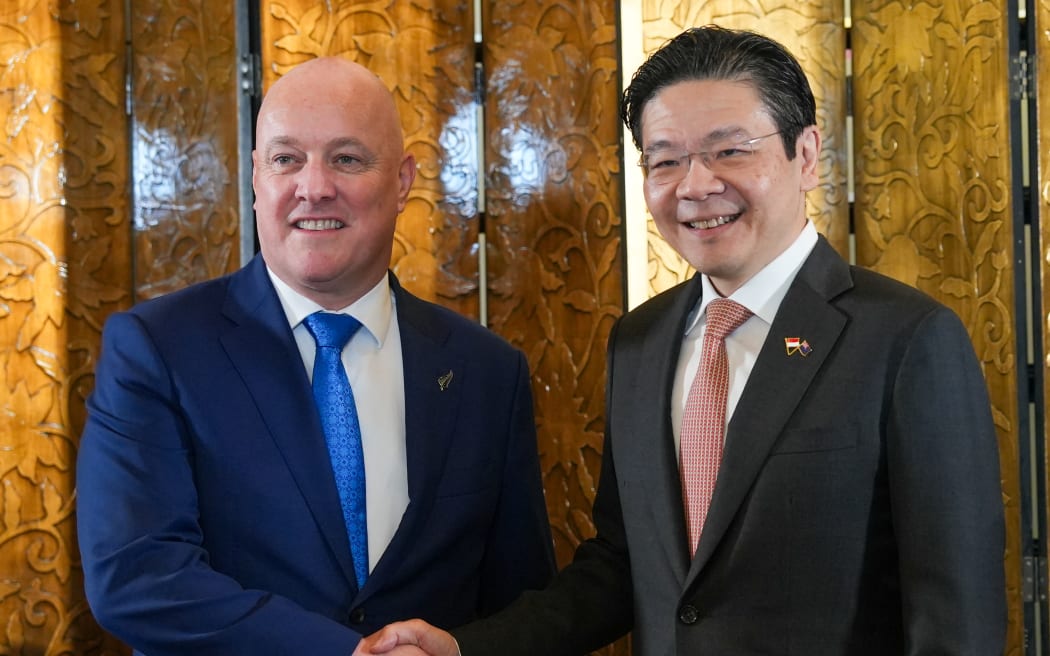
Christopher Luxon and Singapore PM Lawrence Wong.
Photo: Supplied / PMO
The deal will be incorporated into the existing New Zealand-Singapore Free Trade Agreement, following domestic approval processes in both countries.
Speaking to media after their bilateral meeting, Wong said the agreement showed “even under strain, trusted partners will keep faith with one another”.
Every country would be tempted to look inward in difficult times, he said.
“But when that happens, supply chains break down and everyone ends up worse off. So this agreement is our answer, it’s a commitment that we will do things differently, that we will keep markets open, keep essential good flowing, and stand by one another.”
Luxon described the partnership as active, practical and future focused.
“We have each other’s backs,” he said.
Both Luxon and Wong were clear the agreement could be extended to include other countries.
“It’s not meant to be exclusive, we welcome other countries to join us, and if they are able to meet the same standards, then it will start to expand a network of trusted partners who can provide similar assurances to one another,” said Wong.
Luxon added he was “absolutely open” to include others.
New Zealand will chair a meeting of the The Future of Investment and Trade Partnership in July.
Along with New Zealand and Singapore, the partnership consists of Chile, Brunei, Paraguay, Uruguay, Malaysia, Switzerland, Liechtenstein, Norway, Iceland, Costa Rica, Panama, Rwanda, Morocco, and the United Arab Emirates.
Speaking to media afterwards, Luxon said there would be countries within that group that were “more up for doing things a little differently”, but it would take a high level of commitment.
“It’s got to work for both parties, right? That’s the bilateral power of this, where we’re proving food to a country that imports 90 percent of its food, but also we need pharmaceuticals, fuel and building and construction supplies as well.”
Luxon said in light of the United States’ tariffs, it was important to continue to work out how countries could innovate or modernise trade architecture for the benefit of everybody.
While it was a groundbreaking agreement for supply chains, the Prime Ministers agreed further ground could be broken.
They referred to defence, security, the green economy and the digital economy as areas in which New Zealand and Singapore could collaborate further.
Both Prime Ministers said “the sky is the limit” for the relationship between the countries and business leaders.
Fuel supply not an issue – Luxon
Luxon said he met with a number of major fuel companies in Singapore and was assured there would not be a supply issue in the next few months, despite the Middle East war putting a strain on access to oil.
New Zealand gets around a third of its fuel from Singapore.
Luxon said refineries there had been able to access alternative sources of crude oil, and were maintaining production.
“We know it’s going to be potentially bumpy, and that’s why we’re preparing … in the way that we are with our four-phased approach back at home, but importantly for now, we don’t see a risk to any of that supply based off the conversations we had this morning.”
Luxon said even if a ceasefire happened today, there would be around a six-month lag effect.
‘Companies are confident they’ll continue to have supply’
Finance minister Nicola Willis said fuel giants were confident they could continue to access crude oil, but there would still be pressures on price.
The refineries have had to adapt from dealing with sour crude to sweet crude, which had been a significant engineering challenge.
Fuel was coming in, but in some cases it was taking longer, which had higher transport costs associated with it.
“So long as they pay the price for alternative sources of crude oil, it will be available. They can transport it, they can get there. But they are conscious that if supplies diminish over time, as reserves are used, that could put a pressure on price,” she said.
“We knew that coming into the visit that there are still pressures. For so long as the Strait of Hormuz is closed, that creates a global supply pressure. That does remain the case, but these fuel importing companies are confident they’ll continue to have supply.”
Responding to news of shipping giant AP Moller-Maersk raising some of its freight charges by 27 percent, Willis said it would have a different impact, exporter by exporter, depending on their commercial arrangements.
“This is what we’re talking about when we talk about the secondary impacts that come through to overall inflation. It’s not just how much the petrol price increases, but it’s how this conflict in the Middle East puts price pressure on across the board that eventually gets reflected in our economy,” she said.
“And that’s why you’re seeing economists reflecting that they expect inflation to go higher this quarter, because of these secondary effects, in part.”
New Zealand’s goods were still in high demand, Willis said, and exporters continued to reassure the government they could find willing buyers who wanted New Zealand products.
Sign up for Ngā Pitopito Kōrero, a daily newsletter curated by our editors and delivered straight to your inbox every weekday.