
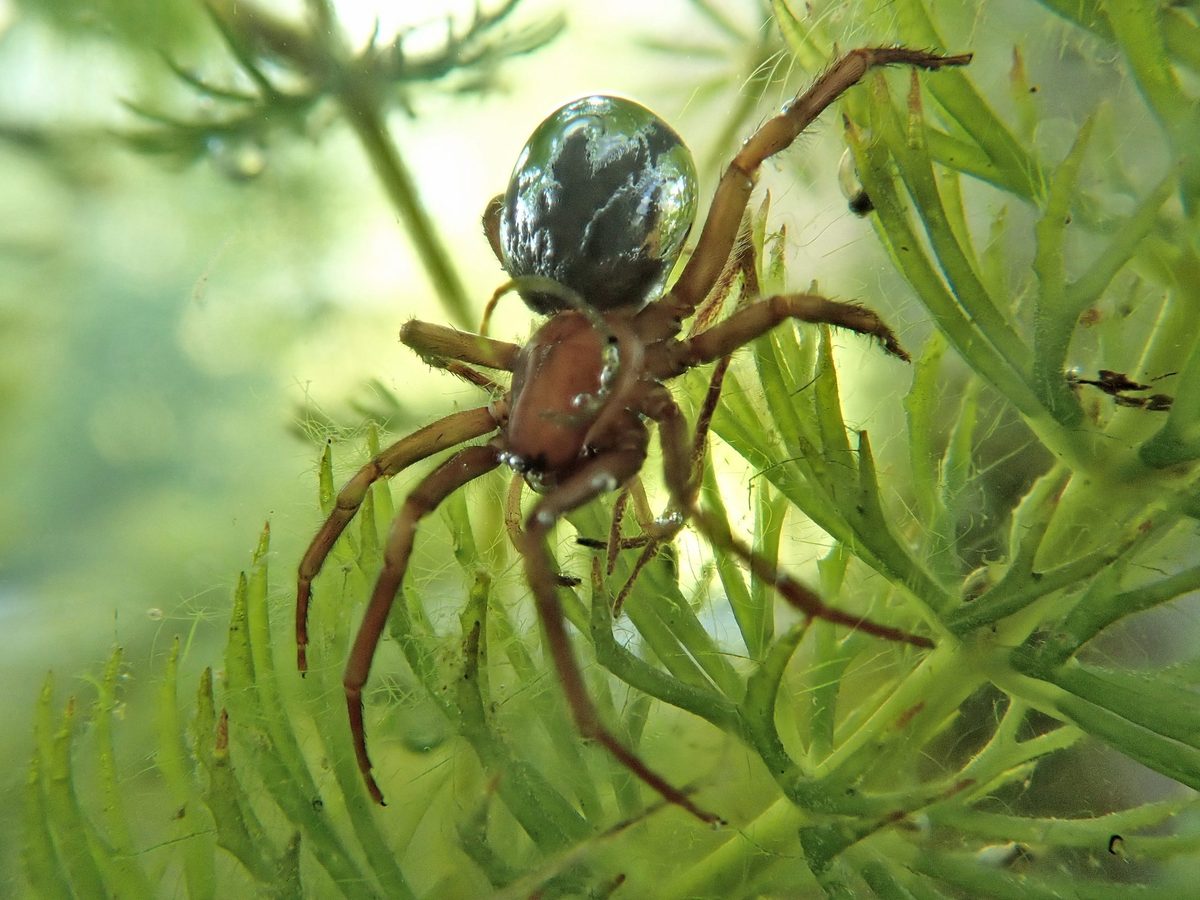
The diving bell spider, or Argyroneta aquatica, is an incredible arachnid that has created a remarkable way of managing to live almost entirely underwater.
According to a 2017 research paper looking at record breaking achievements by spiders, the diving bell spider is the spider that spends the longest time underwater – which is most of its life.
While there are several species of spider that live in wetlands (and even some that can be underwater for long periods of time), there is only one spider that actually lives most of its life underwater.
It lives, rests, catches and eats prey, mates and lays eggs all under water. But it does need oxygen to live. How does it do it?
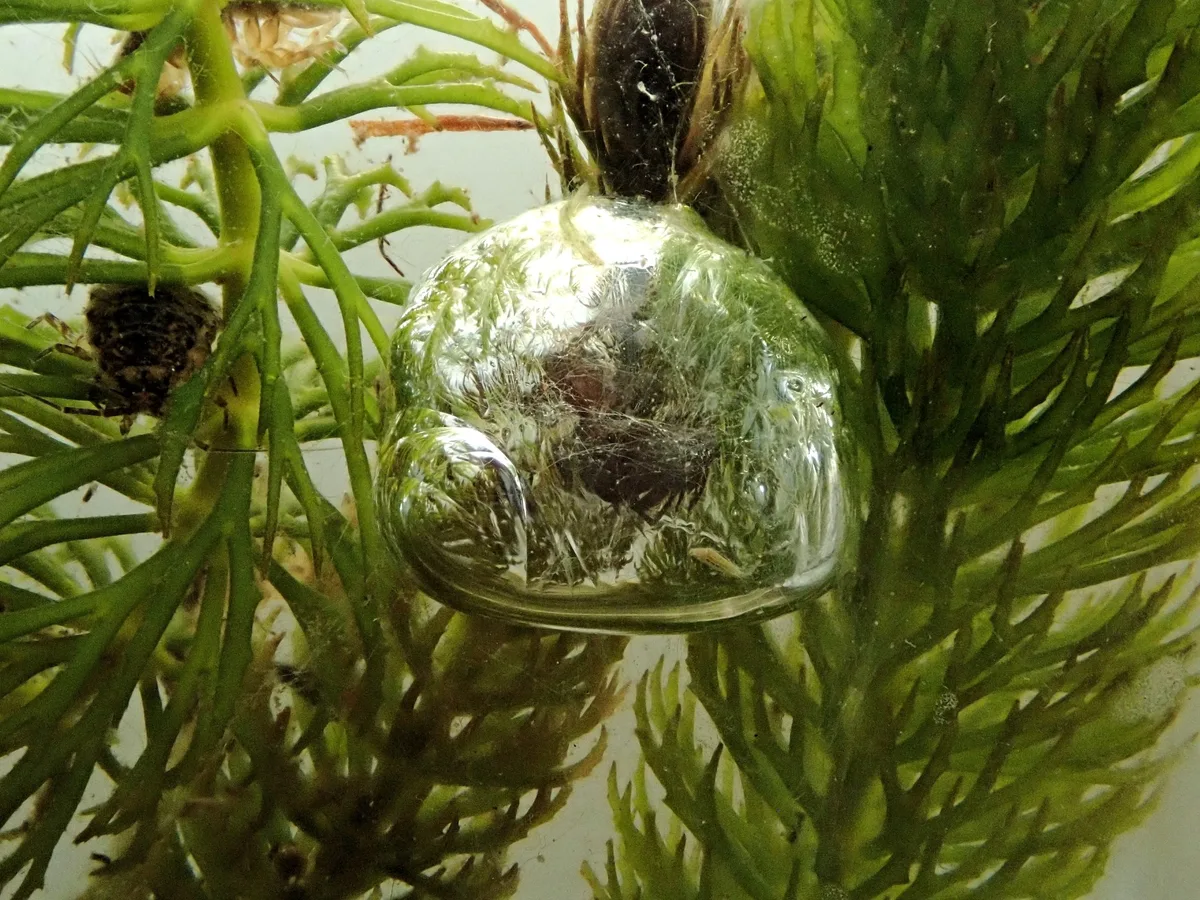 The diving bell spider Argyroneta aquatica in its diving bell bubble. Credit: Geoff Oxford from the British Arachnological Society
The diving bell spider has specific adaptations to breathe underwater and goes about creating a dome-shaped web between aquatic plants which it then fills with air carried from the surface of the water. As the spider submerges into the water, an air bubble is trapped by a layer of hydrophobic hairs on its abdomen and legs.
It then releases this into the dome-shaped web and after a few journeys to the surface, the bubble is large enough for the spider to fit inside.
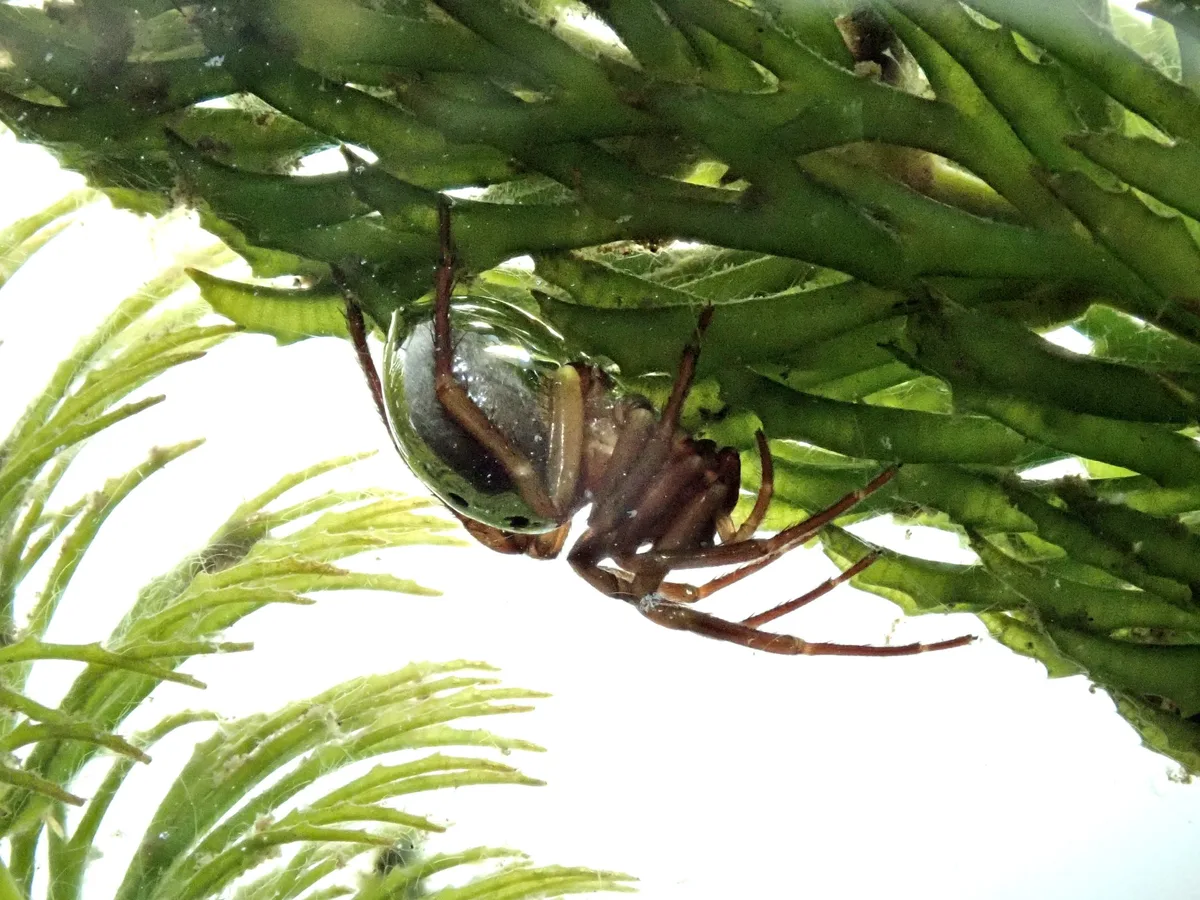 The diving bell spider Argyroneta aquatica with a bubble on its abdomen allowing it to breathe underwater. Credit: Geoff Oxford
How does the diving bell spider’s bubble work?
But the bubble is not just an air pocket, it is also a gill. Fresh oxygen from the surrounding water naturally diffuses into the bubble and carbon dioxide is diffused out. Diving bell spiders are able to stay inside their bubbles for over a day without having to head up to get more oxygen.
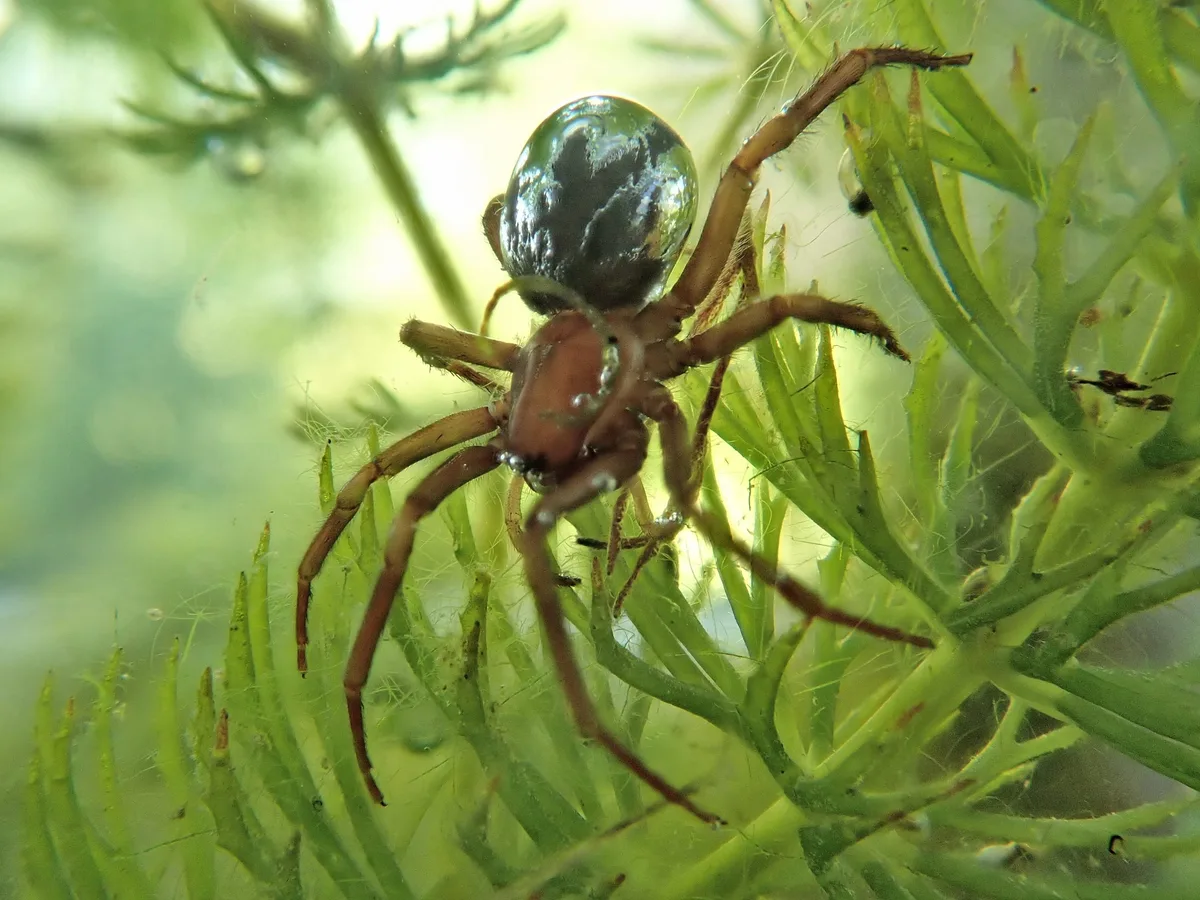 The diving bell spider Argyroneta aquatica with a bubble around it enabling it to breathe underwater. Credit: Geoff Oxford – Credit: Geoff Oxford from the British Arachnological Society
What’s also remarkable about this spider is that if it wants to move through the water, the hydrophobic hairs on its body traps air from the web bubble so that there is a thin layer of air around the body of the spider, enabling it to breathe.
Female spiders tend to spend most of their time within their bells, or webs, and come out mainly to catch animals that have been caught on their webs. The spider’s hairs and air pockets make the spider look silvery under the water, but when out of the water they are brown.
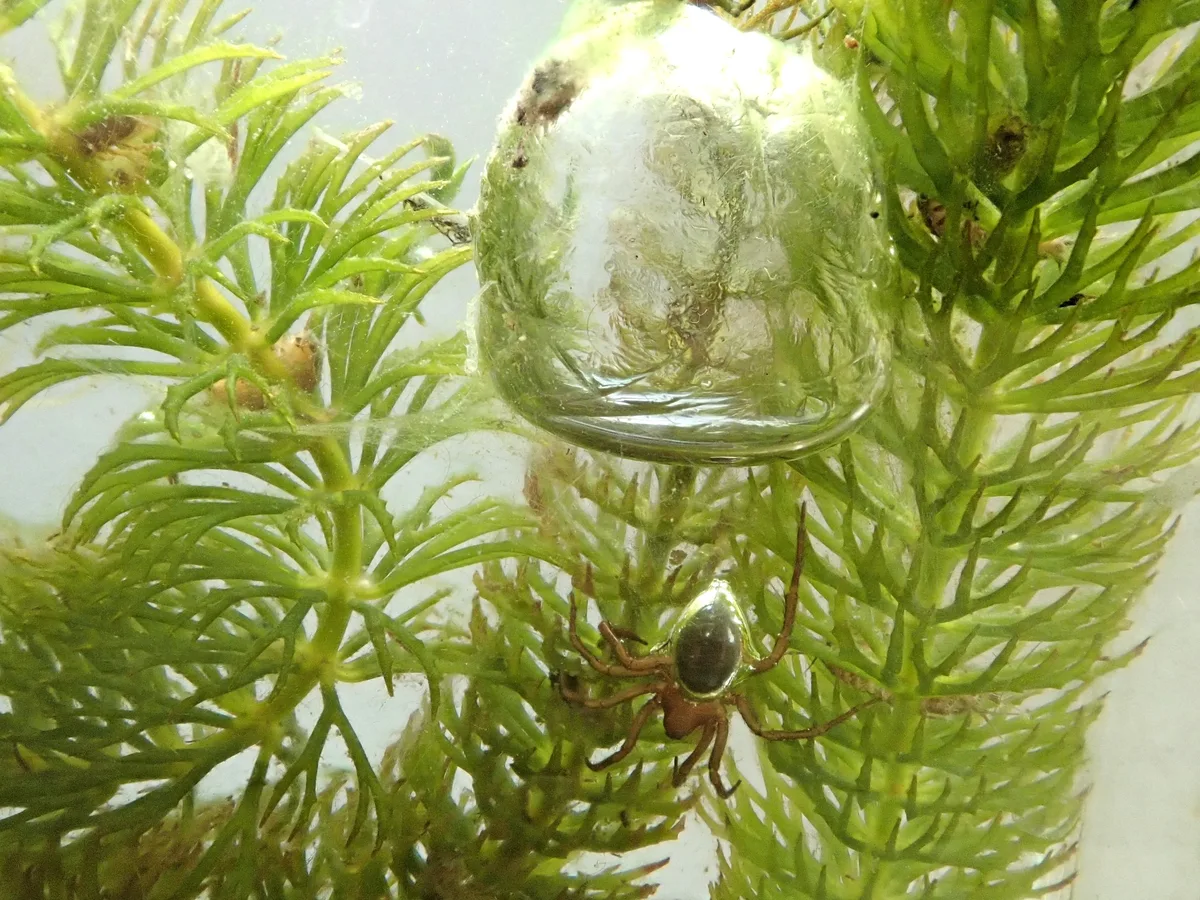 The diving bell spider Argyroneta aquatica having just left its diving bell bubble. Credit: Geoff Oxford
Other spiders that can be underwater
The diving bell spider is the only spider that lives almost entirely underwater. However, there is another spider that is able to survive for a remarkable period of time underwater. The salt-marsh species of wolf spider Arctosa fulvolineata is able to survive for more than 16 hours underwater. This is due to the spider’s ability to fall into a hypoxic coma.