
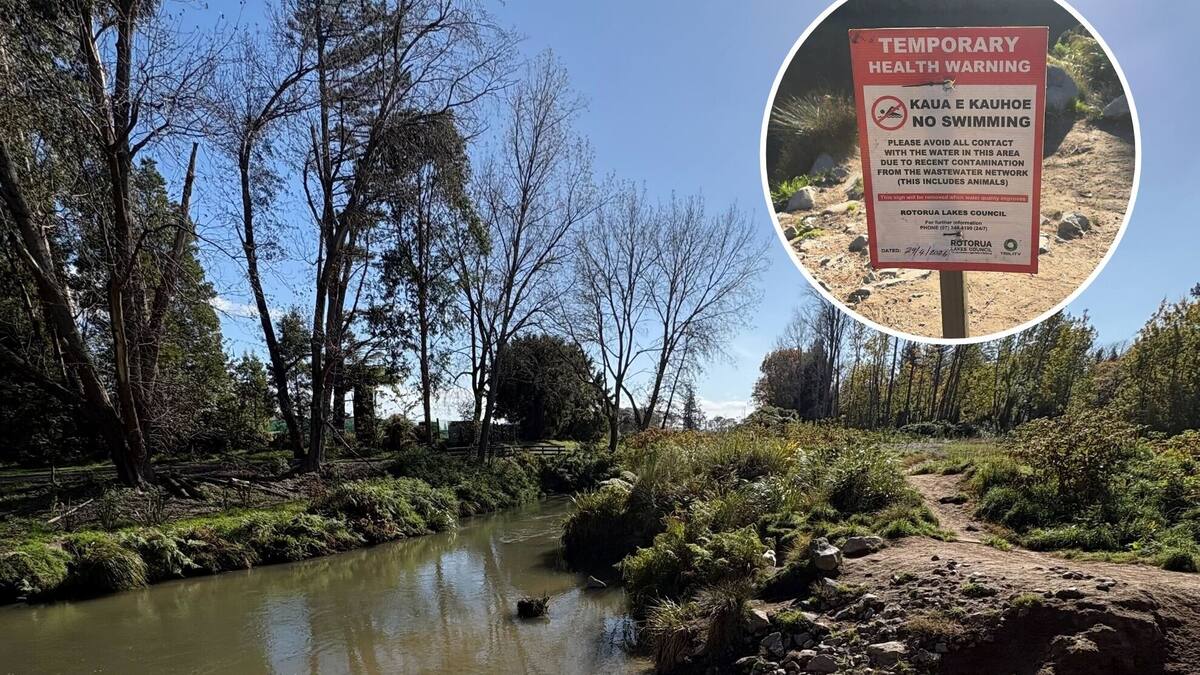
This blockage caused an overflow from a sewer manhole on Jameson Ave, which was detected on Wednesday.
“The overflow entered a stormwater cesspit, which drains into the Puarenga Stream,” the council said.
The warning sign advising of potential contamination at Rotorua swimming hole. Photo / NZME
After Wednesday’s leak, levels reached 630CFU per 100ml.
Further testing on Thursday returned normal results on Friday, with the water now considered safe for recreational use – including by dogs.
The council said closing the affected stretch of water was a “mitigation measure” aimed at reducing the risk of exposure.
“Contaminated water presents a potential public health risk, due to the possibility of sewage-borne diseases being present in the waterway,” it said.
Dogs regularly frolic in the water hole. Photo / NZME
The council said the incident was a “timely reminder” of what should and should not be disposed of via household plumbing.
“Anything that isn’t pee, poo or toilet paper does not readily break down and can cause blockages in our pipes.
“Rags, wet wipes and fats in the sewerage network can cause significant damage, particularly to the environment, and should not be washed down the sink or flushed down the toilet.”
The financial impact of fatbergs is also significant.
Water New Zealand has estimated that damage caused by such blockages costs the nation’s councils more than $16 million annually.
Fatbergs, like this one in New Plymouth, can block wastewater networks. Photo / NZME
Rotorua Lakes Council said it had 48 “dry weather overflows” over the past 12 months, of which an estimated half were caused by “fats and rags”.
In 2022, a fatberg blockage led to a section of Linton Park being closed after wastewater overflowed from a manhole.
That incident prompted the council to release a list of unusual items found in Rotorua’s wastewater network, including children’s toys, an oil can, a hedgehog and even a pig’s head.
While the affected section of the Puarenga Stream is now deemed safe, the council has advised pet owners to take precautions if they believe their animals may have come into contact with contaminated water.
“They should be washed to prevent the spread of contamination,” the council said.
“You should then monitor your pet and, if you are concerned about their condition or wellbeing, we advise you to seek advice from a veterinarian.”
Mathew Nash is a Local Democracy Reporting journalist based at the Rotorua Daily Post. He has previously written for SunLive, been a regular contributor to RNZ and was a football reporter in the UK for eight years.
– LDR is local body journalism co-funded by RNZ and NZ On Air.