
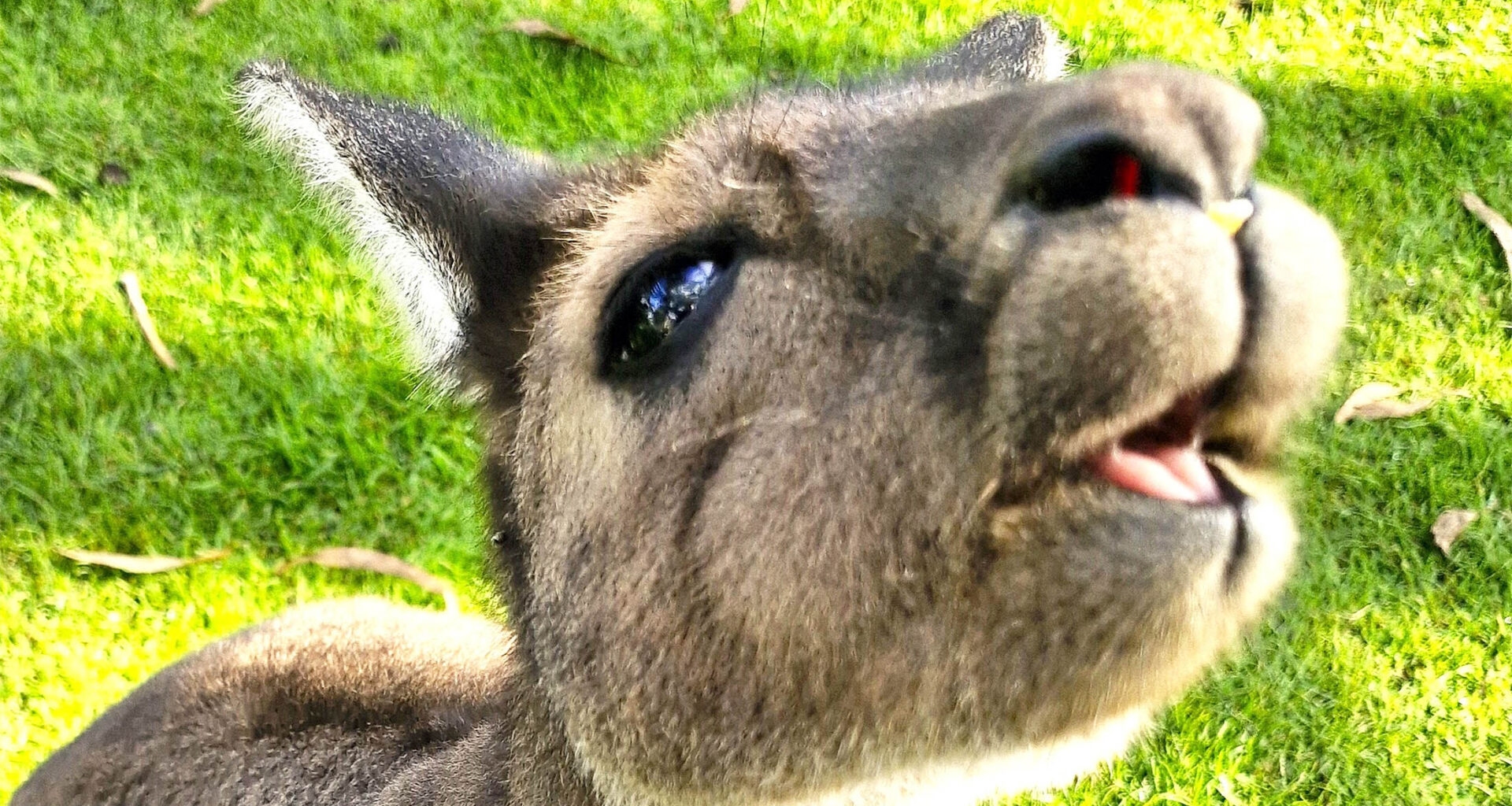
Grasslands shape the life of an ecosystem in a very specific way. Across continents, animals that feed on tough grasses tend to share one key feature: specialized teeth.
Horses, zebras, and antelopes all carry tall, ridged molars built to grind down abrasive plants over years of chewing. This pattern appears so often that it feels almost predictable.

However, Australia tells a different story. The most prolific grazers that reside there do not follow this pattern at all.
In contrast, kangaroos thrive on grass, yet their teeth seem characteristic of a completely different group of plant-eaters.
This odd mismatch has puzzled scientists for years, and a new study on the animal explains why.
Grass-eaters share similar teeth
Grass is not an easy food to consume. It contains silica and other tough particles that wear down teeth quickly.
To handle this, many grazing mammals evolved high-crowned teeth with complex ridges.
These structures act like grinding surfaces and last longer under constant stress.
This design appears again and again in animals, even ones that live far apart. It suggests a shared solution to the same problem. Thus, this is why kangaroos stand out.
Kangaroos challenge expectations
Compared to other animals, kangaroos dominate Australia’s grasslands. They compete successfully in an environment that demands efficient grazing.
However, their teeth do not resemble those of other grazers. Instead, their dental structure looks closer to animals that eat softer foods.
“The teeth and jaws of kangaroos are like those of herbivores which feed on softer leaves, manatees, monkeys, lemurs, and some extinct relatives of elephants, or animals that you would think have little in common with kangaroos,” said Dr. Aidan Couzens of Flinders University.
This comparison raises a clear question. How does an animal with such teeth succeed in a harsh grazing environment?
Fossils reveal hidden details
The team turned to fossils for answers. They used X-ray scans to study kangaroo teeth from different time periods.
Instead of focusing only on shape, the researchers measured enamel thickness, a critical detail.
Enamel is the hardest substance in the body. Its thickness determines how well a tooth can resist wear and reveals its resilience.
Advantage of thick enamel
Kangaroos have extremely thick enamel. This creates a strong surface that can handle abrasion even without elaborate ridges.
It is a different way to solve the same problem. Additionally, chewing style also plays a role.
“Because kangaroos slice their food up vertically, the most straightforward way for them to adapt to grazing was by making their enamel thicker. This is unlike hoofed mammals, which chew from side-to-side,” noted Couzens.
Other grazers move their jaws sideways to grind food, but kangaroos move their jaws vertically, cutting through plants. This difference shaped their dental evolution.
Similar diets, different adaptations
Both kangaroos and hoofed mammals face the same dietary pressure. Grass wears down teeth in any environment. But their jaw movements pushed them toward different solutions.
One group built complex grinding teeth. The other reinforced simpler teeth with thick enamel.
This shows that evolution does not always follow a single path, even when the problem is the same.
Human evolution enters the picture
The findings extend beyond kangaroos. When researchers compared enamel thickness across species, they found a surprising match.
An extinct human relative called Paranthropus had similarly thick enamel, similarly to that of the kangaroos.
Scientists have debated its purpose for years. Some suggested it helped crack hard foods. Others argued it protected teeth from wear caused by gritty plants.
Abrasion explains thick enamel
The kangaroo data supports the second idea, in comparison to humans, and in examining abrasion clues.
“It’s been debated whether human ancestors had thick enamel to eat grasses or sedges, or to protect teeth from breaking when chewing nuts,” said Couzens.
“Our results support the idea that it was dietary abrasion driving their evolution.”
This link connects Australian marsupials to human evolution in an unexpected way.
Extinction reshaped the ecosystem
The story includes another twist. Australia once had other plant-eating marsupials with teeth more like those of horses and deer. These animals seemed better suited for grazing.
Yet they disappeared before grasslands expanded. Their extinction left open space in the ecosystem. Kangaroos moved in and adapted over time.
Why those earlier species vanished remains unclear. Competition, climate, or other factors may have played a role.
Outcomes can defy prediction
It is easy to assume that evolution follows a clear path. The best adapted species survive and take over. However, the kangaroo story challenges that idea.
“In some ways the evolutionary history of herbivorous mammals in Australia is upside down because the vertical chewing herbivores (i.e., kangaroos) win out whereas the reverse occurred on the northern continents,” said Couzens.
Animals with the expected traits did not dominate. Instead, a different group succeeded by finding another way.
The role of timing and luck
This research highlights the role of timing and chance. Extinctions, environmental shifts, and inherited traits all influenced the outcome.
“Just because you have the right adaptations doesn’t guarantee success. Other things need to go in your favour, including a certain degree of luck,” noted Couzens.
Kangaroos did not succeed because they were perfect grazers from the start. They adapted step-by-step as conditions changed.
Unexpected evolutionary success
Today, kangaroos define Australia’s grasslands. Their success shows that evolution can take unexpected routes.
The same challenge can produce very different solutions. What matters is not just the problem, but also the history behind it.
In this case, thick enamel and vertical chewing shaped a path no one would have predicted at first glance.
The study is published in the journal Science.
—–
Like what you read? Subscribe to our newsletter for engaging articles, exclusive content, and the latest updates.
Check us out on EarthSnap, a free app brought to you by Eric Ralls and Earth.com.
—–