
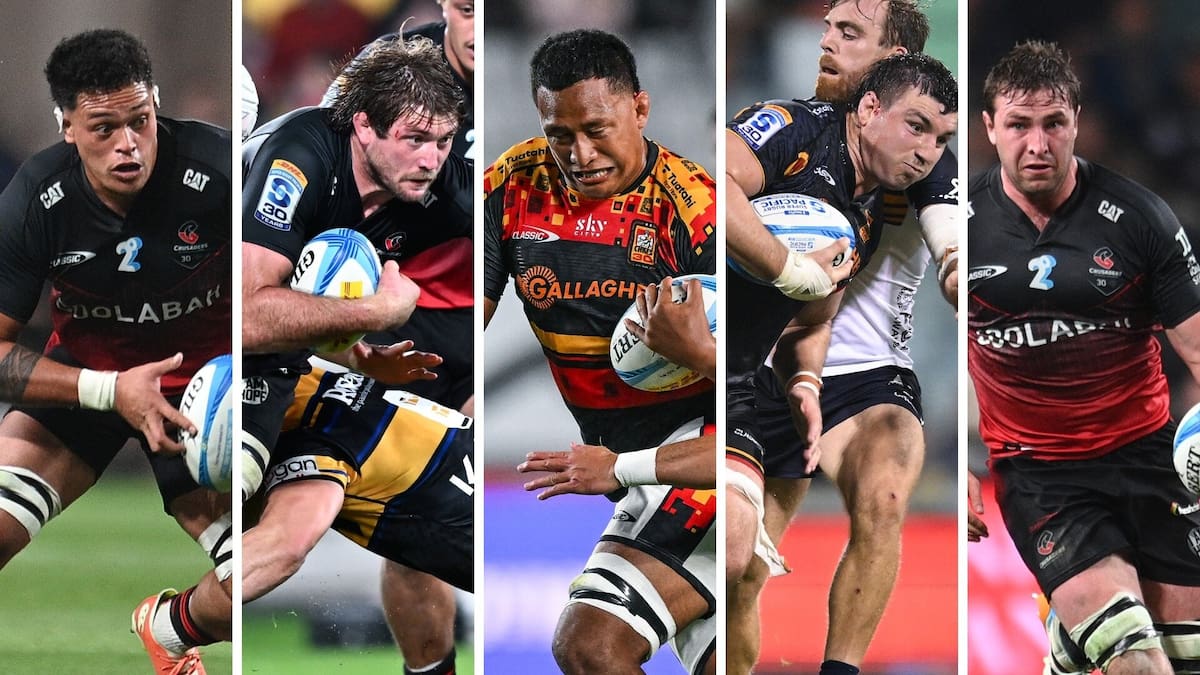
As coaches are fond of saying, the numbers on the back are not important in the modern game but only time – and maybe All Blacks coach Dave Rennie – can answer that question.
Leicester Fainga’anuku’s efforts in the No 7 jersey will have caught the eye of Dave Rennie. Photos / Photosport, SmartFrame
Sizing them up
Talking of loose forwards, the identity of the All Blacks blindside flanker became no clearer after the weekend’s action. Incumbent Simon Parker and teammate/rival Samipeni Finau were not playing, while other candidates did well enough without moving the selection needle significantly. Hurricanes loosie Devan Flanders had half an hour off the bench and performed well; Anton Segner played openside for the Blues in their 45-19 win over Moana Pasifika, reminding everyone that he, like Ardie Savea, Peter Lakai and Wallace Sititi, can play all three loose forward positions … pretty well too.
Ethan Blackadder was busy at No 6 in a typical shift, demonstrating again that his main asset is defence and that he offers less going forward. His replacement against the Canes, Dom Gardiner, does; he scored a try and performed well as the Crusaders closed things up at the end. Segner, Lakai and Lio-Willie were the pick of the New Zealand tight-loose brigade with Lio-Willie’s physical go-forward providing the base for the Crusaders’ best moments.
He is primarily a No 8, however, and if we assume Savea and Sititi will be two of the All Black starting loosies at 7 and 8 respectively, a bigger blindside flanker offers a lineout option and breakdown grunt. Savea and Sititi are smaller as loosies go and many rugby fans feel Segner and Flanders, for example, might be a touch light for a blindside.
The All Blacks have fielded small back rows before and have successfully used Savea, for example, at the front of the lineout to secure ball. However, size does matter more when it comes to behemoth forward packs like those of South Africa, France and England.
There’s an old saying about it not being the size of the dog in the fight but the size of fight in the dog and Savea is living proof of that – but it’s still interesting to look at the physical characteristics of the blindside candidates. The All Blacks have never settled on a consistent No 6 since the days of Jerome Kaino (1.96m and 110kg) and Liam Squire (1.96m/113kg).
Both were big men with an abrasive edge, making them a handful on both sides of the ball with another All Blacks hard nut, Jerry Collins, 1.91m and 112kg. So, here are the physical dimensions of those in contention:
Blackadder (Crusaders): 1.90m/113kgFinau (Chiefs): 1.93m/115kgFlanders (Hurricanes): 1.92m/108kgGardiner (Crusaders): 1.91m/111kgLio-Willie (Crusaders): 1.89/111kgParker (Chiefs): 1.97/117kg
There’s another candidate – Japan-based All Black Shannon Frizell, who finished the last World Cup cycle strongly, is coming home; he was last listed at 1.95m and 108kg. He, however, is now 32 and playing in Japan is not always the best springboard for making the All Blacks. He will become eligible for selection only in October, so the end-of-year tour may be the best he can hope for.
Parker is a big man with the best physical qualifications but has faded out of a few tests and has not yet cemented his place in the face of growing challenges from Flanders, Gardiner and Segner.
Head-to-heads
Other key head-to-head clashes from round 12 were:
Cam Roigard v Noah Hotham
Both scored tries and played well, but this was a points victory to Roigard. Hotham is challenging the Chiefs’ Cortez Ratima for the No 2 halfback spot with Ratima’s support play his biggest asset and Hotham, who scored with a typical individual run, dangerous round the rucks and mauls.
Pasilio Tosi v Fletcher Newell
A narrow victory to Tosi, usually understudy to Newell and Tyrel Lomax. They were even in the scrums but Tosi got round the field a little better and pulled off a turnover to shade it.
Codie Taylor v Asafa Aumua
No real conclusion to be drawn; both hookers were comparatively quiet.
Three duff tries
Not sure what happened to the referee-linesmen-TMO review system in the Hurricanes-Crusaders match but, by my count, three tries were scored that should have been disallowed.
Cam Roigard’s 38th-minute try came after what appeared to be an earlier forward pass by Kirifi. Most glaring of all, Fehi Fineanganofo scored after a forward pass clear to everybody except the officials and especially ref James Doleman who seemed to talk himself into awarding the try. Finally, Gardiner’s try in the 76th minute was actually a knock-on.
The whole point of having a TMO is to ensure accurate decisions are made – if we’re not going to use them, why have them?
Paul Lewis writes about rugby, cricket, league, football, yachting, golf, the Olympics and Commonwealth Games.