
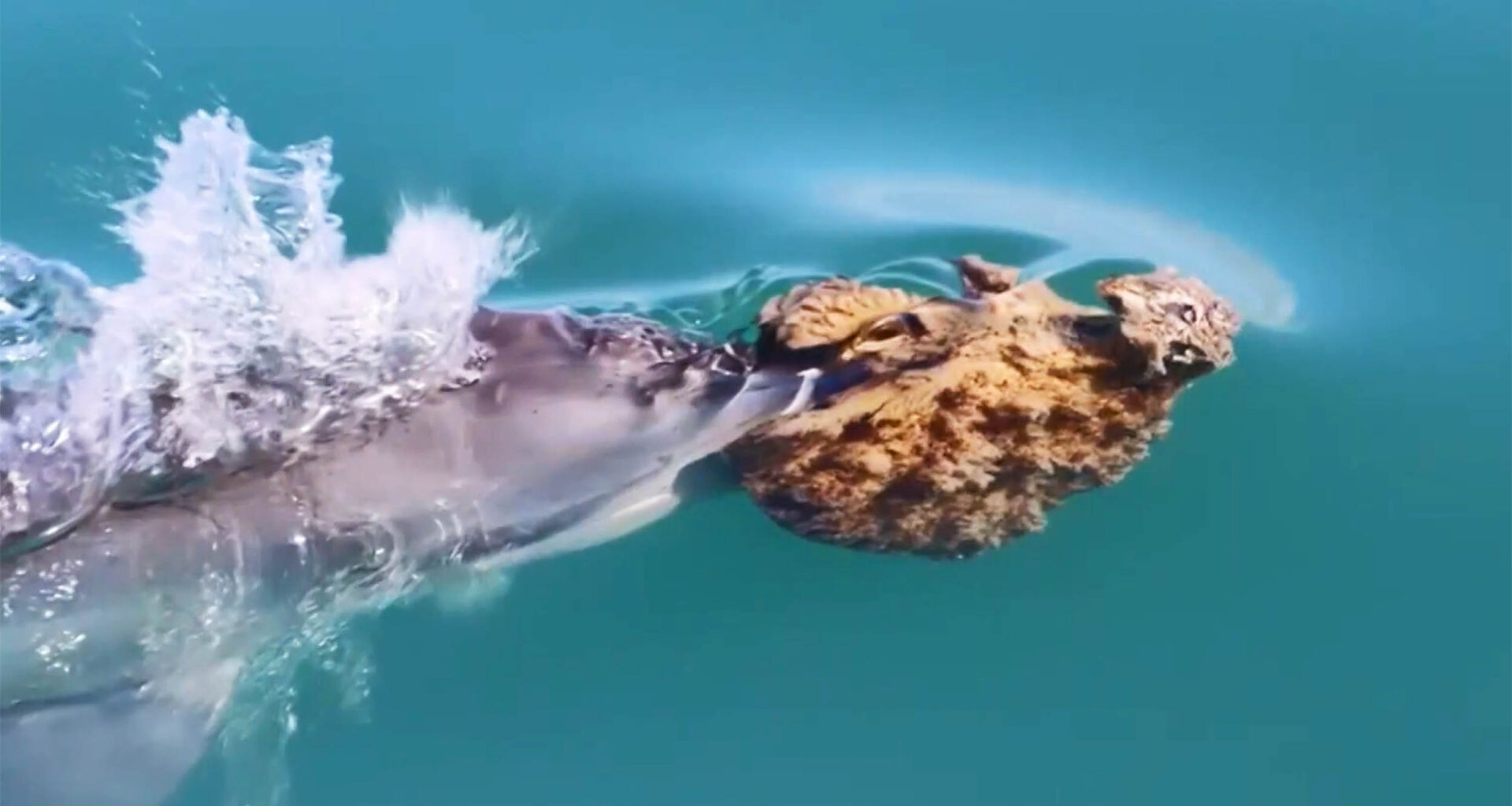
Wild dolphins were captured on film putting sea sponges over their snouts, using them as tools to hunt along the seafloor.
Dolphins pass down this unique skill from parent to child, and it is much more complex than almost any other animal behavior in the wild.

Because the sponge significantly distorts the acoustic signals dolphins emit and receive, it impedes their ability to detect prey using their sonar. So the question remains, why do it at all?
Dolphins hunting with sponges
In Shark Bay, Western Australia, some bottlenose dolphins, Tursiops aduncus, have been filmed grabbing marine sponges and covering their beaks.
The work was led by Ellen Rose Jacobs, Ph.D., at Aarhus University, where she studies dolphin behavior and sound.
Jacobs teamed with the Shark Bay Dolphin Research Project at Georgetown University, which has tracked these dolphins since 1984.
By following the sponges from seafloor to snout, the researchers aimed to learn the benefits for dolphins of using these sponge tools, along with the costs of this strange behavior.
Shielding from rocks and stings
During these hunts, the sponge shields delicate skin on dolphin snouts from sharp rocks and stinging animals that are often hiding in the sand.
At the same time, the sponge bends the “click” sounds for echolocation, finding prey by listening to echoes, and the signal arrives warped.
In a detailed report, Jacobs described the sponge as changing sound cues while the dolphin searches for fish.
“Everything looks a little bit weird, but you can still learn how to compensate,” said the team lead during fieldwork in Shark Bay.
Clicks, echoes, and jawbones
Click sounds used in dolphin language pass through the melon, a fatty organ that focuses sound forward, before spreading into the water.
Echoes return through the lower jaw, where fat-filled tissues carry vibrations toward the middle and inner ear.
When a sponge covers the snout, some of that outgoing beam and incoming echo must pass through sponge tissue twice.
That extra layer can scatter energy and smear timing, which forces the brain to work harder before the chase begins.
Analyzing dolphin sponge behavior
To test whether dolphins kept clicking with a sponge on, Jacobs listened underwater as they worked the channel bottoms.
Jacobs’ recordings showed active clicks, and the AU team used a physics-based computer analysis to trace those sound changes.
By scanning real sponges and building digital shapes, the team followed a click from its first emission back to the returning echo.
The results pointed to constant variation because each sponge has its own shape, so learners face new problems each hour.
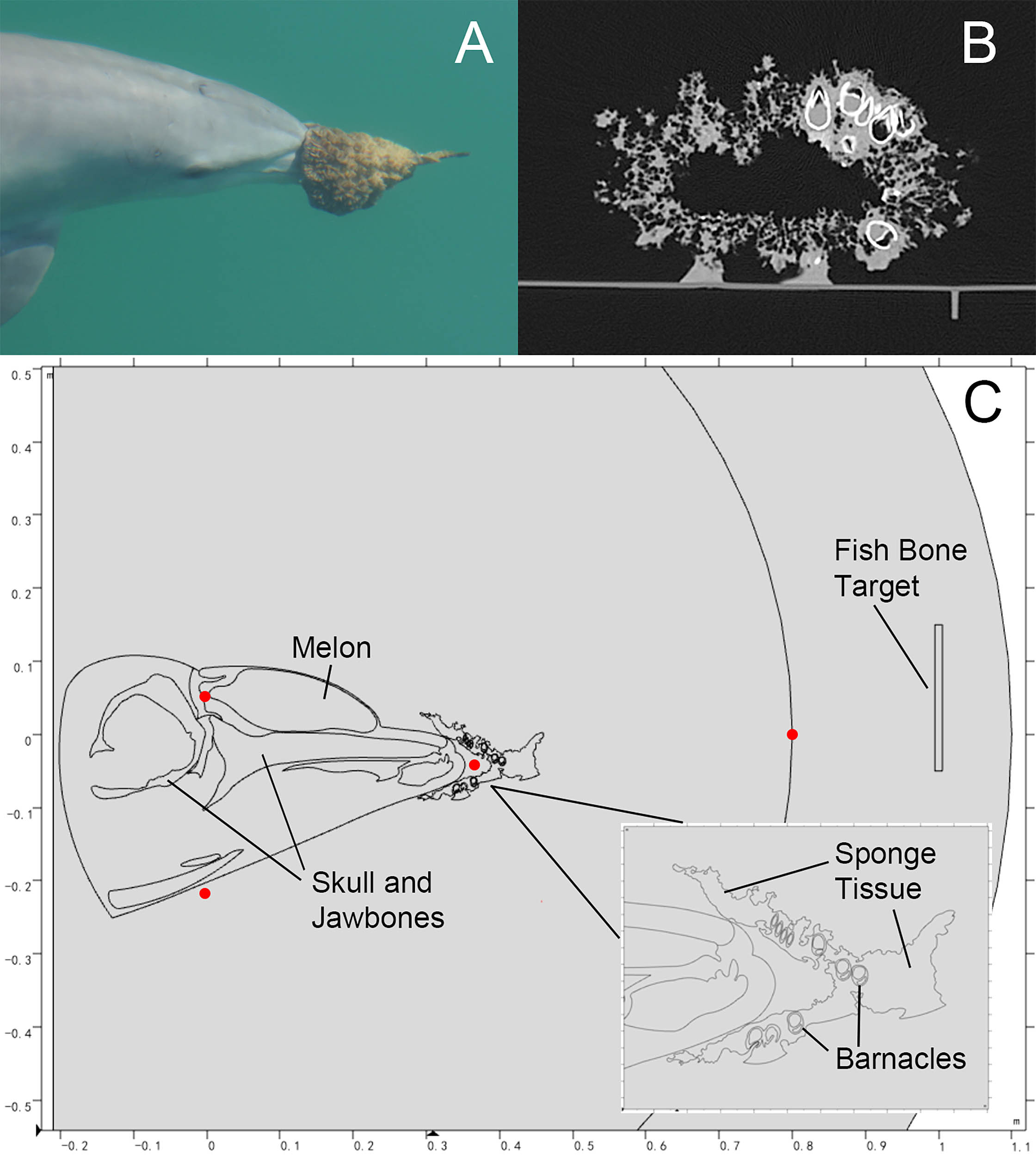 Sponging dolphin and model set-up. (A) A dolphin sponge foraging using an Echinodictyum sponge. Photo taken by Ewa Krzyszczyk with the Shark Bay Dolphin Research Project. (B) A cross-section of the Echinodictyum sponge used in the model. (C) The full model set-up in COMSOL. Credit: Royal Society Open Science. Click image to enlarge.Shape matters more than size
Different sponge shapes produced different sounds, even when dolphins used similar hunting moves in the same habitat.
Cone-like sponges such as Echinodictyum mesenterinum guided the outgoing click into more of a straight line, while basket-like Ircinia sponges tended to spread the click’s signature over a wider area.
The wider beam also reached the dolphin’s jaw with less strength in the simulations, so the echo arrived weaker and longer.
Because dolphins pick up fresh sponges often, small differences in shape could decide whether they feel that the tool fits their needs.
Learning takes years, not days
Only about 5% of the dolphins observed in this population kept using sponges, even though many neighbors saw them hunt.
Young dolphins stayed close to their mothers for around three to four years, and that long teaching period built strong muscle memory.
Because calves watched the same technique thousands of times, most learning happened inside those family bonds, not in wider groups.
Limited access to practice kept most dolphins from training long enough to get past the sensory confusion caused by wearing sponges on their noses.
Why the benefit stays high
Once a dolphin mastered the move, the sponge let it probe sandy channels and flush fish hiding under rubble.
The dolphins would push their covered beaks along the seafloors, stirring up barred sandperch, then they would drop the sponge to chase their prey. Wild sponges ranged from softball size to a cantaloupe, so the tool also had to fit the hunt.
Because the payoff was food that the other dolphins had missed, a few specialists were still willing to invest time learning this harder technique.
Culture with hard limits
Tool use can spread fast in animals when it adds value without disrupting other skills, but sponging carries a penalty for the dolphins who use this technique.
While tools often help animals get food or avoid harm, scientists have paid far less attention to the hidden difficulties that can prevent those tools from spreading through a population.
The team linked the penalty paid from using sponge tools to a slow learning curve, even when the hunting payoff stayed high.
That kind of trade-off helped explain why other dolphin families living beside this group of sponging dolphins did not copy them, despite frequent contact.
Dolphins, sponges, and cultural transmission
Dolphins hunt in murky water by firing off rapid sound clicks and listening for the echoes that come back. It’s a remarkable system. But the so-called sponging behavior shows how easily it can be thrown off.
When boat engines rumble through and human activity picks up, the background noise drowns out the faint returns dolphins rely on.
Add a sponge over the snout, and the signal gets muddier still. Any extra noise in the environment can push an already difficult hunt past the point of working at all.
That’s why quiet foraging grounds matter so much. For dolphins that essentially navigate and feed by sound, what they can hear is what they can eat.
The sponge itself tells a bigger story. A single tool, picked up by one dolphin and passed along, ends up defining how an entire family group lives. It shapes what they learn, where they hunt, and how they make sense of the world around them.
Plenty of questions are still open. Why do some dolphins choose certain sponges over others? And as the ocean grows louder year after year, which hunters will keep succeeding and which will fall behind?
Those are the threads researchers will be pulling on next.
The study is published in Royal Society Open Science.
—–
Like what you read? Subscribe to our newsletter for engaging articles, exclusive content, and the latest updates.
Check us out on EarthSnap, a free app brought to you by Eric Ralls and Earth.com.
—–