
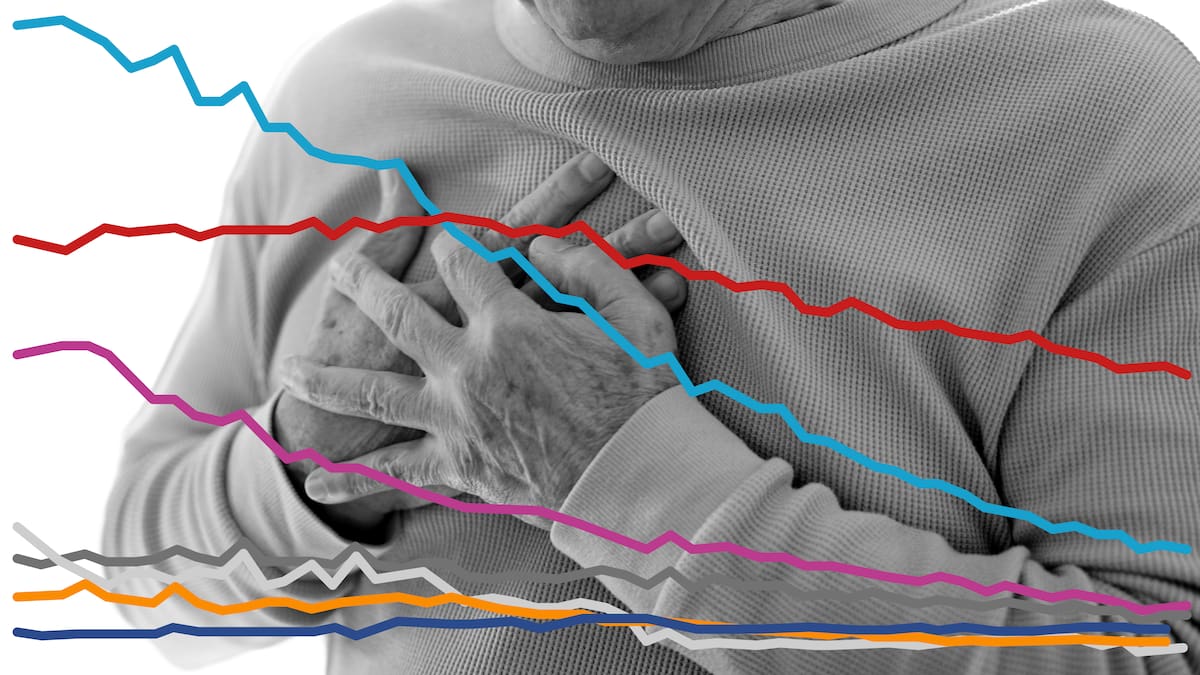
“Total mortality [the number of deaths from any cause during a time period] peaked in the late 1960s, and it’s been falling. We’re gaining between four and six hours per day,” he says.
Deaths from cancer and cardiovascular disease have reduced over time, he says, but they are still the biggest killers.
“Coronary heart disease is still the single number one killer. It depends on if you look at a single [disease] versus a group [of diseases]. So all cancers are more common than all cardiovascular disease.”
The most common causes of death change as we age, so what are you most likely to die of – and when?
In your 20s
External injuries are the leading cause of death for people in their 20s.
These are classified as intentional – suicide, self-harm or assault – or unintentional, including falls, burns, vehicle crashes, dog bites and drownings.
“This age group is generally fit and healthy, so less likely to die from the usual suspects that lead to death in older age, [such as] heart disease and cancers,” says Bridget Kool, professor in epidemiology and biostatistics at the University of Auckland.
“They are often described as accidents, although we avoid this term as it suggests they are not preventable, which is generally not the case as they are usually both predictable and preventable.”
New Zealand has a high suicide rate in this age group and younger.
Shaun Robinson, chief executive of the Mental Health Foundation of New Zealand, says this is a long-term trend.
“There are many reasons that contribute to suicide, there is no simple answer … when things are not working well in our society, in our community, it’s young people that usually suffer first and hardest, and that is definitely contributing to deaths by suicide.”
Marginalisation, economic disadvantages, drug and alcohol abuse, unemployment and bullying all play a part, he says.
“Rangatahi Māori are twice or more times more likely to self-harm or die by suicide.”
Robinson says accessible mental health support services are key for young people.
Kool says men generally have higher rates of unintentional injury than women, in part due to risk-taking behaviours.
This is the case around the world, but there are some nuances – for example, New Zealand has many rural communities – where patterns of death differ from those in urban environments.
“[In] urban settings you’re more likely to have violent injuries,” she says.
There are more unintentional deaths in rural workplaces, such as farms, or as a result of vehicle crashes on rural roads.
In your 30s
While conditions like cancer and heart disease begin to rise in frequency as we age, when tallied up, external injuries – things such as suicide, road crash deaths and assault – are still the leading cause of death for people in their 30s.
Kool says prevention can help reduce the risk of death, but it is difficult to change behaviours.
“Primary prevention is about addressing the risk factors.
“So stopping injuries happening in the first place – seatbelts and smoke detectors and helmets for cycling, and drink-driving legislation.”
Environmental solutions – think of speed bumps on a road, or your car beeping at you until you put your seatbelt on – can also help prevent injuries.
“It’s very difficult to change behaviour. Behavioural education’s really important to support that, but at the end of the day, making the safest thing to do the easiest [thing to do] is the most effective solution.”
Secondary prevention, through emergency medical services and effective treatment, is also key to minimising the impact of injuries.
New Zealand had a national injury prevention strategy, but this no longer exists. Joining existing agencies, who work on water and road safety and other types of harm reduction, could help reduce injury deaths around the country, Kool says.
In your 40s
Cancer emerges as a major cause of death from the 40s onwards.
In New Zealand, five types account for half of all cancer deaths: 18% are due to lung cancer, 12% bowel cancer, 7% prostate, 7% breast and 6% pancreas.
George Laking, medical oncologist at Te Puriri o Te Ora/The Regional Cancer and Blood Service at Auckland City Hospital, says lung cancer isn’t diagnosed as frequently as other cancers “but the trouble is, it is just so much more deadly”.
He says the most frequently diagnosed cancer in New Zealand is non-melanoma skin cancer, which is less likely to be fatal.
The number of people being diagnosed with and dying from cancer in New Zealand has increased over time, as the population grows and ages. But the mortality rate – the risk of dying – from cancer itself has fallen.
“One of the reasons we see more cancer is simply because people are living to the age where they can get cancer. Screening programmes capture cancer earlier, so fewer people die, and mortality goes down.”
Laking says bowel or colorectal cancer is the second-biggest killer from cancer in New Zealand, and cases are increasing among younger people. It’s considered early-onset if diagnosed in people younger than 50.
Heart disease also emerges as a more common cause of death in this decade.
Dr Julia Shanks, a senior research fellow at the University of Auckland, says heart disease symptoms can be missed in younger women in particular, delaying diagnosis.
“Women are more likely to develop heart failure at a younger age if they’ve had adverse outcomes during pregnancy … [such as] high blood pressure or gestational diabetes.”
In your 50s
In your 50s, cancer is the leading cause of death.
“Māori are about 60% more likely to die from cancer. Pacific, about 40% more likely. And if you’re deprived economically, [you are] 55% more likely,” Laking says.
“These things combine with each other, so you don’t escape this extra risk if you’re Māori or Pacific and you’re wealthy – you still carry extra risk.”
When it comes to reducing cancer risk, the environment is a major factor.
“We’ve got things in our environment that lead to cancer; a lot of them are really addictive things,” Laking says.
Because smoking is the primary cause of lung cancer, environmental changes like higher tobacco prices and the ban on displaying tobacco products in shops are aimed at making it harder to smoke.
“That has changed the environment … and has actually done more to stop people smoking, compared to still having visible advertising, really cheap cigarettes and just saying, ‘You’ve got to quit from willpower’.”
Meanwhile, he says, “alcohol causes heaps of cancers and alcohol’s very much in our environment, in supermarkets for example. So we can expect to see more cancer.
“The general public health messages [are] don’t smoke, it’s probably best not to drink, or cut it down, put on a sunhat and cover up.”
For people in their 50s, heart disease is the second-most-common cause of death, but symptoms can present differently in men and women, and there are differences in the age of onset and how the condition develops.
“[It’s] traditionally thought of as a man’s disease, and while it affects a lot of men, we’re understanding more about [how it impacts] women – and it does increase in women post-menopause,” Shanks says.
“Men have the classic symptoms of a heart attack, a tight chest, and they get blockages in the big blood vessels in the heart, which we’ve got quite a few good diagnostic techniques to now identify.
“Whereas when women experience a heart attack, they’re more likely to see blockages in the really tiny vessels of the heart, which might be missed.”
She cites a recent study showing that under the age of 55, while men are more likely to have a heart attack, women are more likely to die from one or be readmitted to hospital.
“Men are more likely to experience heart failure at a younger age and women are more likely to experience heart failure post-menopause.”
In your 60s
Cancer remains the leading cause of death for people in their 60s, followed by heart disease. Age is a big factor in people’s cancer risk.
“If we could live to be 200 everyone would get cancer, because the risk just goes up,” Laking says.
“There’s a little bump in risk earlier in life, and that’s childhood and adolescent cancer. The rate is still low for children and adolescents, compared to people of retirement age.”
The risk of heart disease increases in our 60s and beyond because as we get older, fatty plaques build up in our blood vessels. This causes them to stiffen and lose elasticity, making it harder for the heart to pump blood through them.
“The heart has to work a bit harder, the heart gets bigger and eventually loses its efficiency to pump blood around the body,” Shanks says.
Heart disease encompasses a range of conditions; the deadliest of which is ischaemic or coronary heart disease, while heart failure is a chronic condition people live with.
“In terms of risk for ischaemic heart disease or [the] chance of having a heart attack, we usually see [it] in men at a younger age, and in women this can occur a little bit older.”
In your 70s
As a group of diseases, cancer still poses the highest risk of death in your 70s, followed by heart disease.
The risk of getting breast cancer increases with age, which is why the age limit for free breast screening was raised last year and will roll out to become available for women aged 70-74. The risk of getting bowel cancer also increases with age; bowel screening is free for people aged 60-74.
Heart disease is the second-most-common cause of death at this age, and if you have high blood pressure or diabetes, it’s important to get those under control to reduce your risk of getting heart disease or dying from it.
“Beyond that, lifestyle interventions are really good at attempting to prevent heart failure, or if you’ve got heart failure, improving symptoms … [by] staying active, reducing salt and improving your diet,” Shanks says.
Respiratory diseases pose a risk of death in this age group, as immunity declines. Older people are also more likely to have other chronic conditions, such as diabetes, that impede recovery.
Common respiratory diseases include chronic obstructive pulmonary disease (COPD), asthma, occupational lung diseases caused by long-term inhalation of substances like asbestos or silica in a workplace, and pulmonary hypertension – high blood pressure affecting arteries in the lungs.
Covid-19 and influenza are also respiratory diseases that pose a risk of severe illness and death in elderly people.
80s and beyond
When you reach your 80s, heart disease is the leading cause of death.
The risk increases over time because as people age, they’re more likely to have comorbidities – other conditions such as high blood pressure and cholesterol, diabetes or obesity – that accelerate the process.
“It really is this progressive thing over decades, which is why heart failure increases as we get older,” Shanks says.
However, it’s never too late to make changes to reduce your risk, Jackson says.
“Coronary disease is the number one preventable premature cause of death, because we basically know the causes – a diet high in saturated fat, high blood pressure, a diet high in salt, being overweight, smoking, high blood glucose.
“It’s never too late to change your diet. It’s never too late to stop smoking … [You can] reduce your risk surprisingly rapidly.”
The risk of death from stroke rises in this age group as well, though strokes can occur at any age.
About 2000 people die of stroke in New Zealand each year and between 2018 and 2028, there is expected to be a 40% increase in strokes in New Zealand.
According to Stroke Aotearoa NZ, most strokes are preventable. Up to 90% of strokes are linked to 10 risk factors, including high blood pressure, physical inactivity, poor diet and smoking – many of which can be controlled.
Māori and Pacific people tend to experience stroke at a younger age, with 60% occurring between the ages of 15 and 64, while for other ethnicities, 20% of strokes occur in this age group.
Neurodegenerative diseases like dementia also account for many deaths in this age group, with one in four Kiwis now expected to die with the condition, according to Alzheimers New Zealand.
Older adults can reduce their dementia risk by exercising regularly, eating a healthy diet, socialising with others, staying mentally active and getting vaccinated against shingles.
Bethany Reitsma is a lifestyle writer who has been with the NZ Herald since 2019. She specialises in all things health and wellbeing and is passionate about telling Kiwis’ real-life stories.