
In its first grand coalition, the equivalent of Prime Minister, the Taoiseach, was split evenly between the parties for half a term each: two-and-a-half years.
This time, it is a three-year and two-year split to reflect the higher vote Fail won over Gael.
When one leader is Taoiseach, the other is their deputy, as well as Minister of Foreign Affairs and Defence.
Former ambassador to Ireland and former Labour Speaker Sir Trevor Mallard observed its operations with interest. “It appears to work,” he said, adding it had more transparent processes than New Zealand does, for debating big issues.
Cabinet sat on a Tuesday and the two leaders – and the ministers with the two main finance portfolios from each party – got together every Monday night to thrash issues out.
“They are enormously wealthy, so they’ve got the advantage of not having to make the same sorts of hard decisions that might have to be made here.
“But they have good processes for working things through.”
Herald business editor at large Liam Dann weighed in last week to support a recent call by Auckland Mayor Wayne Brown for a grand coalition between National and Labour.
They both argue that a grand coalition could be an answer to the problem of pesky smaller parties in coalition having outsized effects on Government policy, the tail-wagging-the-dog scenario, or the handbrake being applied too liberally to prevent change.
Dann suggested the tribal base of centre-right National and centre-left Labour might mean a grand coalition wouldn’t happen anytime soon. But it could break the “political stalemate and inertia that MMP has delivered”.
A grand coalition could potentially work here. In New Zealand politics, there is already a large degree of bipartisanship on monetary policy and free trade.
A great deal of social policy is settled, with the differences being more on emphasis.
No one has any appetite for more restructuring in health – although everyone has an appetite for greater efficiency.
Labour’s opposition to education reforms is more about the pace of it than ideological objection.
It might not be so hard for National to agree to a limited capital gains tax and Labour to agree to lifting the superannuation age by a few years for the price of a Government not subject to the extremes of Act, the Green Party or Te Pāti Māori – or the populist policies of New Zealand First.
So how would it work in New Zealand?
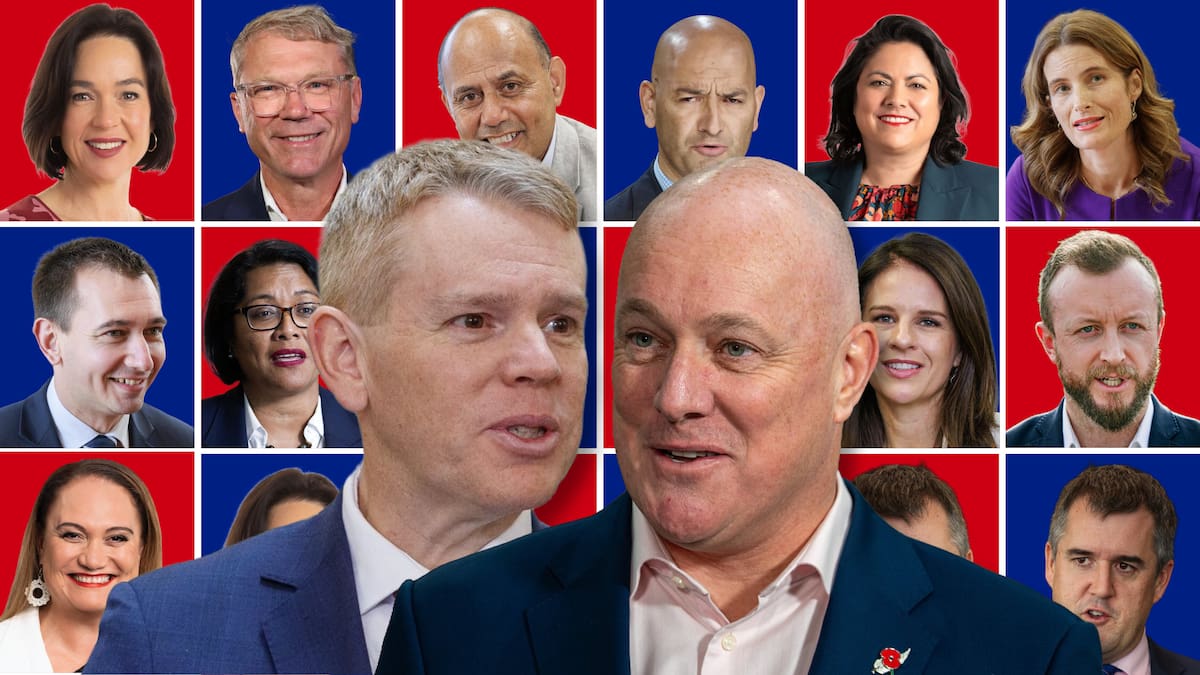
I have come up with a potential scenario for what a National-Labour Cabinet Government might look like.
In a three-year term, it would be possible to have the prime ministership shared for 18 months each, assuming National and Labour received similar levels of voter support. That could be subject to negotiation.
But for the sake of continuity – and for this exercise – it would be better for positions to be held for a full term.
Prime Minister Christopher Luxon (left) and Labour leader Chris Hipkins leading MPs into the debating chamber together at the 2023 State opening of Parliament. Photo / Mark Mitchell
The first scenario below is predicated on the assumption that National retains the position of Prime Minister and Labour gets Finance.
Labour would get Health and National would keep Education. National would keep most of the law and order portfolios but Labour would get Justice – which is responsible for developing policy in that area.
Labour leader Chris Hipkins would be Deputy Prime Minister, plus Minister of Foreign Affairs and Minister of Defence, prestigious and important portfolios.
National would have most, but not all, economy-related portfolios, such as Revenue, Economic Development, Land Information, SOEs, ACC, Trade and Agriculture and Labour would have most but not all social policy portfolios, such as Health, Housing, Social Development and Children. Māori Development and Māori Crown Relations would be split between Labour and National, respectively.
In a Cabinet of 25, only a handful of ministers would keep their current portfolios, including Erica Stanford in Education, Todd McClay in Trade and Agriculture, Mark Mitchell in Emergency Management and Paul Goldsmith in Treaty Negotiations.
That’s because there is no one in their own party who would obviously be better.
Simeon Brown’s ranking would rise slightly above Chris Bishop’s to compensate for losing Health in one scenario and taking on Finance in the second.
Five major portfolios would have a minister from one party and an associate minister from the other party, the five being: Finance, Education, Health, Foreign Affairs and Māori-Crown Relations.
That’s because they are such major portfolios. The potential consequences of disagreement would work as an incentive for agreement between both parties from the outset.
In the first scenario, Barbara Edmonds’ associate in Finance would be Bishop, Hipkins’ associate in Foreign Affairs and Defence would be Nicola Willis, Ayesha Verrall’s associate in Health would be Tama Potaka, Stanford’s associate in Education would be Camilla Belich, and Potaka’s associate in Māori Crown relations would be Vanushi Walters.
No associate minister would be a former holder of the main portfolio, because that could present problems of dynamics. A former minister could assume a natural sense of superiority over a new minister.
The associate minister could be given a specific delegation, such as a particular sector of the education system, like Early Childhood Education, and/or the tertiary or vocational sector, or in Health, oversight of the iwi partnership boards and Māori advisory committee.
But for it to work well, the party leaders would need to insist on ample consultation and agreement with the associate at the outset before development of positions or important policy was initiated by the minister.
They would encourage a degree of partnership and collaboration between the minister and their associate, rather than reverting to a “senior and junior” model.
The former co-captains of the parliamentary cricket team, National’s Chris Bishop (left) and Labour’s Kieran McAnulty would be forced to work closely in a grand-coalition Cabinet. Photo / Mark Mitchell
The allocation of portfolios in scenario one also suggests that Bishop, Brown and Kieran McAnulty would work together closely, because of the synergies of their portfolios in relation to the new super ministry, which brings together the Ministry for the Environment, Ministry of Transport, Ministry of Housing and Urban Development, and the local government functions of the Department of Internal Affairs.
The new super ministry, the Ministry for Cities, Environment, Regions and Transport (MCERT), is due to become operational on July 1 and is designed to get more cohesion into planning for transport, housing and water infrastructure.
Under scenario one, Bishop would get Planning, renamed from Environment, to bed in the operation of the new planning laws that are replacing the RMA. Brown would get Infrastructure and Transport, and McAnulty would get Housing and Local Government.
Under both scenarios, Labour would negotiate a portfolio dedicated to pay equity.
Walters, a human rights lawyer and one of Labour’s rising stars, would get justice.
The maths mean that perfectly adequate or even promising ministers miss out, along with struggling ones.
Current ministers missing from National are Simon Watts, Matt Doocey, Penny Simmonds, Scott Simpson and newly promoted ministers Cameron Brewer and Mike Butterick.
Former Labour ministers missing out are Jan Tinetti, Priyanca Radhakrishnan, Rachel Brooking, Deborah Russell, Damien O’Connor and Phil Twyford.
Notable performers missing out include Labour’s Tangi Utikere, Cushla Tangaere-Manuel and Reuben Davidson, and National’s Catherine Wedd, Katie Nimon and Tom Rutherford.
Scenario One
Christopher Luxon, Prime Minister, National Security
Chris Hipkins, Deputy Prime Minister, Foreign Affairs, Defence, GCSB, SIS, Space
Nicola Willis, Public Service, Social Investment, Associate Foreign Affairs and Defence
Carmel Sepuloni, Conservation, Women, Pacific Peoples
Simeon Brown, Infrastructure, Transport, Rail, Revenue
Barbara Edmonds, Finance
Chris Bishop, Attorney-General, Planning, Associate Finance, Regulation, Leader of the House
Ayesha Verrall, Health
Erica Stanford, Education
Willie Jackson, Māori Development, Whānau Ora, Regional Development, Mental Health, Youth
Paul Goldsmith, Treaty of Waitangi, Media and Communications, ACC, Arts, Pharmac
Megan Woods, Climate Change, Science Innovation and Technology
Todd McClay, Trade, Agriculture, Forestry, Food Safety
Louise Upston, Economic Development, Tourism, Land Information, SOEs
Kieran McAnulty, Housing, Local Government, Racing
Tama Potaka, Māori Crown Relations, Oceans and Fisheries, Associate Health
Ginny Andersen,, Social Development, Child Poverty Reduction
James Meager, Police, Corrections, Hunting and Fishing, South Island
Vanushi Walters, Justice, Associate Māori Crown Relations
Chris Penk, Energy, Resources, Immigration
Arena Williams, Commerce and Consumer Affairs, Small Business and Manufacturing, Auckland Issues
Mark Mitchell, Customs, Biosecurity, Emergency Management, Sport
Willow-Jean Prime, Children, Community and Voluntary Sector
Nicola Grigg, Internal Affairs, Seniors, Disability Issues
Camilla Belich, Workplace Relations and Safety, Pay Equity, Associate Education
A second scenario would see Labour holding the post of Prime Minister and National of Finance, but not with the current Finance Minister, Willis.
It assumes that Christopher Luxon would rather resign than become deputy to Hipkins and, for the sake of argument, that deputy leader Willis would take over the leadership of National.
She would appoint Brown as Finance Minister, giving Bishop a suite of portfolios not too different to his current ones.
Alternatively, she could appoint Bishop to Finance and simply give Brown all of Bishop’s portfolios below, except Attorney-General, which would go to Edmonds, a former tax lawyer and senior Labour MP.
Scenario Two
Chris Hipkins, Prime Minister, National Security
Nicola Willis, Deputy Prime Minister, Foreign Affairs, Defence, GCSB, SIS, Space
Carmel Sepuloni, Conservation, Women, Social Investment, Pacific Peoples
Simeon Brown, Finance
Barbara Edmonds, Attorney-General, Revenue, Associate Finance
Chris Bishop, Planning, Infrastructure, Transport, Rail, Regulation, Leader of the House
Ayesha Verrall, Health
Erica Stanford, Education
Willie Jackson, Māori Development, Whānau Ora, Regional Development, Mental Health, Youth
Paul Goldsmith, Treaty of Waitangi, Media and Communications, ACC, Public Service, Arts
Megan Woods, Climate Change, Science Innovation and Technology, Associate Foreign Affairs and Defence
Todd McClay, Trade, Agriculture, Forestry, Food Safety
Louise Upston, Economic Development, Tourism, Land Information, SOEs
Kieran McAnulty, Housing, Local Government, Racing
Tama Potaka, Māori Crown Relations, Oceans and Fisheries, Associate Health
Ginny Andersen, Social Development, Child Poverty Reduction
James Meager, Police, Corrections, Hunting and Fishing, South Island
Vanushi Walters, Justice, Associate Māori Crown Relations
Chris Penk, Energy, Resources, Immigration, Pharmac
Arena Williams, Commerce and Consumer Affairs, Small Business and Manufacturing, Auckland Issues
Mark Mitchell, Customs, Biosecurity, Emergency Management, Sport, Ethnic Communities
Willow-Jean Prime, Children, Community and Voluntary Sector
Nicola Grigg, Internal Affairs, Seniors, Disability Issues
Camilla Belich, Workplace Relations and Safety, Pay Equity, Associate Education