
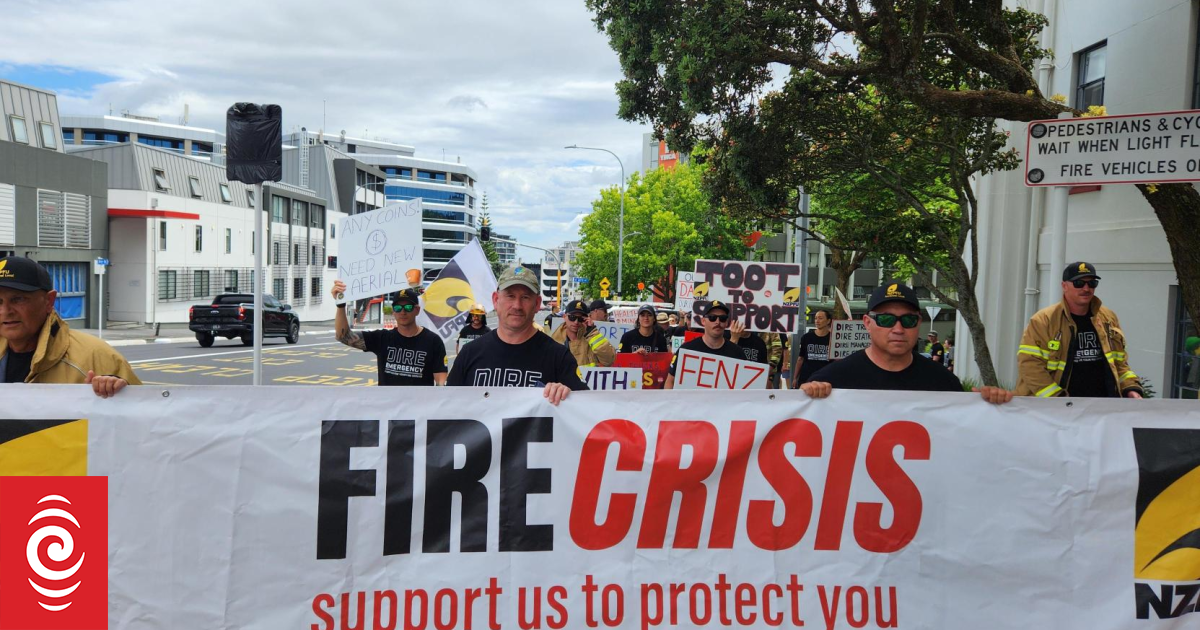

Firefighters have been in pay disputes with their funding body, FENZ, for two years and their industrial action has been going on for six months.
Photo: RNZ/Lucy Xia
Firefighters appear to be in an endless standoff with the body that funds them, with neither side willing to budge
Firefighters’ pay dispute with their funding body, FENZ, has been going on for two years, and their industrial action for six months.
In that time we’ve seen the graffiti on fire trucks, heard about equipment breakdowns at crucial times, and read about blazes that weren’t attended to immediately because they came during a one-hour strike. The fire that claimed a heritage block at Northcote College in Auckland in February is one example.
Today on The Detail we speak to RNZ reporter Phil Pennington who’s been following this dispute.
“There seems to be an overwhelming problem,” he says.
“Everything compounding together … the finances, the strife, even the personal conflicts, and then of course climate change bearing down on us all.”
Extreme weather events have meant more rescues, flood work and landslide jobs – which are the most deathly of emergency tasks.
Farmers worry that with more forests being planted, volunteers will be left to put out forest fires.
Issues with the breakdowns in the vehicle fleet are so bad they’ve sparked a Parliamentary inquiry – one in which National MP Tim Costley says he’s struggling to get straight answers from FENZ.
The fire service has over 1000 vehicles, although many of those are small utes rather than specialist appliances. It’s the specialist vehicles that are the problem.
“They obviously do have a big problem, they’ve admitted that,” says Pennington.
Megan Stiffler, the deputy chief executive, operational response at FENZ, has said the organisation inherited a very old fleet when it was established eight years ago. She says since then FENZ has replaced 317 appliances, another 60 are on track to be delivered, and $20 million is being invested in that area every year for the next three years.
Pennington says they told a select committee last month they just don’t have enough money for a general overhaul of the fleet.
“When you listen to that, that’s on the ‘ok, give them a break side’ … but can you give them a break? They were told to do a strategy about where to put the really big trucks with the ladders – aerials – after the Auckland Convention Centre fire, so that was back in 2019.
“They haven’t done a strategy yet. They’ve been working on it since then – or not working on it – it’s just stalled, delayed … we haven’t seen one.
“Yeah … very difficult situation for them, I think made more difficult by them.”
FENZ wanted to help fund pay increases and fleet renewals by increasing the fire levy paid on insurance policies by more than five percent.
“The funding is not from the government – this is not like a government department,” says Pennington.
“All but one percent of their money comes from insurance levies, and that’s about $800 million.”
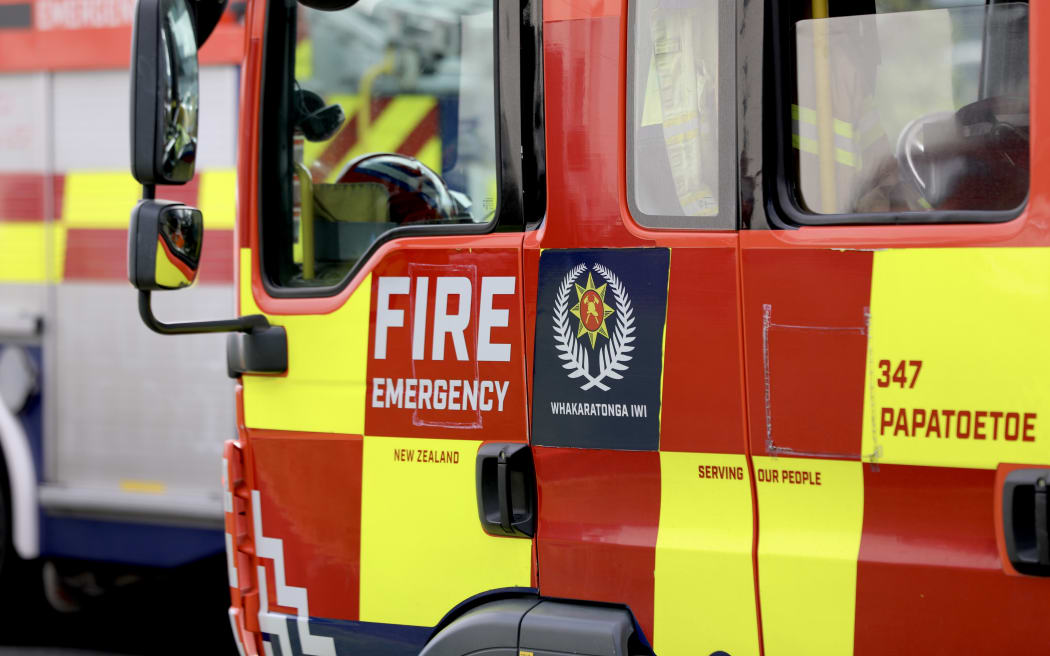
Over the next three years $20 million will be invested in new appliances, FENZ says.
Photo: RNZ/Marika Khabazi
However Internal Affairs Minister Brooke van Velden wasn’t convinced they needed more money, told them they could have a 2.2 percent rise – and asked them to save $60m over three years.
“At the same time FENZ has found its revenue base has become more uncertain,” Pennington says.
It turns out that in a restricting economy, people are opting to gamble with their insurance and not pay higher premiums, so the insurance base contracted.
The phrase “‘perfect storm’ is bandied about, but it is really like that.”
“You’ve got declining, uncertain revenues, a cost-cutting drive that is fed into a restructure, all against the background of this industrial dispute and then the bigger picture, which really is the question of, with climate change and floods they are often the first responder – but can they cope as first responder? Are they going to be there when they have all these pressures on them?”
On top of all this, the fire service has yet to sort out the fallout from mistakes made in calculating holiday pay which has affected thousands of businesses, but more so those involving shift work. The New Zealand Professional Firefighters Union has urged its members not to sign anything that would give FENZ the right to make pay deductions.
The union is also urging members to fill in a Whanaungatanga Survey being done by the University of Canterbury to gauge their mental health.
The NZPFU wants around three times the current FENZ offer and has asked for a meeting to get negotiations back on track.
Check out how to listen to and follow The Detail here.
You can also stay up-to-date by liking us on Facebook or following us on Twitter.