
“I had T cell lymphoma – quite rare, less than 2% of all lymphomas – and the international clinical trial I was entered into was specifically designed for this type of lymphoma,” Neill said.
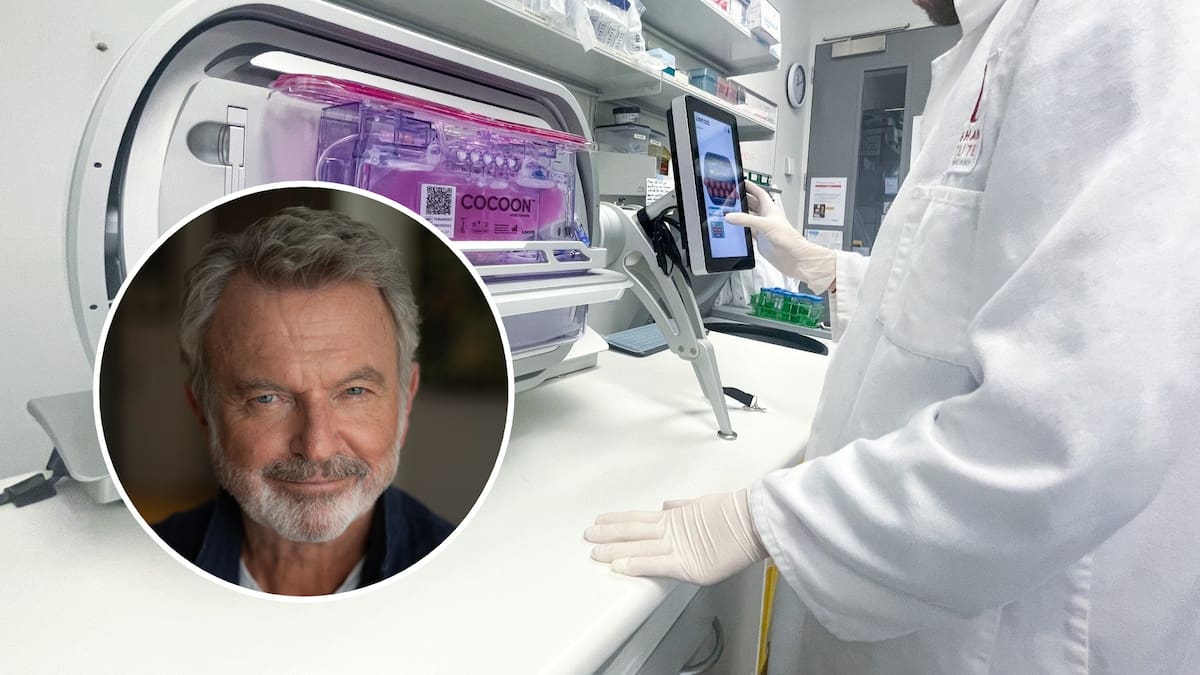
Automated manufacture of immunotherapy in the form of LONZA Xoxoon technology pioneered by BioOra in asoociation with the Malaghan research Institute in Wellington September 2021. Photo / Supplied
Neill said while he was not a medical expert, he felt compelled to speak out about inequity in access.
“CAR-T isn’t one single therapy – different therapies exist for different cancers,” he told the Herald.
“But the broader point is this: even for the more common B cell lymphomas, for which CAR- T is approved and government-funded in Australia, there is currently no government-funded CAR-T access in New Zealand at all. That needs to change, and urgently.
“Medicine is moving with incredible rapidity and access shouldn’t be determined by which side of the Tasman you live on.”
Sir Sam Neill at the 2025 New Zealand Screen Awards in Auckland. Photo / Robert Trathen
Celebrated NZ Herald photojournalist Jason Oxenham also underwent CAR-T cell therapy, travelling twice to Shanghai after being diagnosed with myeloma.
The treatment cost close to half a million dollars in nine months.
It initially worked, before the cancer returned.
Oxenham died earlier this year after a six-year battle with the disease.
Neill said he supported organisations working to advance treatment access in New Zealand, including the Malaghan Institute of Medical Research.
That institute sits at the centre of New Zealand’s only homegrown CAR T-cell programme, led clinically by Professor Robert Weinkove.
CAR T therapy involves removing a patient’s immune cells, genetically reprogramming them to recognise cancer, and reinfusing them back into the body as a “living drug” designed to hunt down malignant cells.
“It’s a form of treatment that involves taking a patient’s own blood cells, particularly a type called the T cell, and taking them to the lab and then genetically modifying them,” Weinkove said.
“What we’re doing is reprogramming the patient’s own immune cells to now recognise something on their cancer cells as foreign.”
He said the engineered cells multiply inside the patient after infusion, attacking cancer in a way that resembles a natural immune response.
“It’s a living drug in a real sense of the word,” he said.
“We introduce a gene that encodes that new receptor into the patient’s own T cells, we grow them up in the lab, and then they are given back as a quick push through the veins over a few minutes.”
The Malaghan Institute of Medical Research and biotech company BioOra are working to move CAR T-cell therapy from clinical trial success into a regulated, funded treatment pathway in New Zealand. Photo / Supplied
CAR T-cell therapy is now considered standard of care internationally for certain blood cancers, particularly some lymphomas and multiple myeloma.
But in New Zealand, access is still limited to clinical trials.
“We don’t have any publicly funded CAR T-cell treatments,” Weinkove said.
“We are behind our cousins across the ditch. Australia has multiple CAR T-cell products funded for several indications, and we don’t have any yet.”
Alongside the Malaghan Institute’s clinical work, Wellington-based BioOra is emerging as a key commercial partner in the push to scale CAR T-cell therapy beyond trials.
The company recently announced it has secured rights to develop and commercialise a next-generation CAR T product originating from New Zealand research, with plans to expand its reach into major global markets including Australia, the United States and Europe.
Weinkove said, at present, New Zealand patients were being forced to travel overseas for treatment, often at great personal cost.
“It is becoming more and more of a stark difference, with more patients increasingly aware of these options and then seeking to travel overseas to obtain it.”
Renowned photojournalist Jason Oxenham, who passed away last month, travelled to Shanghai to receive Car-T therapy. Photo / Supplied
At present, the Malaghan Institute has treated just over 60 patients in New Zealand using CAR T cells manufactured locally through trials in Wellington, Auckland and Christchurch.
“But those are clinical trials and they don’t really meet the need,” Weinkove said.
The institute’s current phase two trial is expected to complete enrolment around the end of the year.
If results are positive, there is hope the treatment could move towards approval.
“In an optimistic scenario, we may have something suitable to be publicly funded next year,” he said.
“But that’s going to be in a particular kind of lymphoma and it doesn’t address the entirety of need, particularly in myeloma.”
Even if approval comes, Weinkove said CAR T therapy does not fit neatly into existing health system categories.
“They’ve got characteristics of a medicine, but also of a procedure and a blood transfusion.”
That complexity is one reason New Zealand health agencies, including Pharmac and Medsafe, are now working with the Cancer Control Agency on how CAR T therapies should even be assessed for funding.
“We’re still at that stage,” he said.
“I think we’ll hopefully hear news in the next few months about that assessment pathway.”
For patients, the potential benefits are significant.
Depending on cancer type and treatment, around a third of patients achieve long-term remission.
“We’re always cautious about using the word cure,” Weinkove said.
“But we do have five-year-plus follow-up data, and a good fraction of patients may well be cured.”
Even where cure is not achieved, many patients experience extended remission periods, often with fewer side effects than intensive chemotherapy.
“They felt less unwell compared to some of the intensive chemotherapies they’d received before,” he said of New Zealand trial participants.
But CAR T therapy is not without serious risks, including inflammatory reactions that can resemble severe infection, neurological effects such as confusion, and complications requiring intensive monitoring.
“There are important side effects that people need to watch for; these can range from mild fever to patients becoming quite unwell and septic,” Weinkove said.
Blood Cancer NZ says the stakes extend beyond individual treatment outcomes to system-wide access and planning.
“CAR T-cell therapy is now an established standard of care in many countries, yet New Zealanders with blood cancer are increasingly having to travel overseas to access it,” chief executive Tim Edmonds said.
“The minister’s announcement of a blood cancer oversight group is a positive step.
“But ultimately, the measure of success is improved patient outcomes. For blood cancer, outcomes are directly shaped by the system’s ability to deliver modern treatments.”
The financial burden of overseas treatment, combined with the difficulty of returning home for follow-up care, is already being felt in New Zealand hospitals, Weinkove said.
“We can’t really live in a bubble,” he said.
“These treatments are happening internationally. They’re going to keep happening, and we have to be aware that they’re there.”
Ben Tomsett is a multimedia journalist based in Dunedin. He joined the Herald in 2023.