
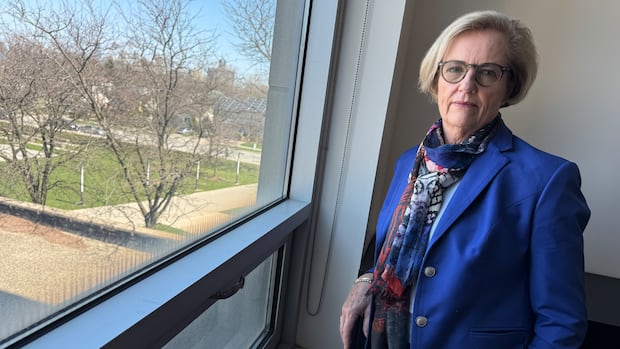
Canada experiences the largest number of medical supply shortages in the world, according to a Windsor researcher who’s trying to fix the system.
Anne Snowdon is tasked with improving the country’s medical supply chain and to “strengthen patient safety” when it comes to accessing medications, devices and supplies.
She’s a nurse, who worked on the front lines during the SARS epidemic in 2003, and is now the scientific director and CEO at Supply Chain Advancement Network in Health.
More than 3,000 medical supply shortages happen each year in Canada and Snowdon found they last longer, compared with other countries.
“In health care you can’t afford that disruption, because patients can’t get care that they desperately need,” Snowdon said.
Health Canada tells CBC News that comparing medical supply shortages between countries is “challenging,” because reporting varies by nation.
In 2024-25, Health Canada said there were nearly 2,600 drug shortages, a decrease of 20 per cent compared to the previous year.
“Most reported shortages are successfully managed before they impact patients,” said Health Canada spokesperson Marie-Pier Burelle.
Although Snowdon has been researching Canada’s medical supply system for more than 15 years, she is currently less than a year away from completing a five-year grant.
The Social Sciences and Humanities Research Council, a federal research funding agency, has tasked her with coming up with solutions, and Snowdon is working with agencies including Health Canada, Public Health Agency of Canada, local and regional health systems and supply chain teams to implement them.
Snowdon says managing medical supplies in Canada is “challenging,” partly because of our smaller population and lack of market influence compared to the U.S.
Hospitals should be collaborating, not competing, researcher says
One solution, already underway in Atlantic Canada, is having healthcare providers collaborate on obtaining supplies.
During the COVID-19 pandemic, each hospital was competing every other for “precious few” supplies like N-95 masks, said Snowdon.
“We’re too small to compete against each other,” she said.
Stemming from her research, an AI-driven platform has been created so healthcare organizations can search for specific Health Canada-approved products and where they are made.
She said this allows them to support Canadian suppliers, but also gives healthcare providers options for where else to source products in the event of a shortage or disruption.
National coordinated strategy wanted
What’s missing from that platform is information about what supplies come from other parts of the world, something Snowdon is working on with the University of Windsor’s Cross Border Institute
“So that when there’s geo-political conflict or a weather event … knowing what products rely on those logistics and distribution channels,” said Snowdon.
Stronger integration of information around Canada’s healthcare supply chain is something HealthPRO Canada’s CEO is also pushing for. HealthPRO works in healthcare procurement — essentially sourcing supplies.
Christine Donaldson, who also previously worked as the regional director of pharmacy at Windsor Regional Hospital, said patients would benefit from a national coordinated strategy around medical supplies.
Right now there isn’t the ability, on a national scale, to know how a major weather event in a specific part of the world would impact medical supply access in Canada.
“That’s the sort of thing where we should have that intelligence to understand, how will that impact any of our critical medical supplies,” said Donaldson.
 Christine Donaldson is president and CEO of HealthPRO Canada. (Jason Viau/CBC News)
Another big gap Snowdon has identified is the lack of digital infrastructure to keep track of how many Canadians need a particular medical supply, in the event of a shortage.
There’s also a risk assessment tool in the works to help supply chain teams understand the medical urgency for some products and how to “ensure the highest risk populations in the country have access to the few products we have on hand.”
“Is that a must-have product that, without it, patients may be so severely impacted they may struggle to survive? Or is it a product that’s important, but it might not kill anybody?” Snowdon asked.
As the national lead in medical supply procurement, Donaldson with HealthPRO admits there are some “vulnerabilities” in this sector.
But she said the organization is working at making the medical supply chain more resilient.
 HealthPRO Canada helped find a solution for the children’s Tylenol shortage in 2022. (Submitted by Kari Raymer Bishop)
Instead of awarding a drug contract to one company, Donaldson said that’s now split up into two separate manufacturers.
“That way they can help each other out if by chance there is some kind of supply disruption — and we actually have contractual terms that obligate them to help each other during any shortages,” said Donaldson.
There’s also a 90-day supply of critical drugs to create a buffer in the event of a shortage, Donaldson added.
WATCH | How Canada solved its children’s Tylenol shortage in 2022:
How Canada solved its children’s Tylenol shortage in 2022
Christine Donaldson is president and CEO of HealthPRO Canada and she talks about how her organization helped solve the children’s Tylenol shortage in 2022.
Snowdon is also looking to improve how medical products are tracked in patients.
Why isn’t the healthcare supply chain as strong as auto?
It’s achievable, she said — pointing to the automotive industry, which tracks faulty parts to specific vehicles for recalls, or similar systems for food products that need to be pulled from shelves.
“We can’t do that in healthcare,” Snowdown said.
When healthcare products are recalled, Snowdon said there’s also no broader system in place to know which patients are impacted and how Canadians can be notified if a medical device inside their body is recalled.
Tracking patients with breast implants was one example highlighted as a gap.
On Wednesday, Health Canada announced the launch of a new voluntary registry specifically designed to send out alerts about breast implant recalls and safety issues.
Discussions about building domestic capacity
For Donaldson, she said there’s also a conversation about strengthening Canada’s domestic capacity.
“The best possible answer is a mix … between investing in domestic capacity and also working with our global supplier network,” said Donaldson.
“Canada can’t do it all. We’re not big enough,” she said, noting Canada only makes up two per cent of the global demand for pharmaceuticals.
Health Canada said it’s working closely with federal partners to see how the government can support the Canadian pharmaceutical sector “in light of current pressures.”
Supply Ontario, a provincial government agency that procures healthcare supplies, points to the Buy Ontario Procurement Directive as a way it’s supporting Canadian suppliers.
A spokesperson also said Supply Ontario is always looking for ways “to increase the purchase of domestic medical supplies and to support domestic production and growth.”
Snowdon’s research stems from improving Canada’s health supply system and a way to “learn from your mistakes” following the COVID pandemic.
‘How did we not learn the lessons from [SARS]?’
As a nurse who worked through the SARS epidemic in 2003, she says she had hoped Ontario would have learned those lessons sooner.
A SARS Commission in Ontario examined the epidemic and made recommendations to learn from those mistakes.
With more than 200 recommendations, Snowdon said only one was implemented.
“When I looked at what the recommendations were, they are almost exactly the same as the challenges we had during COVID,” said Snowdon. “How did we not learn the lessons from that? I wish I had the answers.
“Now I think we have a much brighter light shining as a result of COVID.”