
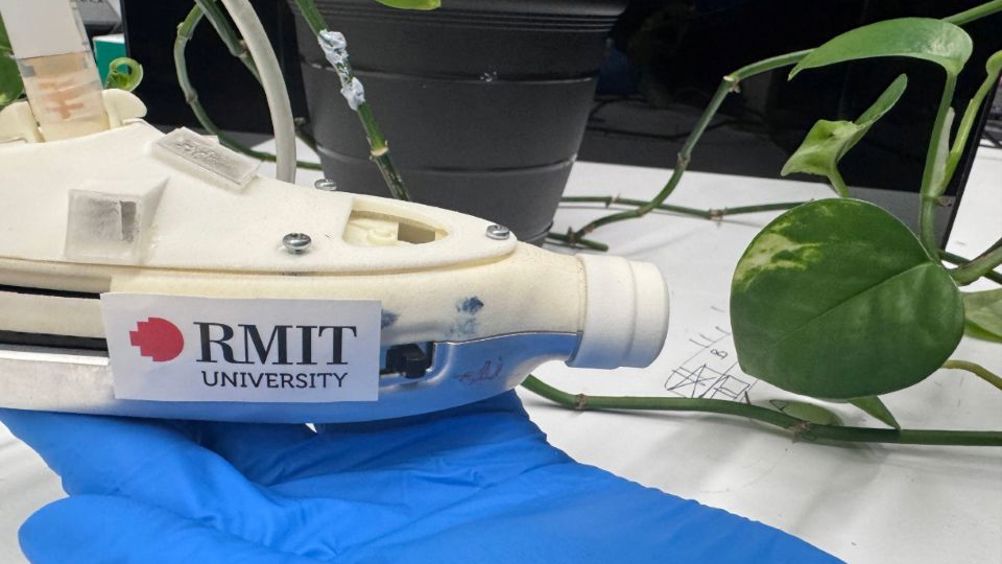
The technique creates a fine mist that forms a coating at room temperature, avoiding the heat and harsh chemical processes commonly associated with advanced surface treatments. The team said the approach could expand the use of coatings on sensitive materials such as soft plastics, biological tissue and emerging electronic components. Their work is detailed in Science Advances.
The researchers demonstrated the process by applying the coating to sections of living plant leaves, enabling direct comparison with untreated areas. According to the team, the coating acted as a protective layer against ultraviolet radiation without interfering with photosynthesis.
“The coating absorbs harmful UV light while allowing visible light through,” lead author and PhD researcher Javad Khosravi Farsani said in a statement. “That means the plant can continue photosynthesis while being protected from damage.”
The researchers said the coated leaves and plants continued growing normally for several months after the coating was removed, indicating the process did not damage plant health. The plant trials were carried out as a proof-of-concept demonstration for the wider coating platform.
The study used a liquid made from a covalent organic framework (COF), a class of porous material designed for applications such as light absorption, molecular separation and surface protection. The liquid assembled into a solid UV-blocking layer during spraying.
According to the researchers, the work demonstrated that highly ordered COF coatings can be produced and deposited simultaneously in a single step at room temperature. Previous methods have generally required multiple stages or elevated temperatures, limiting their compatibility with fragile materials.
Distinguished Professor Leslie Yeo, from RMIT’s School of Engineering and a senior author on the study, said existing processing requirements had restricted broader use of the materials.
“These materials have extraordinary properties, but you’ve typically had to choose between preserving their structure and protecting the surface you’re applying them to,” said Yeo. “What this work shows is a way to avoid that trade off by forming and coating the material under very gentle conditions.”
Conventional coating systems often rely on ovens, aggressive solvents or specialist equipment, which can damage heat-sensitive materials. Associate Professor Amgad Rezk said the new process instead uses sound waves to drive both material formation and deposition.
“By using sound waves, we’re able to form and deposit the coating within minutes without heating or damaging the surface,” he said. “That’s a major shift from conventional coating methods and it allows us to work with fragile materials, including living plant tissue.”
The process uses high-frequency vibrations to break the liquid into microscopic droplets. As the droplets move through the air, the COF material organises into a solid layer before settling evenly onto the target surface.
Associate Professor Joseph Richardson, a co-corresponding author on the study, said the method operates in open air and at room temperature.
“Our method effectively combines manufacturing and coating into a single step,” said Richardson. “That simplicity is what makes it adaptable across different surfaces and applications.”
The method could support industries developing sensitive membranes, sensors and electronic components that require protective surface coatings but cannot tolerate heat or chemical exposure.
The research involved collaborators from Australia and Europe, including the Catalan Institute of Nanoscience and Nanotechnology. RMIT University has also filed a provisional patent related to the technology.