
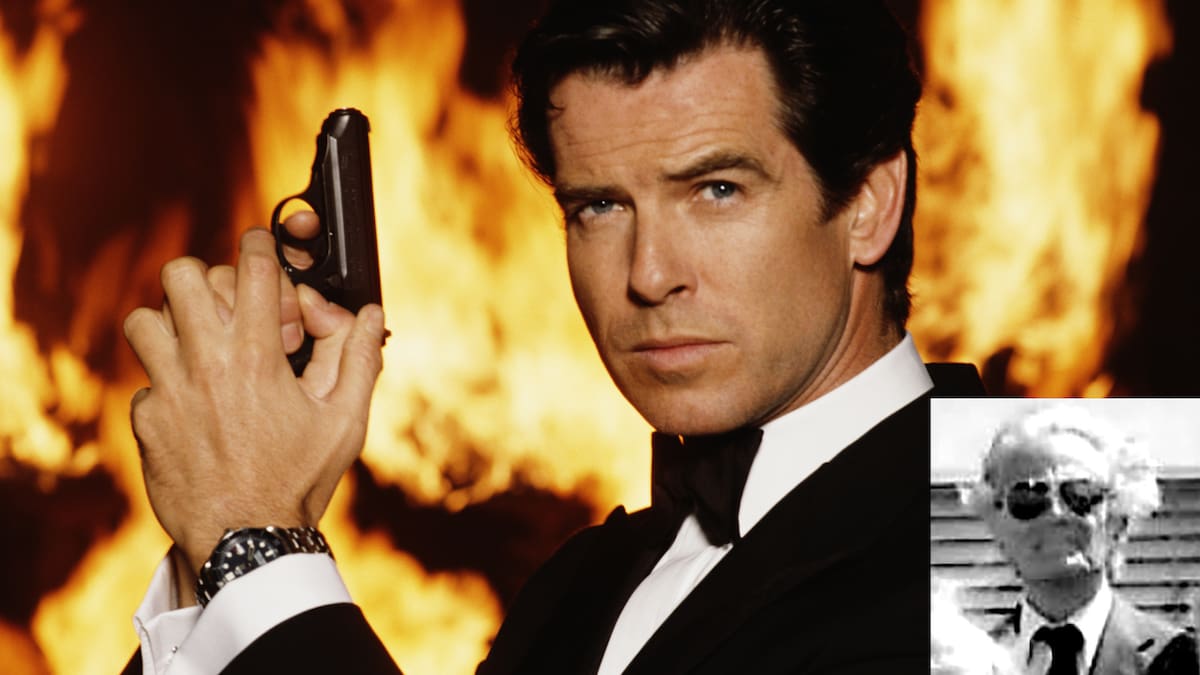
The glum, dull-brown Beehive theatrette of the mid-1980s was the unlikely setting of the final rodeo for the Englishman whose escapades came straight from the pages of Ian Fleming’s James Bond novels.
Picture this: the distinguished correspondent for the UK’s Sunday Times, with his great mane of white
hair, strides to the front row of PM David Lange’s riotous press conferences. He’s surfacing in the capital at a resonant moment. The Rainbow Warrior has been sunk in an act of terrorism by the French; anti-nuclear New Zealand is adrift from old allies Great Britain and the USA.
“He always sat in the front row,” recalls veteran political journalist Richard Harman of the old lion’s appearance week after week, “and never asked questions”.
For the moment, the correspondent, Antony Terry, dazzles the local journalists of the parliamentary press gallery. They’ve heard he’s slowing down after 40 eventful years as a world-famous foreign correspondent and set up house up the road in Karori.
What’s he doing here? There’s a plausible reason. He’s married a Kiwi fellow journo, Edith Lenart, his third wife, and she’s come back home after decades away to be with her daughter.
But activist and muckraker Toby Truell was picking up some strange vibes about the new guy in town. Terry was said to be sniffing around the Wellington peace movement, asking questions, claiming to be a sympathetic ear.
In the front room of his crumbling Mt Victoria villa, Truell hand-types Wellington Confidential on an old Corona. It’s a rough, gossipy newsletter he’d cyclostyle and post out on occasion, a pre-internet version of a blog.
Peace campaigner Owen Wilkes is Toby’s co-editor; I’m their researcher. And in 1988, our issue, headed The Spy Who Stayed out in the Cold, drops a bomb on Antony Frédéric Aimé Imbert Terry, who plays an astonishing role in the James Bond origin story.
The spy who loved us? From left, Antony Terry, right, in Vienna in 1947, Hitler with deputy Martin Bormann, who Terry alleged later worked as a Soviet agent, and Terry, left, at a breakfast for Austrian politician Oskar Helmer. Photos / Getty Images
Daring raids
One thing’s for sure about Terry: he never matched Bond in the suave stakes. He had icy blue eyes behind thickly lensed specs and favoured anonymous dark suits.
His resume is more interesting than his wardrobe. Born in London in 1913, Terry grew up in Germany, raised by British diplomat parents. By his late teens, he’d found work as a journalist, then signed up for war service.
His superb language skills saw him scooped up by military intelligence, but he chose to enlist as a commando and participate in a series of deadly raids. He earned a Military Cross, and spent three years as a German prisoner of war.
After the war ended, he became a feared interrogator of Nazi war criminals at a secure facility known as the London Cage, gaining the title “the shit with the glasses”.
In 1947, he joined the Mercury foreign news service at the invitation of its manager, Ian Fleming. Mercury was part of the then Kemsley Newspapers group, which owned British regional and national papers, including The Sunday Times. Fleming, today remembered as James Bond’s creator, joined the group in 1945 after a war spent in British secret intelligence.
Ian Fleming invited Antony Terry to join the Mercury news group. Photo / Getty Images
The Mercury network of overseas-based UK journalists supplied material to Kemsley mastheads. That was the official line. It has subsequently – and conclusively – been exposed as a quiet rump of the British Secret Intelligence Service, or MI6, under the unsexy code name BIN.
Terry was first posted to Vienna, a strategic crossroads during the Cold War. Some of his dispatches, with lurid headlines like “Britain, Red Target” and “Red Lights of Doom”, even popped up in papers such as New Zealand Truth.
Fleming was so impressed with Terry he gave him a coveted Berlin posting. In his book With My Little Eye: The Memoirs of a Spy-Hunter, Donald McCormick, one of Terry’s Mercury colleagues, recalled his experiences of Fleming.
“One problem posed by my working links with Fleming in those days was that on occasions,” McCormick wrote, “one could never be sure when he sent a letter or cable of instructions, whether the material he wanted was for a story in Kemsley Newspapers, an inquiry on behalf of British intelligence, or a personal mission for Fleming himself.”
Terry made his name as a specialist of wild rumour with a grain of truth. He filed interviews with Hitler’s sister; told of Nazi gold bars hidden in an Austrian lake; claimed Hitler’s deputy Martin Bormann was not only alive, but working (and recruiting) as a Soviet agent.
Behind the scenes, Fleming was busy developing James Bond. In 1953, he published Casino Royale, his first novel featuring Commander Bond, 007. He embarked on such successors as Moonraker and Goldfinger, relying on field men like Terry to provide lurid storylines and colour.
Intelligence writer Jeremy Duns claims, in Agent of Influence, that of all the correspondents in Fleming’s stable, Terry was the one he came to rely on the most. The character of Sir Hugo Drax, the villain of Moonraker, for example, draws on Terry’s Sunday Times reports about werewolf “murder gangs”, a largely fictitious last-ditch Nazi resistance movement. And his influence is seen in the Goldfinger movie, where Bond uses a kilo bar of Nazi gold, stamped with a stylised eagle, to tempt the villain.
Terry spent the 1950s in Berlin, with his second wife, Rachel Stainer, a journalist. He’d been briefly wed to Eileen Giffiths in the 1930s but this one was essentially an arranged marriage. According to Duns, “MI6 did not employ bachelors: a ‘solidly married man’ made for more plausible cover and was thought to dissuade the Soviets from attempted honey-traps”. Stainer, Duns wrote, was informed of her husband’s intelligence role.
Terry with French High Commissioner Antoine Béthouart and his wife Madeleine in Vienna. Photo / Getty Images
Nicholas Shakespeare’s 2023 Fleming biography indicates the Terrys often joined forces on intelligence operations. He recalled how “the chief” [Fleming] got them to rendezvous with a Herr von Mouillard, “well known to a mutual friend of yours and mine”, a reference to MI6.
Based in Hamburg, the contact had inside knowledge of Russian manoevures in Germany. “Terry used Rachel to deliver a parcel containing a pistol and to take some papers from von Mouillard, carbon copies of lists, closely typed, of things unobtainable in East Germany or Russia. These Terry had to fly to London ‘to put into the chief’s own hand’.”
Shakespeare even suggested Terry was a real-life model for Bond, adding that “the number of those who have been identified with varying degrees of credibility as Fleming’s inspiration would have officered Ian’s commando unit”. Other candidates on the distinguished list include master spy Richard Sorge, actor David Niven and writer Patrick Leigh Fermor.
As Fleming sat down to write From Russia With Love, Shakespeare wrote, Terry and Stainer entertained him over dinner with tales about Emma Wolff, a terrifying Soviet intelligence officer they’d encountered in Vienna. Fleming subseqently used some of Wolff’s physical traits in his portrayal of the sadistic villain Rosa Klebb.
By 1964, the Terrys had divorced; Ian Fleming was dead. Stainer went on to build a successful career as a spy writer using the pseudonym Sarah Gainham, drawing on her years behind the Iron Curtain. Her 1983 thriller, The Tiger Life, traversed the back alleys and cosy nightclubs of Cold War Berlin. It is easy to spot Terry as the vile Freddie Ingram, a foreign correspondent, an abusive husband and agent for British intelligence.
In 1972, a fictional Terry popped up again in Frederick Forsyth’s The Odessa File, this time as Anthony Cadbury, “doyen of the British foreign correspondents”. The idea came from another Terry special, his 1967 Sunday Times story about a conspiracy involving escaped former SS officers.
Forsyth wrote: “Fortunately, Cadbury was a methodical man and had kept every one of his despatches from the end of the war onwards. His study was lined with box files along two walls. Besides these, there were two grey filing cabinets in one corner.”
Revealed: Wellington Confidential announces Terry’s hidden life. Right, Terry’s second wife, Rachel Stainer, wrote spy novels under the pseudonym Sarah Gainham.
The move to NZ
Fast forward to 1985. Terry, now officially retired, packs up his real-life archive and ships it out to Wellington. By now he’s married Lenart, a Europe-based freelancer for The Sunday Times and The Economist.
The pair met in Paris in 1972, appropriately at a press conference, during Terry’s decade there as The Sunday Times’ European editor. After his retirement in 1980, the couple based themselves in the south of France, Terry still picking up plum assignments around the world. The couple relocated to Wellington, where Lenart had inherited a large house, in desirably leafy Homewood Crescent, just doors from the British High Commission in Karori.
What is he doing here? A pair of remarkable books published by Judith, Lenart’s daughter, have some definitive clues.
Yours Ever, Ian Fleming: Letters to and from Antony Terry (1994) and Berlin to Bond and Beyond: The Story of a Fleming Man (2007) draw on the vast paper archive found in Terry’s home office after his death. In the latter book, Lenart writes of “an entire room that was occupied by material he had either written or gathered … half a wall of books specifically concerned with Hitler, the Reich, SS, and war criminals written in English, German and French. After my mother’s death these were left to me.”
Terry’s letters, many published in Lenart’s books, contain astonishingly indiscreet insights about his daily life and his connections to the secret world.
Judith Lenart, daughter of his third wife Edith, drew on his archive for Berlin To Bond And Beyond and, right, physically, Antony Terry was nondescript apart from his mane of white hair. Photos / Supplied
In Berlin to Bond and Beyond, Lenart concludes her late stepfather enjoyed what she called “special agent status” with MI6, “somewhat removed from the full-timers on the firm’s [MI6] payroll, but undoubtedly more influential, important, independent and well connected. Everything points to this special status remaining right up to [his] death in 1992.”
Underscoring her point, she quotes a May 31, 1986 letter from Terry refusing free flights to Hong Kong to meet an MI6 handler: “do not like idea of his picking up tabs as this puts things on a different basis, not merely a mutual back scratching one which suits me best”.
As he settled into Wellington, gaining accreditation to Lange’s weekly press conferences and attending diplomatic cocktail parties, Terry began making contact with local nuclear free groups such as Peace Movement Aotearoa.
Another 1986 letter states: “I have got myself on the mailing list of half a dozen of the local way-out movements just to see what they are up to – it might make some copy for The Sunday Times if they really get up to something spectacular.”
The paper continued to include Terry in major investigative pieces, including the high-profile capture of Israeli nuclear technician Mordechai Vanunu. Terry also supplied his old paper with a stream of news backgrounders about New Zealand political affairs, only some of which were used.
In 1987, some of his reports in The Sunday Times recalled his more outrageous Cold War sensations. One story had a focus on “the Soviet/Libyan security risk in the South Pacific … an [expelled] Soviet diplomat … had financed and recuited as Soviet agents for subversive activities young Maori activists.” Another claimed Soviet trawlers fishing along New Zealand’s coastline were “selling Kalashnikov AK-47 automatic automatic rifles to Māori gangs, some of whom claim to be stockpiling them for a future Fiji-type ethnic uprising”.
Meanwhile his overtures to “way-out movements”, began to arouse the suspicions of peace activists like Owen Wilkes and a youthful Nicky Hager. In 1988, Truell’s Wellington Confidential team began its Terry researches. It was surprising to see how often his name popped up in the shelf of histories of British intelligence available in the Wellington Public Library.
The unmasking
In mid-December, over eight pages, Wellington Confidential posted out its profile on Terry. It began its story: “The snowy-haired old gentleman from the London Sunday Times who has wormed his way into the front row of PM David Lange’s press conferences over the past three years is a master of masks.”
It went on to claim Terry was “on active service on behalf of British intelligence or MI6 … using the guise of a foreign correspondent, one he has favoured for the last four decades … the presence in this country of such a distinguished and experienced operative … is certain evidence of the rage Whitehall is maintaining over New Zealand’s nuclear-free defence policy”.
The newsletter’s wide circulation among media and political circles ensured its claims quickly became a talking point, and Lange was apprised of a copy. Terry managed to keep a stiff upper lip, continuing to attend Beehive press conferences even as journalists seated behind him would strike up a loud rendition of the James Bond theme.
But letters published in Berlin to Bond and Beyond confirm the impact of the Wellington Confidential story on Terry.
“David Lange told a visiting colleague [bestselling author] Simon Winchester that I was a spy, which got a laugh from Winchester who told me at once. I looked into it and found that someone (probably Mrs [Margaret] Pope) had been reading a Peace Group newsletter … alleging that Mrs T had sent me to spy on David L for MI6 because HMG was so furious about NZ’s anti-nuclear policy … the only surprising thing is that Lange believed it without checking … as I could not let this idiocy continue (it also upset Edith quite a lot), I went to the family lawyers.”
When Terry died in 1992, glowing obituaries attesting to his journalistic career appeared in British and New Zealand newspapers. The Times wrote of “his extraordinary judgment, investigative skills, breath of experience and unmatched contacts”. The Independent called him “a one-man listening post, a fastidious checker of facts, a burrower into dark corners”.
Private Eye, scurrilous but unusually well informed, took a different line, pointing to the threatened legal action from Terry, which came to nothing. “Terry may have been invaluable to The Sunday Times but he was also pretty useful to MI6 … Terry was exposed by a left-wing magazine in New Zealand as a spy. He issued a threatening letter, with similar threats from The Sunday Times, but no apology was offered. Terry and The Sunday Times wisely decided not to proceed.”
SaveShare this article
Reminder, this is a Premium article and requires a subscription to read.
Copy LinkEmailFacebookTwitter/XLinkedInReddit