
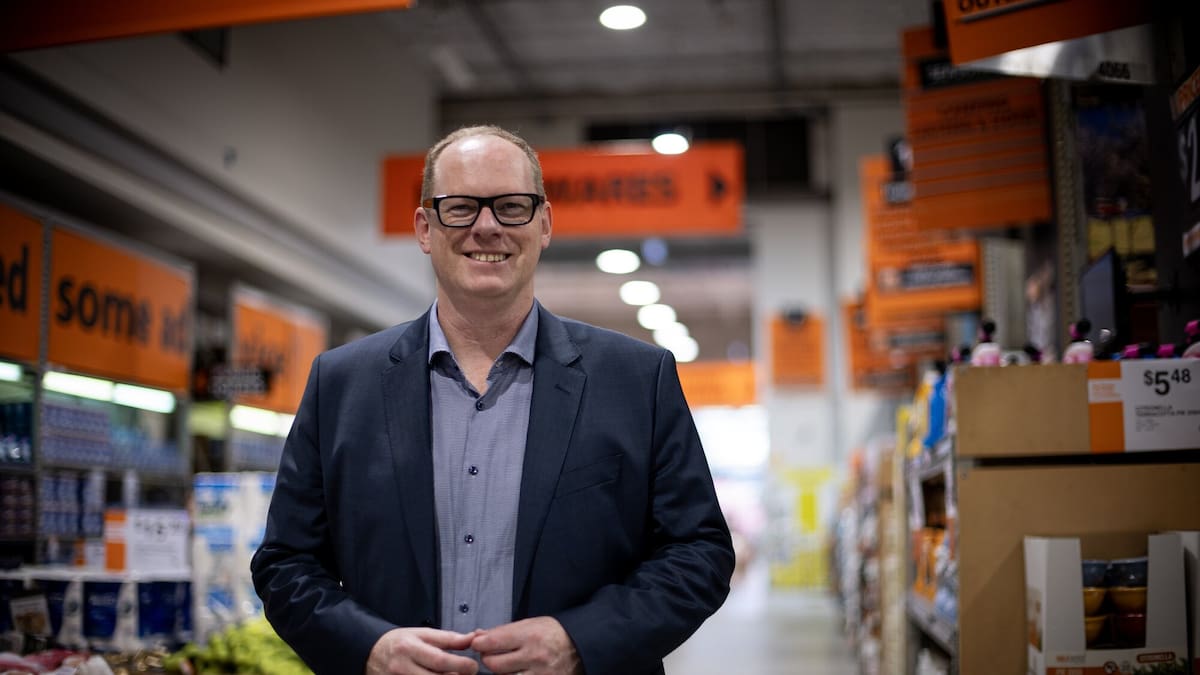
“What’s really exciting about the Mitre 10 role for me is that it’s another co-operative in New Zealand, and the two major co-operatives in New Zealand compete against great competition,” Rowles said.
“It’s another opportunity to have a go at doing that. The fundamentals are the same: pricing and value for customers, great ranges and operator engagement in their stores. It was a great opportunity to come and do what I love, which is retailing and in the co-operative space.”
Rowles said he was focused on getting the fundamentals right with everything from the carpark to wayfinding, to pricing, to stock on shelf and the speed through the checkout contributing to a consistent experience and adding to the value equation.
Rowles lives in a city apartment, so opportunities for DIY are limited, but he said he enjoys creating living, green spaces and bringing nature in through container gardening on his balcony.
Lindsay Rowles has more than two decades of experience in retail operations. Photo / Dean Purcell
Outside work, Rowles said he enjoys travelling and food, “especially spicy food”.
“Most summers I buy cookbooks and learn a new cuisine. This year it was Italian. In years past, I’ve learned to cook French, Cantonese and Sichuan.”
Iran war impact
It’s a challenging time to be in retail with the Iran war impacting fuel costs, which is making it more expensive to ship products to New Zealand and transport them around the country.
Rowles said the business was already seeing the impacts on global supply chains.
“The team are doing a lot of work around assuring supply across our group,” Rowles said.
“The second is getting the product at the best price. Having the customer’s trust and only passing through the costs you need to.
“Then, when those costs pull back, actively taking them out of the business as fast as you can.”
Mitre 10, like many in the sector, has already had to pass on a small number of targeted price increases where they are directly linked to fuel or raw material costs.
Some of these include concrete deliveries to sites, and plastic plumbing products, with Rowles confirming some plastics prices had increased by 20% overseas.
Since taking the helm at Mitre 10, Rowles has been travelling around the country speaking to owners and staff from across the co-op. He has visited 20 stores so far.
He said he had taken the time to look and listen proactively, noting how the owners he had met were “really engaged in their communities”.
Foodstuffs and Mitre 10 are two of the largest co-operative businesses in New Zealand.
Mitre 10 has a network of 69 entities that own shares, each of them owning one or several of Mitre 10’s 80 stores and collectively employing more than 7000 staff.
However, unlike Foodstuffs, not a lot is publicly known about how much the company makes, with each store’s earnings kept private.
The co-op’s store support office reported total revenue of $300.3 million and a net loss of $27m in its last financial result, but the figures represent a fraction of the company’s total earnings.
First Retail Group managing director Chris Wilkinson said the question of how large Mitre 10’s entire business was had a few different angles.
“The ‘retail’ part of Mitre 10 Mega is just one element in each of the store’s businesses. Trade is a very substantial element and because of the owner-operator model – each business has strong local ties – many stores ‘own’ that market, driving revenues well beyond what goes through the checkouts,” Wilkinson said.
“You’ll see that reflected in the number of operators that have off-site distribution and logistics centres, where bulk products and materials can be supplied from.”
Wilkinson said while competitor Bunnings also had a large trade business, Mitre 10’s entrepreneurial operator cohort had additional reason and ability to be competitive, helping to maximise market share.
“I would say they are the dominant players in the category, but by how much is difficult to determine because of these factors.”
RX Group founder and managing director Juanita Neville-Te Rito estimated a market split across the home improvement category could look something like 55-60% Bunnings, 35-40% Mitre 10, with Placemakers, Carters, ITM and independents making up the balance.
But Neville-Te Rito said a clean number was “genuinely impossible” to pin down publicly.
“To get a sense of real network scale: back in 2020, the co-op reported goods supplied to stores of around $818m – and that’s a wholesale/supply figure, so retail turnover across the network would be higher again,” Neville-Te Rito said.
“With store growth since then and a few years of trading, a rough estimate for total network retail sales today would be somewhere in the $1.5 billion to $2b range. I’d frame that as informed context rather than a citable figure.”
When considering Bunnings NZ filed audited accounts showing revenue of $1.76b for the year to June 2024, the competition is closer than ever.
Rowles said the published reports don’t give the full picture, as they do with corporate entities.
“The very clear message is our owner-operators run strong, financially sound businesses. The co-operative’s well backed by that and is in good shape to keep doing that.”
Mitre 10’s total financial performance is private, but chief executive Lindsay Rowles says the company has done well to hold market share. Photo / Dean Purcell
While Rowles’ next few months will involve visiting the remaining stores in the company’s network, Mitre 10 is already at work on its next strategy plan.
The previous five-year plan was marked by a “horrific” software upgrade, as described by one company insider, which sent the firm’s debt spiralling as a result.
Thankfully for Rowles, the issues associated with that upgrade have largely been fixed, allowing him to take control with the company in a more stable position.
Hammer Hardware split
One area Rowles will have to continue to engage with is the separation of Hammer Hardware from the business, although he could not confirm any timelines for when to expect more details.
Rowles said it was difficult to scale the Hammer Hardware business alongside the investments that were being made in Mitre 10.
“Fundamentally, they’re going to set themselves up as a new, independent co-operative, and we will support them on that separation and that journey.
“It’s a great business and it has a role in New Zealand, and we’re really happy to be helping them get underway with that.”
Rowles said his team would be working through its new strategy over the next few months, but believed it was an exciting time to be in any retailer.
“The customer is changing faster than they’ve ever changed.
“Technology change is real, and how you combine a great store experience with a great technical experience, those opportunities are there for this group just like they are for most retailers at the moment.
“Our differentiator that we hold is this local member model. The person who runs the store is in the store. Their teams are engaged and there to help, and it’s something you can palpably feel when you’re in a store, so continuing that model is a really important part of whatever strategy we take moving forward.”
Tom Raynel is a multimedia business journalist for the Herald, covering small business, retail and tourism.
Stay ahead with the latest market moves, corporate updates, and economic insights by subscribing to our Business newsletter – your essential weekly round-up of all the business news you need.