
“I love the age group. Particularly around that First XV coaching side of things because they’re incredibly committed, you’ve got a captive audience, you don’t have the stresses of trying to chase colts to turn up for trainings when they’re busy at university and partying and all those sorts of things.
“You get them at a nice age, that kind of 16 to 18 where they’re still boys and they have to be at school and they have to turn up for training and they want to turn up for training.”
First XV rugby has long been a space for promising coaches to cut their teeth.
Westlake Boys High School First XV perform their haka at Burger Field, where they competed in the St John’s Easter Rugby Festival, in South Africa. Westlake has former All Black Luke McAllister among their coaching staff. Photo /
One of New Zealand rugby’s greatest minds, Sir Graham Henry, famously coached the Auckland Grammar First XV from 1974 to 1980 before moving to Kelston Boys’ High School and taking up the First XV reins there. He resigned in 1996 to become the fulltime coach of Auckland and continued in the professional coaching ranks with Wales, the British and Irish Lions and the All Blacks.
Just last week, another recent First XV coach was appointed to one of New Zealand provincial rugby’s top positions. Jono Phillips had coached Nelson College through a hugely successful period as well as running their rugby programme up until the end of 2024. He’s now head coach at Tasman for the upcoming NPC.
Jono Phillips during his time with Nelson College.
Phillips’ ascent is more indicative of the current environment. He was already an accomplished coach before arriving at the school. Whilst the majority of First XV coaches are volunteers – many are now in paid roles. They’re tasked with creating a near professional environment for their elite players that includes strength and conditioning, nutrition and theory. It’s all part of their school day and many hope it’ll be part of their working life when they leave.
Heinz has already lived that life and is not alone in moving from a professional playing career to coaching schoolboy rugby – even in his current role.
“I’ve been lucky enough to have Owen Franks come on board as our forwards coach.”
Owen Franks charges into Kyle Eastmond and Ben Morgan of England during the 2014 test match at Eden Park. Photo / Photosport.
The 108-test All Black prop has a presence at the school.
“Even just in the term one preseason block, seeing the detail and the standards and behaviours that he brings to the group, particularly with the forwards, those boys have just been loving him,” says Heinz.
Some former teammates and adversaries of Heinz and Franks are also aligned with First XVs this season. At Wellington College, it’s another international prop/halfback duo of Neemia Tialata and Piri Weepu. Luke McAllister is with Westlake Boys’ High School, Pita Alatini with King’s College and Hika Elliott has found tremendous success with Rotorua Boys’ High School.
Rotorua Boys’ High have captured the Sanix World Youth Rugby Championship for the third time, after an emphatic 46-19 victory over Feilding High School in the 2026 final in Fukuoka, Japan.
Elliott’s side won the National Top 4 title last season and followed that up by winning the Sanix World Rugby Youth Tournament in Japan over the past week.
Heinz’s path to coaching wasn’t by accident. He knew where he was heading when his playing days ended.
“I’d taken the back end of my career just to start really taking that transition seriously. Did some study over in the UK in this kind of field, sports directorship type degree,” he says.
“I knew that I wanted to stay involved in the game. I’m a code head deep down and just love the game. I wasn’t 100% sure whether it was coaching or managing and I guess I’ve kind of landed in a place where I’m, I’m doing a bit of both.”
England’s Willi Heinz (left), controls the ball, during a test match against Wales at the Principality Stadium, in Cardiff, Wales. Photo / AP
Heinz says the advice he often gives players is that they “don’t need to be in a rush – but they do need to be ready”. It’s advice he’s found himself following.
“I’ve seen players retire and transition straight into [professional] coaching. Some do a good job; some really struggle. And then I look at some of the key guys that I’ve had as mentors, or some of the best coaches I’ve worked with. Typically, I found the path that they went down was, they retired from the game, went back to grassroots, be it clubs, school, and really cut their teeth and learned their craft. Because you can coach for a long time, right?”
The school sport space is increasingly bridging that gap, allowing a relatively entry-level role that can still be a paid job. Heinz says that market is growing.
“I can’t give exact examples, but I think there are big public schools now paying for coaches. Maybe not necessarily within rugby, but certainly within some other sports.
“The demand for high-profile and, I don’t love using this term at school level, but high-performance, the demands for high-performance sporting programmes at schools increases. I don’t think it’s exclusive to the private schools anymore.”
St Andrew’s College coach Willi Heinz overseeing a scrum at training. Photo / Supplied
Paid or voluntary, coaches of young people have a vital role to play and the 39-year-old father of 3 is acutely aware of it.
“The relationship side of your job as a coach or a manager or a rugby director, or whatever the job title is, the relationship piece is critical and needs to come first, so that when you need to be able to push a little bit more, you can, because they know you care about them.”
It’s clear that Heinz has been an A+ student of the game. Not just what happens between the try lines, but also between games and between the ears of those involved. Now he has a platform to put it all into use – and perspective.
“One of the great things I was told by one of my favourite old coaches was ‘just be where your feet are’. We’ve spoken to the boys around that this year. They’ve got a whole lot going on in their lives and that’s really important for us to remember as coaches.
“They’re not professionals. They’ve got school between 8.30am and 3.20pm every day. They’ve got relationships, they’ve got other sports, they’ve got families, they’ve got all these other things going on.
“We try to make sure that we’re really deliberate with the time we have with them. Try not to overload them with too much stuff, but when they’re with us, give us everything.
“Be where your feet are. Then when you’re done, you can go away and focus on whatever else is going on in your life.”
First XV of First XV coaches (and assistants)
There are stacks of former top-level players involved in school rugby around New Zealand. We’ve tried to pull together a team from them.
15 – Andre Bell (Lindisfarne College). Otago (beat Lions in ‘93)
14 – Sherwin Stowers (Sacred Heart) NZ 7’s
13 – Pita Alatini (King’s College) All Black
12 – Luke McAlister (Westlake Boys) All Black
11 – Lifeimi Mafi (Palmerston North Boys) NZ U21, Manawatū, Taranaki, Munster
10 – Piri Weepu (Wellington College) All Black
9 – Willi Heinz (St Andrew’s College) England
8 – Greg Foe (Nelson College) Samoa
7 – Tafai Ioasa (Hastings Boys’ High) NZ 7’s
6 – Sam Broomhall (Christ’s College) All Black
5 – Dom Bird (Scots College) All Black
4 – Kieran Coll (STC) NZ Heartland XV Captain
3 – Neemia Tialata (Wellington College) All Black
2 – Hika Elliot (Rotorua Boys’) All Black
1 – Owen Franks (St Andrew’s College) All Black
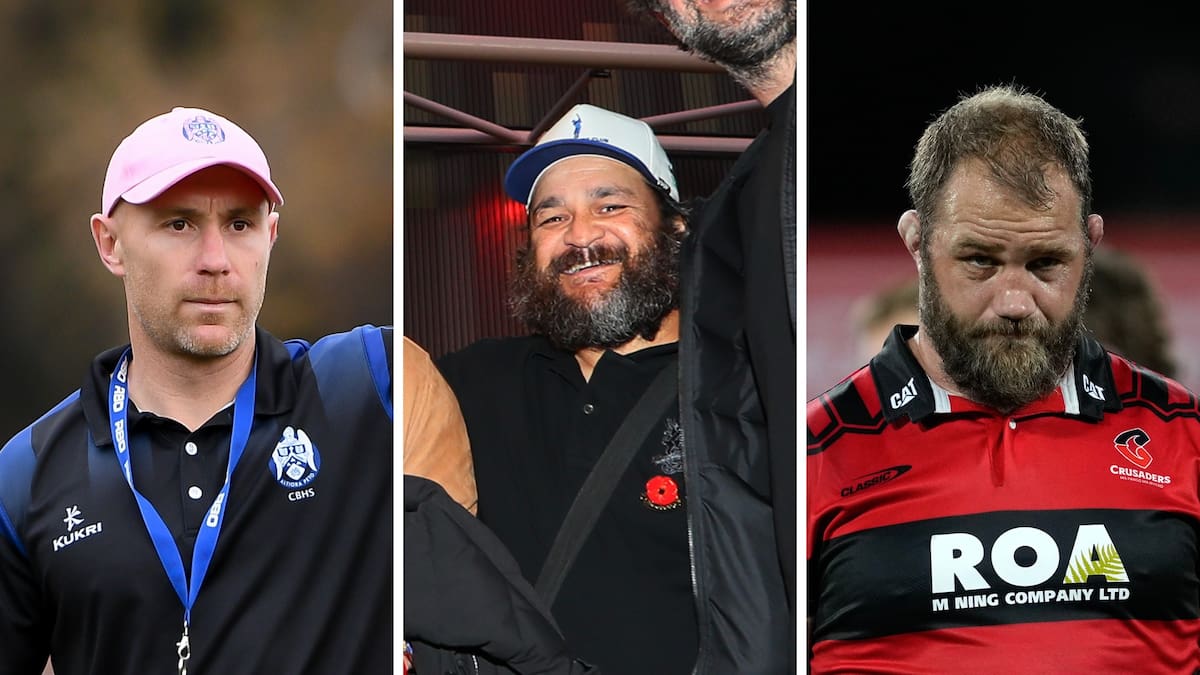
Special mention to Christchurch Boys’ High 4th XV coaches Corey Flynn and Nathan Mauger. Two former All Blacks who are also just two dads helping out.
Mike Thorpe is a senior multimedia journalist for the Herald, based in Christchurch. He has been a broadcast journalist across television and radio for 20 years and joined the Herald in August 2024.