
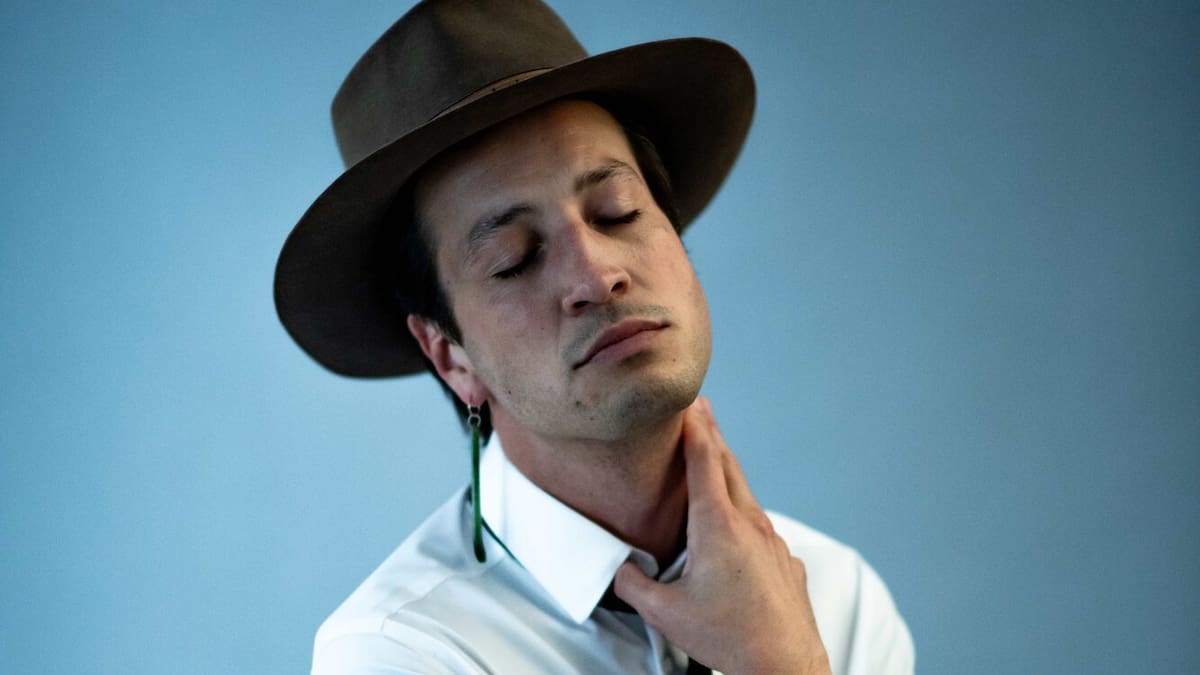
For almost 20 years, the singer-songwriter has been Marlon Williams: capital M, capital W.
He started playing music in high school, founded The Unfaithful Ways when he was 17, and apart from Covid, when everyone slammed on the brakes, he’s been going and going and going.
Williams, 35, will stop going and stop performing – both on stage and off – at the end of May, after he plays a handful of New Zealand shows. He announced the break on social media before tickets went on sale. It was less a cynical marketing ploy, more a sanity-saving decision, although he admits the flurry of headlines about it was “embarrassing”.
“The reason I told people [in advance] was, it’s a bit pathetic, but … I sort of needed to announce it so that people aren’t going, ‘When are you doing this? Like, what’s going on? What’s going on?’
“But you see a headline like that and people’s minds start wandering.”
“Being Marlon Williams – as a public entity – is acting on some level. Or performing at least.” Photo / Ian Laidlaw
It’s late and Williams (Ngāi Tahu, Ngāi Tai) has just arrived in an Amsterdam hotel room after driving more than six hours from Paris where he played the night before. Van life, he says, propped up on a beige hotel pillow against a beige hotel headboard, is certainly starting to lose its romantic appeal. A short holiday in Budapest in a few days is a welcome distraction.
A couple of months have passed since he posted that video on Instagram. He’s had time to sit with the now very real prospect of (happily) getting bored and learning to see the world in a slow, gentle light he hasn’t been able to bask in since he was a teenager.
Williams recalls his most fruitful writing spells came back then, when he was “working at the dairy, rolling ice creams and making lolly mixtures”. He knows this break will help him get back to that.
“When you’re bored, your mind starts to wander again – and that’s how you create interesting new things.”
He doesn’t need time alone to know he is an “introvert with extroverted tendencies” and something of a people pleaser, too. Those realisations have come in recent years, though shelved until he has time to process how to make that work in an industry that can demand so much.
But what does happen when you combine those particular tendencies with a career in which he has transformed from teenage musician gigging around Lyttelton to winner of numerous Aotearoa Music Awards, two Silver Scroll Awards and this year’s Taite Music Award? When you then become someone acting alongside Bradley Cooper and Lady Gaga in A Star Is Born and on the big screen again in the upcoming New Zealand film When Darkness Loves Us, with Game of Thrones’ Emilia Clarke?
For Williams, it has meant a long time living in an “exposed state”.
“As much as I am able to, in some ways, thrive in a social environment, [there’s] a lot of intensity that’s going on under the hood to sustain it,” he says.
“I love touring and I love hanging out with my friends and making things, making music, but I guess it becomes pretty tiring after a while. And if you’re lacking in energy … then everything starts to look grey, including things that you really love.”
To inject some colour back into his world, Williams is pinning his hopes on doing the dishes every night, building a routine (“it’s really hard to do that when you’re constantly moving”) and taking things a little slower. It all sounds so very un-rock ‘n’ roll, but so very needed.
“Predictability, I think, is what I’m looking for.”
Marlon Williams has been touring for almost 20 years. Photo / Fiona Goodall Photography
Williams released four albums in 10 years. The most recent, Te Whare Tīwekaweka, has earned him seven nominations at this year’s Aotearoa Music Awards. It’s more than anyone else up for gongs this year, and he is “tickled” by the whole thing. He’s also nominated for this year’s Apra Best Country Music Song and the album won him and his co-writer KOMMI the 2026 Taite Music Prize last week.
Te Whare Tīwekaweka was recorded in te reo Māori, a documentary (Ngā Ao E Rua – Two Worlds) was filmed alongside it by Ursula Grace Williams, and both projects were released at a time the musician describes as “speaking to the cultural moment” of the use and importance of the language in Aotearoa.
“It’s a real hot topic … people who support it and want to see it, want to see it flourish are rallying,” he says.
The songs will be a gift to local audiences when he tours in May. They have been “exciting” to share with international audiences, too.
“[They change] show to show, audience to audience, depending on how I feel.
“And it’s even more true when you’re performing songs on a stage to different cultures. I played in Paris last night, and the French just really wanted to hear Māori music.
“But of course, you’re dealing with a different sort of cultural comprehension than you do with middle New Zealand, which is different again from a more specifically Māori audience.
“That is sort of what keeps you from losing your mind when you’re touring; you’re repeating things, but you’re watching what the repetition says about the rest of the world, you know?”
Personally, he says learning and writing in te reo connected him to other Māori musicians, thinkers and whānau.
Musically, he hopes it started a “renegotiation” of the expectations for what he does next, the same goal he has for each of his albums.
“I think about like I’ve planted a peg further out in the field in one direction, which means that all these new sorts of games are able to be played, because there’s more room on the ground.
“That’s how I think about musical growth in general; that each base beyond home base is an opportunity when you go back the next time, to do something even more nuanced or even more adventurous.”
He didn’t want the album to be “some sort of religious experience of self-discovery”, instead suggesting that, in the end, language is simply one tool for communication.
“And it’s not to say that it’s just words. This is tied to who we are as people.”
Marlon Williams in Glenorchy, filming his documentary Ngā Ao E Rua – Two Worlds. Photo / Tim Flower
To a musician like Williams, whose lyrics can read like a diary or poetry or short stories, depending on the day, words are always more than how they look on the page. They are always on his mind, too. A current favourite, for example, is the word jeopardy.
“It’s from the French jeu parti, meaning equal chance, right?” he says, more animated than someone should be at this time of night and more confident in this writer’s high school French lessons than anyone should ever be.
“So, we think of being in jeopardy and like, ‘Oh, you’re really in trouble’ … We’re such natural gamblers, [but] to be in jeopardy is just to have an equal chance of winning or losing in a situation,” he says.
“I just love when you learn a word – the etymology of wherever it comes from – and then you see what its modern-day applications are. And they’re always more extreme than the way it’s written. It’s more intense, it’s more flashy, because language tends to amplify things like that.”
What else has been tickling his mental dictionary recently?
“Well, I learned that ‘a moment’ in the Middle Ages was specifically 90 seconds. It was a specific unit of time.
“Now, it’s like time’s sped up.”
Winning, losing and the passing of time. That all sounds a little on-the-nose for a man heading towards a temporary career hibernation, don’t you think?
“Yeah,” he says with a laugh. “I guess maybe it is a little telling.”
Marlon Williams plays around New Zealand in May. For more information, visit marlonwilliams.co.nz
Bridget Jones joined the New Zealand Herald in 2025. She has been a lifestyle and entertainment journalist and editor for more than 15 years.