
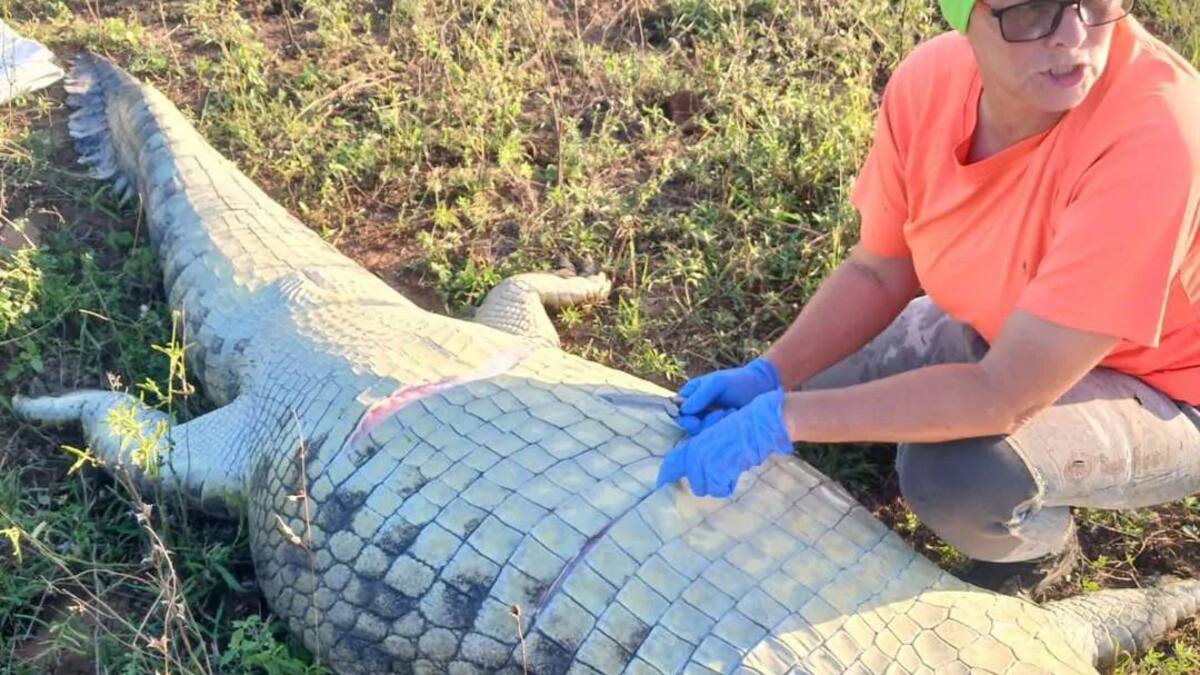
The shot croc had a rope slung round it and was airlifted to a nearby park for examination. The picture of the 500kg reptile – a beast so faultlessly evolved to fit its niche that it has barely changed in a hundred million years – hauled high in the air by a thudding hunk of human ingenuity, was a remarkable one, though not one that the beast itself was in a position to appreciate.
Once returned to the ground that it had spent its years sidling over in the menacing, sinuous, splay-footed way of reptiles in general and crocs in particular, it was flipped on its back and eviscerated.
Inside the beast was found, among other things, a ring thought to have belonged to Batista, some human body parts and six different types of shoes. The shoes could have indicated that the creature had tucked into a range of human beings, but it was equally possible that the croc had just snapped at everything that floated its way. “Crocs,” the leader of the police dive team said, “will swallow anything.”
You don’t have to be bright to survive a hundred million years. You do have to be an opportunist.
So there you have the sad story that gave rise to the headline. But how to explain that headline’s irresistibility? Why should we want to read on?
Well for a start, there’s good old schadenfreude, that uniquely human delight in another’s distress, for which there seem to be two causes. One is that we love a story. Stories are how we grasp the world. And without adversity, without some sort of distress, there is no story.
The other is that, when one reads of another’s misfortune, there’s a selfish sense of relief that it didn’t happen to you. It is as if there were a finite quantity of bad luck allotted to the world, so every hotelier eaten by a croc makes it less likely that you will be.
Furthermore, every bit of bad luck is a cautionary tale. If a man will try to cross a flooded river in his car, then he gets what’s coming to him. And his fate validates our own timidity, our reluctance to take risks in a hostile world. It isn’t cowardice. It’s prudence. Wisdom even.
And this story in particular plucks primitive strings. The idea of the man being found in the belly of the beast echoes ancient fears and archetypal tales. Did not the whale swallow Jonah? Did not a sea monster swallow Pinocchio? There is something primal about being held by a belly, like a second gestation.
And what a beast the crocodile is to do it. It walked with the dinosaurs. It has the grin of nightmare. It sinks slowly into the water and comes silent and invisible upon us. It is dragon and it is sea monster. It is all the creatures we have feared throughout our long evolution, so it is implanted in our amygdala as the toothed essence of a hostile world, a world of eat or be eaten.
It was the hotelier’s misfortune to be caught in an archetype. Hence the headline we cannot resist.