
Thank you for subscribing to my posts. If you’re not yet a paying subscriber, please consider becoming one. That’ll allow you to DM me with questions and comments. I plan to move my posts behind a paywall in coming months. Subscribing now locks you in at a low rate. Thank you so much for your support and feedback!
At some point, there’ll be a peace deal and the fighting will stop. Some time after that, tanker traffic through the Strait of Hormuz will normalize and oil prices will revert to their pre-war levels. What won’t be headed back to the status quo ex ante is long-term interest rates, which have been on an upward trend since the global debt binge during COVID and have taken another step higher since the war began in February.
Long-term interest rates consist of two things: (i) an extrapolation of monetary policy over the relevant horizon; and (ii) risk premia to compensate buyers for the risks they face by holding long-term government debt. The latter will rise if markets worry fiscal policy is irretrievably out of control. High long-term yields are insurance against the risk that governments inflate away public debt by printing money.
Markets can be forgiven for worrying about this for three reasons. First, fiscal deficits reached completely unprecedented levels during the pandemic. Second, deficits stayed far wider in the years since COVID than before the pandemic, so something’s become unmoored. Third, this isn’t just a US problem. It’s true for much of the G10, so lots of debt from all over the place is having to be absorbed by markets. No wonder longer-term yields are rising.
The war only makes all this worse. It’s deepened the rift between the US and Europe, so – if the Europeans didn’t already have plenty of reasons to boost defense spending – they certainly have one now. It’s also increased geopolitical uncertainty more broadly. Who’s to say Russia won’t test the fraying NATO alliance with some kind of incursion in the Baltics? Why wouldn’t China be even more aggressive in its spere of influence? There’s potential for lots of unintended consequences, all of which boil down to wider deficits and more debt.
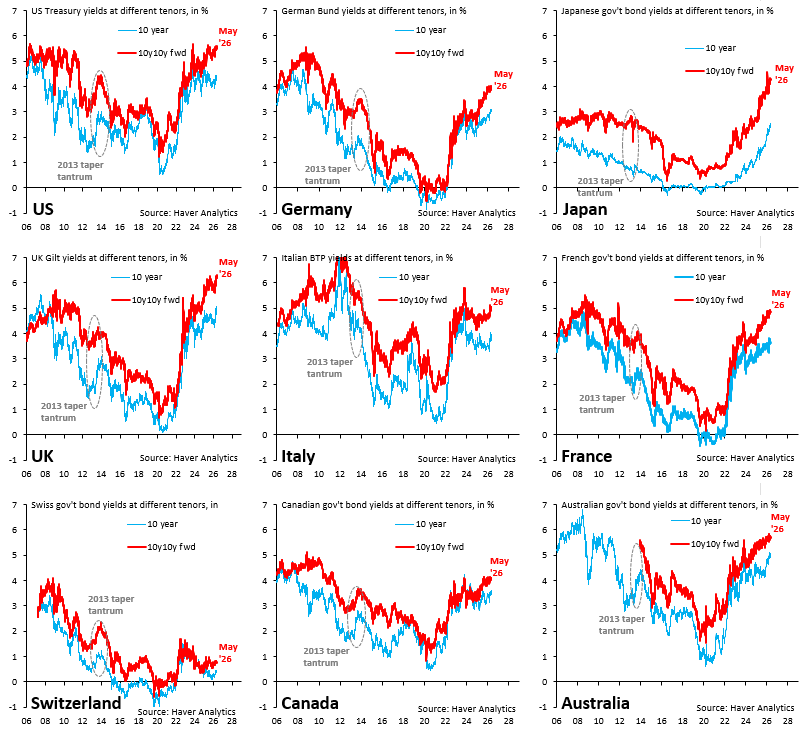
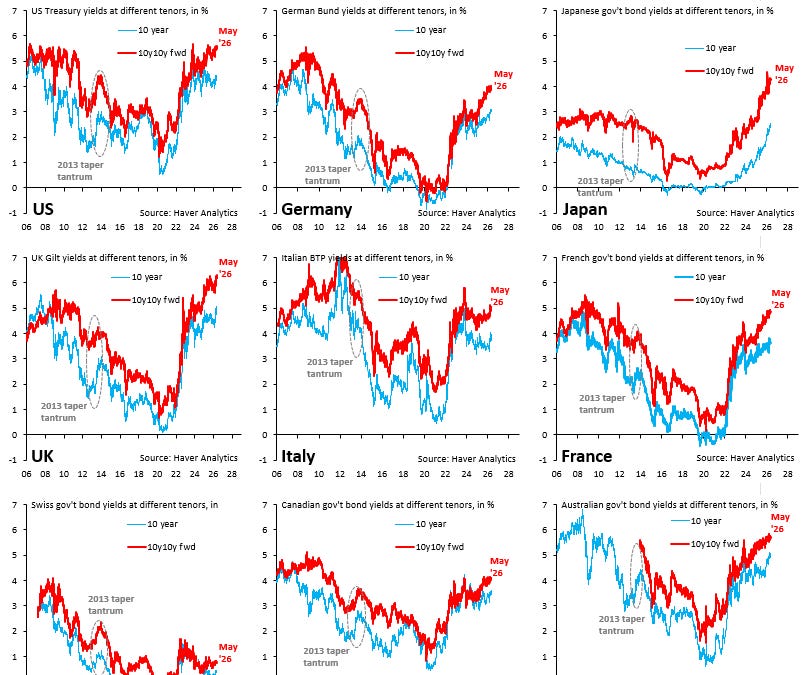
The charts above update a post I did on global debt back in October. The blue line is what we see every day: the 10-year government bond yield. It’s the red line we’re not used to seeing and this is where things get alarming. This is the 10y10y forward yield, which you can think of as the second half of a 20-year yield when you’ve taken out the 10-year yield in the front. The further the red line is above the blue line, the bigger is the risk premium markets demand to hold long-term debt.
Two things are striking. First, there’s a global element to what’s happening, since the red line is rising everywhere. That’s consistent with so many countries running loose fiscal policy during COVID and in ensuing years. Second, there’s many idiosyncratic trouble spots, like Japan’s bond market blow up ahead of its February election or rising long-term yields in the UK now. Each such episode has the potential to destabilize everyone else, given how high debt has gotten all over the place.
In the G10, only the UK in my opinion is making an honest effort to fix its fiscal imbalances. Everyone else is in denial. That to me says long-term yields must keep rising until governments get the message and fiscal policy gets better.