
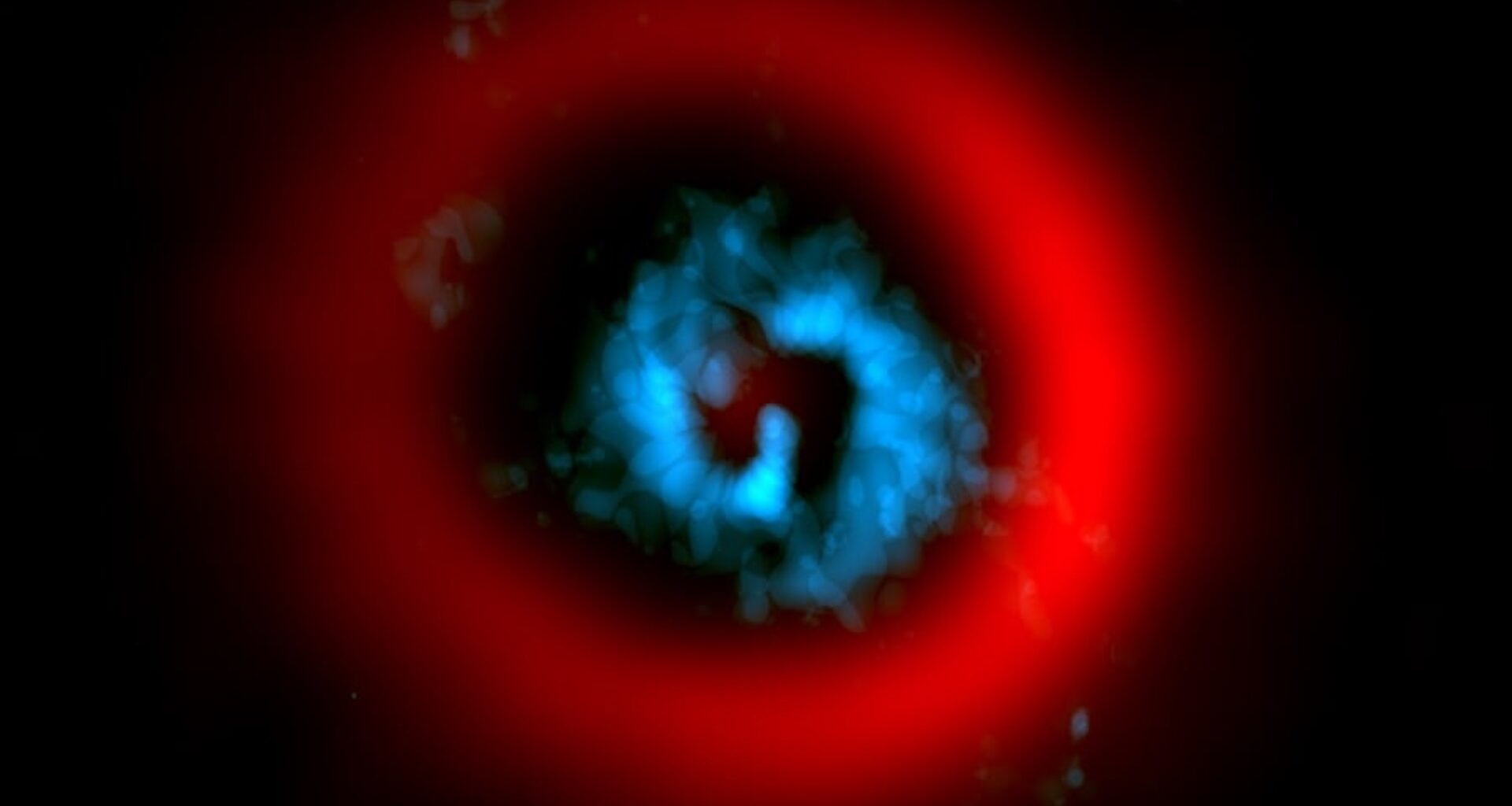
Protoplanets are celestial objects in the act of forming into full planets within the gas and dust disks surrounding hot, young stars. These objects, often several times the mass of Jupiter, are still embedded in their birth environments, actively feeding on surrounding material through their own circumplanetary disks. Unlike mature planets, protoplanets offer a rare glimpse into the violent, chaotic processes of planetary formation, revealing how the worlds we see today form.
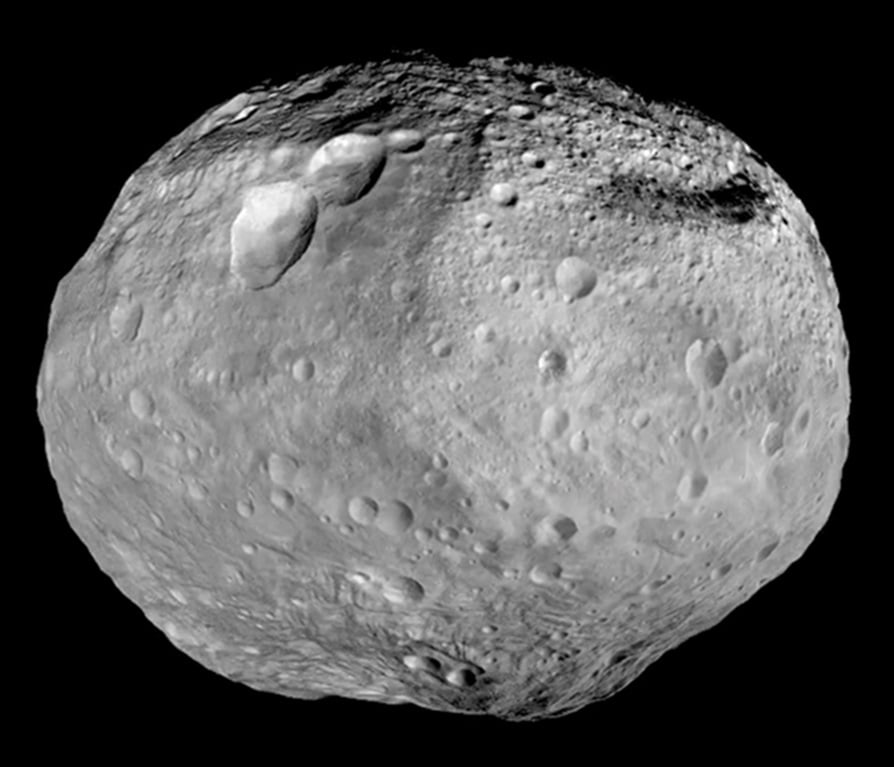
Vesta is a known surviving protoplanet. (Image credit: NASA/JPL-Caltech/UCAL/MPS/DLR/IDA)
Using the Very Large Telescope’s MUSE spectrograph in Chile, an international team led by researchers from the Astrobiology Center in Japan detected hydrogen alpha emission lines from the protoplanet. This hydrogen light comes from hot gas spiraling into the planet as it feeds from the surrounding protoplanetary disk.
You may like
The hydrogen emission detected from AB Aurigae b shows a distinctive pattern that reveals gas falling inward toward the planet rather than being blown away, this is known as an “inverse P Cygni profile.” This pattern has been seen in young stars undergoing rapid accretion, but AB Aurigae b represents the first protoplanet showing such clear evidence of ongoing mass accretion.
The emission appears at wavelengths slightly blue shifted from the hydrogen alpha line which indicates gas moving toward us at about 100 kilometres per second, while absorption features appear at red shifted wavelengths, showing material moving away at roughly 75 kilometres per second. This combination creates the characteristic “inverse” profile that indicates infalling material.
What makes AB Aurigae b particularly interesting is that, unlike other directly imaged young planets which orbit in cleared gaps in their disks, AB Aurigae b remains buried within its birth disk. This allows us to observe the actual feeding process as the planet accumulates mass from its surroundings The system’s young age of approximately 2 million years means we’re witnessing planetary formation in its earliest stages.
The observations of AB Aurigae b’s challenge standard models of planet formation. Located so far from its star, the planet likely formed through a process where dense regions of the disk rapidly collapse under their own gravity rather than the core accretion method that formed Jupiter and Saturn.
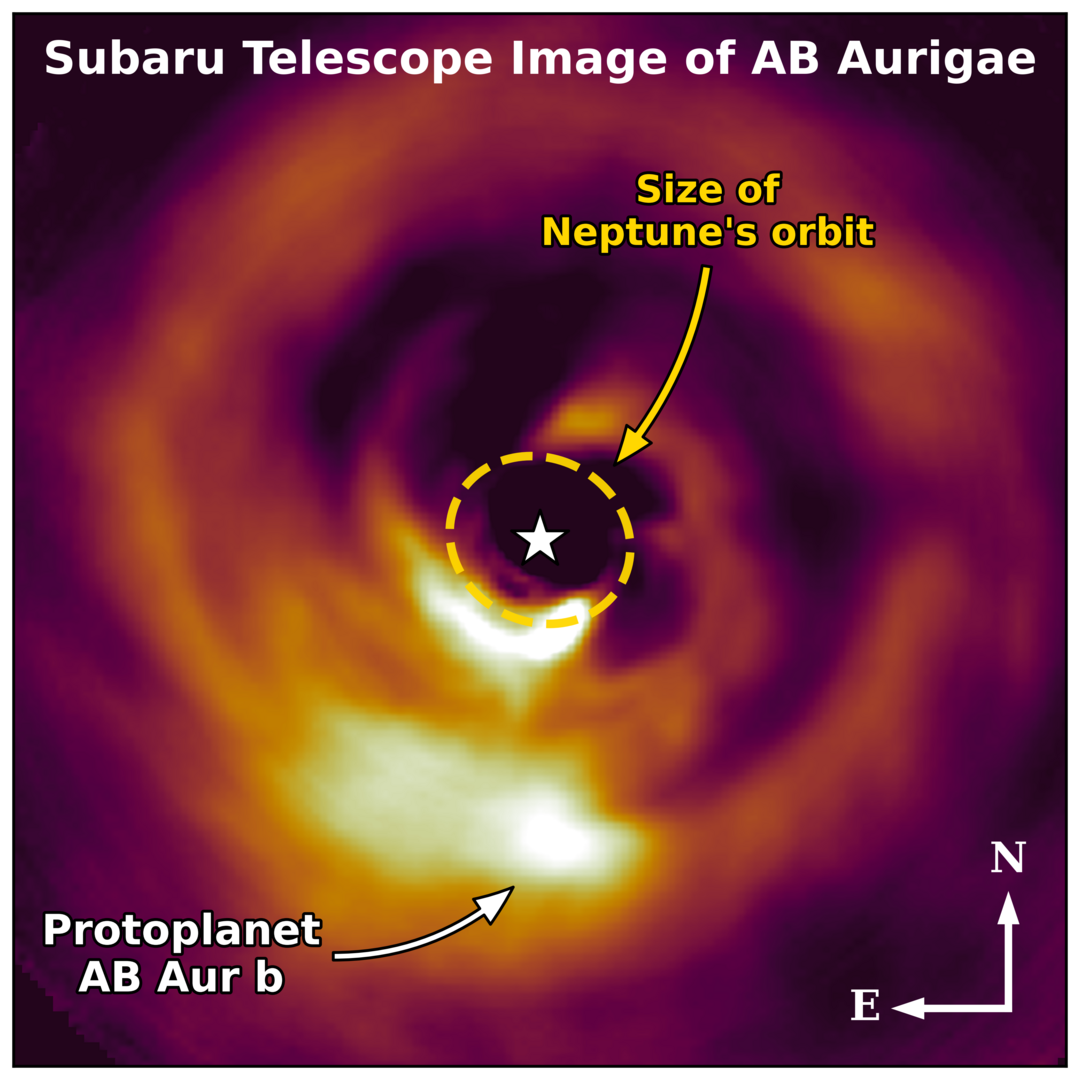
Detection of the protoplanet AB Auriga b from the Subaru Telescope. (Image credit: 2632cgn, CC BY-SA 4.0, via Wikimedia Commons)
The detection of hydrogen emission provides direct evidence of mass accretion onto a protoplanet still within the disk it formed out of, offering crucial insights into how gas giant planets grow during their formation phase. The circumplanetary disk surrounding AB Aurigae b acts as a feeding mechanism, channeling material from the larger protoplanetary disk onto the growing planet.
The detection of AB Aurigae b marks just the beginning of a new era in studying planetary formation. Future observations will help determine exactly how much of the detected emission comes from the planet itself versus reprocessed light from the surrounding disk, and whether similar signatures can be found around other young stars.
The original version of this article was published on Universe Today.